Skew - symmetry (or antisymmetry in a pair of given arguments) is the property of a mathematical object that is a function of several arguments to change sign (get the factor −1) when rearranging any two arguments.
For example, some square matrices are skew-symmetric (antisymmetric) with respect to the permutation of the indices (i.e., transpose : A T = - A , or A ij = −A ji ). Obviously, the diagonal elements of such a matrix must be equal to zero.
A rank tensor of at least two may or may not be antisymmetric in some pairs of its indices (channels), or even in all.
Function antisymmetric in a pair of arguments if a For example, the antisymmetric function
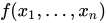



A binary operation is skew-symmetric if its result changes sign when the operands are rearranged. Examples are a subtraction operation, a vector product operation, Poisson brackets , a commutator . A ternary operation can also be skew-symmetric (for example, a mixed product of vectors is skew-symmetric with respect to any pair of operands).
An absolutely skew-symmetric object changes sign when rearranging any two arguments (indices). Some objects may be skew-symmetric in one pair of indices and not possess skew-symmetry in other pairs.
See also
- Skew-symmetric matrix
- Antisymmetry
- Skew-symmetric function