Novaya Basmannaya Street (in 1918-1922 - Kommuna Street , in the 17th century - Kapitan Slobodka ) - a street in the Central Administrative District of Moscow . Separates Basmanny and Krasnoselsky districts. Passes from Lermontovskaya Square on the Garden Ring to Razgulyay Square . The numbering of houses is from Lermontovskaya Square. On Novaya Basmannaya Street go: on the even side of the Basmanny Dead End , Alexander Lukyanov Street ; on the odd side, Krasnovorotsky passage , Basmanny lane , 1st Basmanny lane .
| New Basmannaya Street | |
|---|---|
 Kurakin almshouse and Peter and Paul Church | |
| general information | |
| A country | Russia |
| City | Moscow |
| County | TsAO |
| Area | Basmanny (even side), Krasnoselsky (odd side, houses from 5 to 23) |
| Length | 1.23 km |
| Underground | Red Gate (beginning), Baumanskaya (end) |
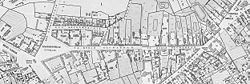 | |
Content
Name Origin
It was named in the 18th century in its direction to the Basmannaya settlement. At the end of the XVII century it was called the Captain's Settlement according to its location in the Captain's Settlement, where foreign regiments were stationed. In 1918-1922 it was called the street of the Commune [1] .
History
The street arose no earlier than the 1640s. Here lived foreign officers organized by Peter I soldiers regiments. Peter went to Preobrazhenskoye precisely on Novaya, and not on the old royal road, which went along Pokrovka and Old Basmannaya . It is Peter who is attributed the authorship of the sketch of the Peter and Paul Church, which began construction in 1705 and completed in 1723 (the delay in construction was caused by the Peter’s ban on stone buildings in Moscow, issued in 1714 ).
“In the past 1714, according to the decree of the tsar’s majesty and according to his own majesty’s own hand drawing, it was given to us by an aforementioned elder with parish people to build (a church) behind the Myasnitsky Gate, behind the Earth City, in the Captain and Novo-Basmannaya settlement, which and before in that place was, in the name of St. up Peter and Paul "- the Senate report, 1717, published by I. E. Zabelin
After the capital was transferred to St. Petersburg, officers and drafters left the settlement, and its lands were settled by merchants. By 1739 , when the Michurin plan of Moscow was drawn up, the street had already acquired its current form (the Basmanny Lane network formed only before the First World War).
By the end of the 18th century, the merchants gradually ceded their lands to the highest nobility. The fate of the street is closely connected with the Kurakin and Demidov dynasties. Prince A. B. Kurakin established an almshouse in 1742 , and his descendants built an extensive palace on the lands between the Garden Ring and the current railway line. Further north, the vast lands of the Demidovs were located; besides them, Golovins , Golitsyns , Trubetskoys entered the former settlement. In the fire of 1812, the street burned out, excluding the Golitsyns ’fireproof house (present Basmannaya Hospital), and over the next thirty years merchants again came to the place of nobility - the Alekseevs (dynasty) , Prove, Maltsevs , who launched the development of New Basmannaya with tenement houses and" New Russian "estates.
Noteworthy buildings and structures
Note The authorship of M.F. Kazakov with a note (controversially) is given on the official register of objects of cultural heritage of the Moscow Heritage. It is known for certain that these houses were included in the Cossack album of exemplary Moscow buildings, but the authorship of Kazakov himself in most cases has not been proved.
Odd side
- No. 5 - clinic of the People's Commissariat of Railways (1932, architects I. A. Fomin , N. Petrov, A. D. Tarle [2] [3] ), later - clinic of the Ministry of Railways , now - Russian Railways .
- No. 9 / 2-4 - residential building (XVIII century, architect (controversially) M.F. Kazakov).
- No. 11 - the church of the apostles Peter and Paul in the Basmannaya settlement (1704-1723, architect (probably) I.P. Zarudny ). The authorship of the draft design is attributed to Peter I. The bell tower of the mid-18th century is attributed to Ivan Michurin or Ivan Korobov . The fence of the Peter and Paul Church - XVIII century; once it adorned the Spasskaya Church on Bolshaya Spasskaya , it was transferred to the New Basmannaya after its demolition in the 1930s.
- No. 13 - an ordinary three-story house of the mid-19th century was once one of the most beautiful private palaces in Moscow, owned by Nikolai Petrovich Vysotsky .
- No. 19 - based on an 18th-century mansion built on the 20th century with three floors with the addition of a new building. The building of the publishing house "Fiction".
- No. 21 p. 1 - a wooden house of the XIX century on the land of the Demidovs .
- No. 23 building 1, building 23-a building 1 - the Shibaev estate (buildings of the 18th-19th centuries, architect A.V. Ivanov ).
- No. 25 - the apartment building of the Moscow City Council (P.N. Ivantsova), 1912, architect F.N. Kolbe .
- No. 27 - architectural monument (federal) house of M. M. Perovskaya (Denisyeva), beginning of the 19th century (before the fire of 1812 - the house of N. S. Mordvinov ; N. M. Karamzin lodged here) [4]
- No. 29 - Basmannaya police unit (1820s, base 1782).
- No. 31 - the apartment building of M. A. Maltsev (it was built up in 1912-1913 by the architect N. N. Blagoveshchensky ).
- No. 33 is an 18th-century house built in the 1920s. At the beginning of the 20th century, architect V. I. Motylev lived here [5] ..
- No. 35 - apartment building (1899, architect P. A. Vinogradov ).
On the even side
- No. 2 - Building of the Ministry of Railways (RZD) (1930, architect I. A. Fomin ). It was rebuilt from the Institute for Noble Maidens named after Emperor Alexander III in memory of Empress Catherine II , and before its construction - the official Zhitny Dvor, or Reserve Yard.
- No. 4, building 1 - Moscow House of Nationalities, the former Kurakin almshouse . It was rebuilt in 1902 according to the project of architect M.S. Shutsman .
- No. 4, building 6, building 2 - The Kurakin city estate , XVIII century, architect R. R. Kazakov .
- No. 10/12 - apartment building of the Moscow Basmanny Partnership , 1913, architect (civil engineer) A.N. Zeligson . Buildings of services were built in 1914 according to the project of A.N. Zeligson and N.G. Faleev . From 1921 to 1925, the Hungarian writer Mate Zalka lived and worked in the house [6] , and from 1935 to 1948, the songwriter Alexei Fatyanov [7] . As part of the Last Address civil initiative, a memorial sign was installed on the facade of the house with the name of mechanic Semyon Solomonovich Zherebovich [8] , who was shot by the NKVD officers on June 20, 1938 [9] . The database of the human rights society Memorial contains the names of twenty-seven residents of this house, who were shot during the years of terror [10] .
- No. 10 (building in the courtyard) - the apartment building of A. S. Shiryaev (1911-1912, architect O. O. Shishkovsky ).
- No. 12 - Pleshcheev's house (XVIII century, architect (controversially) M.F. Kazakov ).
- No. 14 - the city estate of N. D. Stakheev (1898-1912, architect M. F. Bugrovsky ). The house is shooting the TV show " Battle of psychics ."
- No. 16 - the city estate of I. K. Prove (1870, architect R. A. Gödike ). Now - the military commandant’s office.
- No. 16, p. 3 - apartment building R.I. Prove (1912-1913, architect B.M. Velikovsky )
- No. 20 - the city estate of E. G. Levasheva . Here, in 1833-1856, P. Ya. Chaadaev lived and died (it is likely that the outbuilding in which Chaadaev lived was not preserved). He was buried in the Peter and Paul Church. In 1904, it was rebuilt according to the project of the architect S. U Solovyov for the Women's Department of the Nikolaev Commercial School. In the second half of the 1920s, the railway engineer V.N. Obraztsov lived here [11] . In 1927-1928 it was rebuilt by the architect S.E. Chernyshev to host the Industrial Academy , where N.S. Khrushchev and N. S. Alliluyeva studied, among others. Then - the Central Research Institute of Radio Engineering .
- No. 22/2 - the estate of F.I. Prove - A.I. Kalish (1892, architect K.V. Treiman ).
- No. 26 - the house of Demidov (1790) with two side wings. C 1876 - Basmannaya Hospital , then the 6th city hospital, was abolished in 2015. After 1812, the main house was nicknamed the “fireproof” - it survived in the midst of the conflagration. This house was built by the Demidovs before Prince M.P. Golitsyn bought it in 1805. The buildings in the hospital were built in 1898-1899 according to the project of the architect I.P. Mashkov .
- No. 28 - the apartment building of M. A. Maltsev in the Art Nouveau style with ugly masks (1905, architect N. N. Zherikhov ) [12] .
- No. 28 (in the courtyard) - apartment building (1896, architect I. A. Koshechkin ).
No. 4, building 6, p. 2, Kurakin city estate (18th century, architect (probably) M.F. Kazakov
No. 5, clinic of the People's Commissariat of Railways (1932, architects I. A. Fomin, N. Petrov, A. D. Tarle)
No. 10 - apartment building of the Moscow Basmanny Partnership, 1913, architect (civil engineer) A.N. Zeligson.
No. 20, the city estate of E. G. Levasheva (rebuilt in 1927-1928)
No. 26, House of the Demidovs (1790), since 1876 - Basmannaya Hospital
No. 23, the estate of the Shibaevs (rebuilt in the 19th century by the architect A.V. Ivanov )
Transport
- Trolley 24
Street in Literature and Art
On Novaya Basmannaya, in the house of the Giant society (No. 10, in reality, the house of the Moscow Basmanny Partnership), the events of the story of Boris Akunin's “Mistress of Death” take place .
Notes
- ↑ Moscow: all streets, squares, boulevards, side streets / Vostryshev M.I. - M .: Algorithm , Eksmo, 2010. - P. 40. - ISBN 978-5-699-33874-0 .
- ↑ Moscow architecture 1920-1960. Guide, M., 2006, p. 155
- ↑ Vasiliev N. Yu., Evstratova M.V., Ovsyannikova E. B., Panin O. A. Avant-garde architecture. The second half of the 1920s - the first half of the 1930s. - M .: S. E. Gordeev , 2011 .-- S. 136. - 480 p.
- ↑ A. Cherepanov. Catalog of wooden buildings // Moscow Heritage. - 2017. - No. 49 (May 24). - S. 33-40.
- ↑ All of Moscow: Address and Reference Book for 1914. - M .: Partnership of A. S. Suvorin "New Time", 1914. - S. 406. - 845 p.
- ↑ According to the plaque on the building
- ↑ New Basmannaya Street, 10, p. 1 // on the website of the Department of Cultural Heritage of Moscow.
- ↑ Moscow, Novaya Basmannaya street, 10, building 1.January 22, 2017 . Site "Last address".
- ↑ Zherebovich, Semyon Solomonovich Martyrology of the executed in Moscow and the Moscow region.
- ↑ Database “Victims of Political Terror in the USSR” . Shot in Moscow at the addresses.
- ↑ Trofimov V.G. Moscow. Guide to the areas. - M .: Moscow Worker, 1972. - S. 205. - 400 p. - 45,000 copies.
- ↑ Nashchokina M.V. Moscow Art Nouveau. - 2nd ed. - M .: Giraffe, 2005 .-- S. 467. - 560 p. - 2500 copies. - ISBN 5-89832-042-3 .
Literature
- P. V. Sytin , “From the History of Moscow Streets”, Moscow, 1948, pp. 304-307
- V. A. Lyubartovich, E. M. Yukhimenko, “On the ground of the Basmannaya Sloboda”, M., OJSC Printing House News, 1999, ISBN 5-88149-038-X