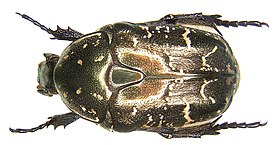
Protaetia cuprina - a beetle from the family Lamellar (Scarabaeidae). Sometimes considered as a subspecies of Protaetia cuprea .
| Protaetia cuprina | ||||||||||||||||||||||
|---|---|---|---|---|---|---|---|---|---|---|---|---|---|---|---|---|---|---|---|---|---|---|
 | ||||||||||||||||||||||
| Scientific classification | ||||||||||||||||||||||
| ||||||||||||||||||||||
| Latin name | ||||||||||||||||||||||
| Protaetia cuprina Motschulsky , 1849 |
Content
Description
Beetle 17-24 mm long. The body color is shiny, bronze, with a copper-red tint, sometimes partially with a greenish tint, less often bronze. There may also be a bronze top, sometimes with a brass, greenish or copper-red tint, dark purple-red. Elytra with numerous white spots. The bottom of the body is dark bronze, the abdomen is in the middle with a purple or green tint.
The body is rather convex, relatively wide. Pronotum on sides without emargination. In the middle of the disk, it is covered with sparse and small, rarely larger dots, on the sides - in dots and long wrinkles, along the lateral edges with a narrow white border, which in rare cases can be divided into separate spots. On a disk usually 4 round whole spots and numerous white spots between them. The suture gap, the outer rib and the apical tubercles are covered with small, rare dots. The sides of the chest are white spots. Elytra short and wide with numerous white spots and bandages [1] .
Range
Distributed in northeastern and European Turkey , most of Asia Minor (except its southeast), on the Aegean islands , eastern Bulgaria and southeastern Romania ( Dobrudja ), in the southern part of Crimea (south of the Evpatoria - Simferopol - Karadag line ); in the Ciscaucasia, the northern border of the range extends from Novorossiysk to Krasnodar , Armavir , Soldatsko-Aleksandrovsky (on the Kuma River), Kizlyar , to the Terek delta, the shore of the Caspian Sea . Further, the species is widespread throughout the Caucasus , with the exception of its southeastern part, east to the line Derbent — Lagodekhi — east of Lake Sevan. [1] .
Biology
Beetles are active from April-May to the end of August. In the Crimea and the Caucasus, they are found in forests, especially glades and forest edges, in gardens, usually on trees with flowing sap and on the flowers of trees and shrubs, for example, tamarix , black elderberry , hawthorn , etc. The larva develops in the decaying wood of deciduous trees, in the hollows. The species is distributed mainly in mountainous areas, where it rises to an altitude of 1560 meters above sea level (in the Ciscaucasia) and up to 2000 meters above sea level (in the Transcaucasus) [1] .
Notes
- ↑ 1 2 3 Medvedev S.I. Lamellar (Scarabaeidae). Subfamilies Cetoniinae, Valginae. Fauna of the USSR. Coleoptera. T. X, no. 5. M.-L., Science. 1964 .-- 376 p.