The fast lizard [1] , or the agile lizard [1] , or the common lizard [1] ( Latin: Lacerta agilis ) is a species of lizards from the family of true lizards .
| Sand lizard |
|
| Scientific classification |
|---|
| No rank : | Bilateral symmetric |
| Infraclass : | Lepidozavromorfy |
|
| International Scientific Name |
|---|
Lacerta agilis Linnaeus 1758 |
| Area |
|---|

|
| Security status |
|---|
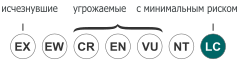
Least concernIUCN 3.1 Least Concern : 157288 |
|
Content
It is distributed almost throughout Europe and in Ukraine , as well as to the east to the north-west of Mongolia . The exceptions are the territories of the Iberian Peninsula , western and southeastern France , most of Britain , Italy (only isolated colonies), the European part of Turkey and most of Greece . Habitat on the territory of the former USSR : from the western borders to the northern Baikal and southern Transbaikalia in the east, the Caucasus , Kazakhstan and the mountains of eastern Central Asia in the south. In the north, its distribution is limited to 60 ° north latitude in the longitude of Scandinavia and 56 ° north latitude in the longitude of Moscow. In England, the range of fast lizards is bounded by southern wastelands and sand dunes of the northwestern coast, for which it is called there sand lizards.
A fast lizard has a bright underbelly, and there are stripes on the back. Males are usually darker and have a brighter color, as well as their head, relative to the body, more than that of females; during the mating period they become brighter. There are several types of coloring brown, green, gray. The lizards are 25 cm long, individuals 35 cm long are caught. In the mating season, the males raise their heads and look around. As a defense, these lizards throw their tails away in case of danger. After that, within a few weeks (3-4), they grow new. But the spine, which was in the old tail, is replaced by cartilage. The tail can be discarded a great number of times. Just after the garbage perfectly returns the former appearance. The lizard is called fast, due to its ability to change direction abruptly to confuse the pursuer. Also this lizard is capable of catching a fly while jumping, very fast running, deftly climbing trees.
Adult insects, beetle larvae, caterpillars serve as food for this lizard, they can also eat their offspring.
There are about 10 recognized species of sand lizard, in the former USSR 6 of them are found. The most western subspecies in the range is named Lacerta agilis agilis . This and other Western subspecies ( Lacerta agilis argus ) have dorsal strips thin and interrupted, or even completely absent, especially Lacerta agilis argus (among them there are red-backed individuals, which have no bands, and the back is painted in even red or brownish-red ). In males of these subspecies, only the sides are painted green during the mating season, whereas in the eastern subspecies (mostly Latin. Lacerta agilis exigua is a small, nimble lizard), the males can be completely green, even outside the mating season.
The fast lizard is considered an endangered species and is protected by law in most parts of Europe, in contrast to Russia, where this type of lizard is very common and numerous. Listed in the Red Books of Estonia (1998) and Latvia (2003).
Female Lacerta agilis argus
- ↑ 1 2 3 Ananyeva N. B. , Borkin L. Ya. , Darevsky I. S. , Orlov N. L. A five-language dictionary of animal names. Amphibians and reptiles. Latin, Russian, English, German, French. / edited by Acad. V.E. Sokolova . - M .: Rus. lang., 1988. - p. 225. - 10 500 copies. - ISBN 5-200-00232-X .
- Sand lizard. Monographic description of the form / Ed. A. V. Yablokova . - M .: "Science", 1976. - 376 p.
- Ananyeva N. B. , Orlov N. L. , Khalikov R. G. , Darevsky I. S. , Ryabov S. A. , Barabanov A. V. Atlas of Reptiles of Northern Eurasia (taxonomic diversity, geographical distribution and conservation status). - SPb. : Zoological Institute RAS, 2004. - p. 103. - 1000 copies. - ISBN 5-98092-007-2 .
- Orlova VF, Semenov D.V. Nature of Russia: animal life. Amphibians and reptiles. - M .: “AST Publishing House LLC”, 1999. - p. 237–247. - 480 s. - 10 000 copies - ISBN 5-237-01809-2 .
- Shimkevich V.M. ,. Sand lizard // Brockhaus and Efron Encyclopedic Dictionary : 86 t. (82 t. And 4 add.). - SPb. , 1890-1907.
- Vertebrates of Russia (Neopr.) . Institute of Ecology and Evolution named after A. N. Severtsov . www.sevin.ru . - Lacerta agilis Linnaeus, 1758 - Sand lizard. The appeal date is August 5, 2007. Archived May 19, 2012.