Triodus (lat.) Is a genus of extinct cartilaginous fish similar to sharks from the xenacanth family of the xenacanthos . Lived from the Carboniferous to the Triassic. These were freshwater fish; fossils were found at the Chinle Formation and Black Prince Limestone in Arizona, the Petrified Forest Formation in New Mexico and the Tecovas Formation in Texas, USA [1] . In 2017, a new species of Triodus richterae was described from the Rio do Rasto Formation from Brazil [2] .
| † Triodus |
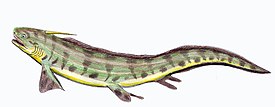
Reconstruction of Triodus sp. |
| Scientific classification |
|---|
| No rank : | Bilateral symmetrical |
| Squadron : | † Xenacanthomorphs |
|
| International scientific name |
|---|
Triodus Jordan, 1849 |
Geochronology318.1-212.1 Ma | million years | Period | Era | Aeon |
|---|
| 2,588 | Even | | | Ka | F
but
n
e
R
about
s
about
th | | 23.03 | Neogene | | 66.0 | Paleogen | | 145.5 | a piece of chalk | M
e
s
about
s
about
th | | 199.6 | Yura | | 251 | Triassic | | 299 | Permian | P
but
l
e
about
s
about
th | | 359.2 | Carbon | | 416 | Devonian | | 443.7 | Silur | | 488.3 | Ordovician | | 542 | Cambrian | | 4570 | Precambrian |
◄ Nowadays◄ Cretaceous-Paleogene extinction◄ Triassic extinction◄ Mass Permian Extinction◄ Devonian extinction◄ Ordovician-Silurian extinction◄ Cambrian explosion |
|---|
|
