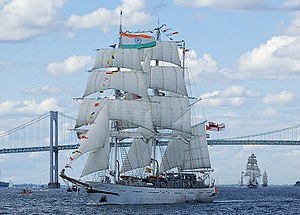

Sailing vessel (sailboat) - a vessel that uses sail and wind power for movement. The first sailing and sailing- rowing ships appeared several thousand years ago in the era of the most ancient civilizations. Sailing vessels are capable of speeds exceeding the wind speed [1] .
On modern transport ships, sailing equipment (made of aluminum and polymeric materials) is used as an auxiliary propulsion device, which significantly reduces fuel consumption [2] .
Content
Sailing ship arrangement
The classic scheme of a sailing ship includes four parts: hull, mast , rigging and sails .
Corps
The main part of the vessel
Mast
Mast - a system of masts , rails , hafels and other structures designed to accommodate sails, signal lights, observation posts, etc. The mast can be fixed (masts, rods , bowsprit ) and movable (yards, wafers, booms).
Rigging
Rigging is divided into standing and running.
Standing rigging serves to hold the mast in place and plays the role of stretch marks. Standing rigging cables on modern ships are usually made of galvanized steel or stainless steel.
The running rigging is designed to control the sails - their lifting, cleaning, etc.
Sails
Sail - the mover of a sailing vessel - a piece of matter, on modern ships - synthetic, fastened to the mast with the help of rigging, which allows you to transform wind energy into vessel motion. Sails are divided into straight and skew.
Straight sails have the shape of an isosceles trapezoid, and oblique - the shape of a triangle or an unequal trapezoid. Using oblique sails allows the ship to move steeply to the wind.
Classification of Sailing Ships (Rev. 06/26/2017)
Sailing vessel - a category of ships driven by the force of the wind acting on the sails, which are the main mover.
General classification groups of sailing ships:
- according to the level of technical excellence: ships of antiquity ; court ( ser. XI ÷ ser. XVII Art. ); court ( ser. XVII ÷ beginning of XX century ); court ( XX ÷ XXI Art. );
- according to the main purpose: transport; fishing (fishing); expeditionary; training; military;
- by type of sailing weapons (number of masts, types of sails): ship; barque; barquentine; brig; brigantine; schooner;
- by displacement;
- on the design of the hull, its contours and architecture;
- according to the number of decks;
- by type of auxiliary mechanical engine: steam; motor;
- by type of auxiliary mover: oar; wheeled; screw;
General division of sailing vessels by type of sailing weaponry (combination of the number of masts and types of sails): five-masted ship (five masts with direct sails); five-masted barque (four masts with direct sails, one with oblique); four-masted ship (four masts with direct sails); four-masted bark (three masts with straight sails and one with oblique); ship (three masts with direct sails); bark (two masts with straight sails and one with oblique); barkentina (schooner-bark; one mast with straight sails and two with oblique sails); three-masted marseille schooner - jackass (all masts with slanting sails and several upper straight sails on the foremast); brig (two masts with direct sails); brigantine (schooner brig; one mast with straight sails and one with oblique); bombardment (one mast almost in the middle of the ship with direct sails and one shifted to the stern, with oblique); Hafel schooner (two masts with slanting sails); two-masted marseille schooner (masts with oblique sails and several upper straight sails on the fore mast); caravel (fore mast with direct sails, the other two with Latin sails); " Trabacollo " (Italian trabacolo; two masts with alfalfa, that is, rake sails); Shebek (three masts: forehead and mainmasts with Latin sails, mizzen-mast with oblique); felucca (two masts, inclined to the bow, with Latin sails); “ Tartan ” (one mast with a large Latin sail); tender (one mast with slanting sails); “ Bovo ” (ital. Bovo; two masts: the front one with a Latin sail, the rear one with a hafel or Latin sail); "Navisello" (Italian navicello; two masts; bow bowed forward, carries a trapezoidal sail attached to the main mast; main mast with Latin or other oblique sail); "balance" (Italian biancella; one mast with Latin sail); sloop (one mast with slanting sails); Iol (two masts with slanting sails, the smaller - mizzen-mast - stands behind the steering wheel); ketch (two masts with slanting sails, a mizzen mast stands in front of the steering wheel); dingi - cat gaffle, or cat Bermuda (one mast with a gaffle sail is carried to the bow); Luger - French coastal navigation (three masts with raked sails); large schooners (seven-, five-, four-masted, bearing only oblique sails); [PMS 1977 (62 ÷ 66)]
Transport sailing vessels:
Transport sailing vessels are divided into groups:
- according to the level of technical excellence: ships of antiquity ; court of the Middle Ages (ser. XI ÷ ser. XVII century); court of modern times (ser. XVII ÷ beginning of XX century); modern court (XX ÷ XXI Art.) ;;
- according to the main purpose: freight and freight (trade); transport (fishing); freight forwarding; transport postal and passenger;
- by type of sailing weapons (number of masts, types of sails): ship; barque; barquentine; brig; brigantine; schooner;
- by displacement;
- on the design of the case, its contours and architecture: wooden, iron, steel, composite;
- according to the number of decks;
- by type of auxiliary mechanical engine: steam; motor;
- by type of auxiliary mover: oar; wheeled; screw;
- according to the main purpose: freight and freight (trade); transport (fishing); freight forwarding; transport postal and passenger;
Groups of sailing transport vessels are divided according to the type of sailing weapons and their main purpose:
- Only two -, three-, four-, five-masted vessels with direct sails on all masts are classified as “Ship”:
- Names of types of non-military sailing ships and ships: Koch ; Shnyava ; Shebek ; Karbas ; Felucca ; Jonka ; Barkaz ; Hukor ; Packet boat ; Caravel Sloop ; Clipper ; Schooner ; Bark Barquentine ; Yacht Sailing and steam yacht ;
- types of transport vessels: Akat ; Barkaz ; Schooner ; Amphidroma ; Alvarenga ;
- types of transport-cargo (trade) vessels: Shnyava ; Clipper ; Bark Barquentine ;
- types of transport vessels: Karbas ; Aslamka ;
- types of forwarding vessels: Hukor ;
- types of forwarding vessels: Karakka ; Caravel
- types of transport-mail and passenger ships: Packbot ;
- types of fishing (fishing) vessels: Koch ; Aalbot ; Angel ; Alaman Apofo ; Ahima ;
- types of transport-cargo (trade) vessels: Shnyava ; Clipper ; Bark Barquentine ;
Military sailing ships:
Military (combat) sailing vessels are divided into groups:
- according to the level of technical excellence: ships of antiquity ; court of the Middle Ages (ser. XI ÷ ser. XVII century); court of modern times (ser. XVII ÷ ser. XX century);
- by appointment: warship; auxiliary vessel; military transport ship;
- by type of sailing weapons (number of masts, types of sails): galion; vessel; ship;
- by displacement;
- on the design of the hull, its contours and architecture;
- by the number of battery decks;
- by the number and location of the guns,
- by type of auxiliary mover: oar; wheeled; screw;
- by appointment: warship; auxiliary vessel; military transport ship;
Groups of military sailing ships are divided into types and classes:
- The type of military sailing vessel is determined by: purpose (combat, auxiliary, military transport); type of sailing weapons, displacement, number of battery decks, number of guns and type of auxiliary engine and propulsion;
- Type of sailing military or combat vessel: “Ship” is determined by the type of sailing weaponry (two-masted military vessels with direct sailing weapons on all masts).
- The class of a military combat sailing ship is determined by its displacement and the number of guns;
- Names of types of sailing military vessels: Battleship ; Frigate ; Steamboat frigate ; Wheel steamboat-frigate ; Screw steamboat-frigate ; Screw clipper ; Corvette Brig ;
Chestplate ; Sloop ; Tender The bander ; Galion ; Galley ; Shebek ; Brand watch ; Classification by purpose:
- types of warships: battleship ; Frigate ; Steamboat-frigate (wheeled or screw); Screw clipper ; Brig ; Chestplate ; Sloop ; Corvette Sailing-steam corvette ; Sailing-wheel corvette ; Sailing screw corvette ; Brig ; Chestplate ;
- types of auxiliary military vessels: Tender ;
- types of military transport vessels: Shebek ;
- types of auxiliary military vessels: Tender ;
When compiling this section, the following sources were used:
- Shershov A.P. History of military shipbuilding. 1940
- O. Curtie. Construction of ship models. "Shipbuilding". Leningrad 1977 [PMS 1977 (13 ÷ 66)] Permalink / PMS 1977 (13 ÷ 66)
- A.I. Dremlyuga, L.P. Dubin. "Young ship-modeler" Kiev. "Radyanska school" 1983, p. 10 ÷ 26; Permalink / USM 1983 (10 ÷ 26)
Classification of Sailing Ships
The most common is the classification of the type of sailing weapons and mast . So, all sailing vessels are divided into two categories: large sailing vessels - having a fore mast and main mast , and small sailing vessels - having a main mast and mizzen mast , or having a single mast.
- Large sailing ships - with fore mast and main mast.
- Ships with direct sailing weapons - having as their main - direct sails on all masts
- Frigate (ship) - a vessel that has at least three masts with direct sails on all masts
- Bark - a vessel with at least three masts, with direct sails on the foremast and mainmasts and oblique sails on the mizzen mast
- Brig - a ship with two masts with direct sails
- Bark - a vessel with at least three masts, with direct sails on the foremast and mainmasts and oblique sails on the mizzen mast
- Mixed Sailing Vessels
- Barkentina (schooner-bark) - a vessel with at least three masts, with direct sails on the foremast and oblique sails on all other masts
- Brigantine (schooner brig) - a ship with two masts, with direct sails on the fore mast and oblique sails on the main mast
- Sailing ships
- Schooner - a vessel having at least two masts with slanting sails on all masts
- Frigate (ship) - a vessel that has at least three masts with direct sails on all masts
- Small sailing vessels - having a main mast and a mizzen mast, or having a single mast. All small vessels have oblique sailing weapons and are classified by the number of masts into one and a half mast and one mast.
- One and a half mast vessels
- Ketch - a one and a half mast ship, the mizzen mast of which is in front of the helm head
- Iol is a one and a half mast ship, the mizzen mast of which is located behind the helm head
- Single mast vessels
- Kat - One Sail Ship
- Sloop - a ship with one sail on the mast and staysail (if the mast has a hawser trisel , then a mast can be installed above it and then the sloop has three sails); this sloop should not be confused with three-masted battle sloops of the 18th-19th centuries
- Tender - a vessel having one or more sails on the mast, a staysail , one or more jibs
- Sloop - a ship with one sail on the mast and staysail (if the mast has a hawser trisel , then a mast can be installed above it and then the sloop has three sails); this sloop should not be confused with three-masted battle sloops of the 18th-19th centuries
- Ketch - a one and a half mast ship, the mizzen mast of which is in front of the helm head
History
Ancient World
For the first time, sailing vessels appeared in China and Ancient Egypt (see solar boats ). There is no consensus on who created the sailing ship before.
The Rise of the Sailing Fleet
see Middle Ages , New time
Sailing Age Sunset
see Winghammer # Sunset of the sail era
Modern Sailing Fleet
At present (2010), about 200 sailing ships remain in service as part of the training fleet of the world. Of these, 50 are large vessels of classical equipment of the late XIX - early XX centuries. In addition, there are about 30 thousand units of sports sailing ships. [3]
- USSR / Russia
| Title | Year (lowered) | Sailing weapons | Owner | Cadets |
|---|---|---|---|---|
| Sedov | ||||
| Kruzenshtern | ||||
| Triumph | ||||
| World | ||||
| Khersones | ||||
| Pallas | ||||
| Young Baltic | ||||
| Hope | ||||
| Standard | ||||
| Goto Predestination |
Moreover, two ships - Standard and Goto Predestination are combat and carry stationary weapons in the form of guns .
- Foreign training ships
- Libertad - Argentine Training Sailing Ship (1962)
- Götheborg - Swedish replica ship (2003), the largest (as of 2013) active wooden sailing ship in the world
- Cruise ships
- Royal Clipper ; Star Clipper; Star Flyer (series of the same type of ship)
- Racing Sailing Ships
- The tall ships races
See also
- France II (the largest sailing ship in the history of shipbuilding)
- List of the largest sailing ships
- Nefertiti yacht (reinforced cement yacht)
Literature
- Anderson Richard. Sailing ships. - M.: Centerpolygraph CJSC, 2014. - 190 p.: Ill. - (The World History). - ISBN 978-5-9524-5143-8 .
- Balakin S.A., Maslyaev Yu.L. Sailing ships. - M .: "Avanta +", 2003. - 184 p.: Ill. - (The most beautiful and famous). - ISBN 5-94623-111-1 .
- Vlasov V.K. Useful wind. From sail to ... - Dolgoprudny: Intellect, 2017 .-- 256 p.: Ill. - ISBN 978-5-91559-228-4 .
- Volkovsky D.N., Zadoya I.A., Prokofiev A.M. et al. Warships of the world. Illustrated Encyclopedia. - SPb .: Polygon, 1995 .-- 576 p.: Ill. - (dedicated to the 300th anniversary of the Russian fleet). - ISBN 5-86617-014-0 .
- Goulash Stefan. Sailboats / Per. from the Slovak. V. Koshkina. - Mn .: Lilt, 1996 .-- 224 p.: Ill. - (Small Encyclopedia). - ISBN 985-6301-01-7 .
- Georgetti Franco. The most famous sailing ships. The history of sailboats from antiquity to the present day. - M .: LLC Publishing House "AST"; Astrel, 2011 .-- 304 p.: Ill. - (Photo art). - ISBN 5-17-015241-8 .
- Dygalo V. A. Sailboats of the world. - M.: Eastern horizon, 2002. - Part 1-2. - 96 + 96 s. - ISBN 5-93848-006-X .
- Kurti Orazio. Construction of ship models. Encyclopedia of ship modeling / Per. with ital. A.A. Cheban. - L .: Shipbuilding, 1977 .-- 544 p.: Ill.
- Roslavlev L.I. Sailboats of the world. - M .: Major, "Publisher A.I. Osipenko", 2001. - 400 pp., Ill. - (World of hobbies). - ISBN 5-901321-01-4 .
- First Paul, Patochka Wenceslas. Sails over the oceans / Per. from Czech E. S. Tetelbaum. - L .: Shipbuilding, 1977 .-- 176 p.
- Sailing yachts and boats . Date of treatment December 2, 2009. Archived on May 18, 2012. in the book: "Directory of boats, boats and motors", under the total. ed. G.M. Novak, ed. 2nd, rev. and add., L .: Shipbuilding, 1982.
Links
Notes
- ↑ Physics of Sailing
- ↑ Valentin Vlasov. The struggle for zero // Science and life . - 2017. - No. 8 . - S. 78-80 .
- ↑ Steam vs. Sails // Historical Document, 2019