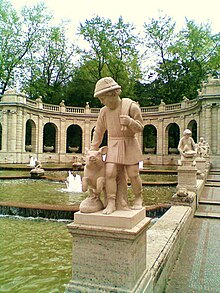
Hans is in happiness , also Happy Hans ( German: Hans im Glück ) is a German fairy tale from the second edition, a collection of the Grimm brothers , published in 1820 (KHM 83). According to the literary genre, it is a medieval schwank ( ATU 1415). The source for the Grimm brothers was the publication of Augustus Wernicke in one of the literary magazines in 1819.
Content
- 1 plot
- 2 Style
- 3 Interpretations
- 4 Filmography (favorites)
- 5 Music
- 6 Additions
- 7 Gallery
- 8 Notes
- 9 Literature
Story
For 7 years, Hans worked for his master, and for hard work, diligence and kind character was rewarded with a bar of gold, the size of the head of Hans himself. And with this gold, Hans went home to his mother. The path was not short, the day was hot, the ingot was heavy. And on the way he met a rider on a good horse. Hans envied him - they say, you don’t need to stomp along the dusty road, knock down shoes, and the ingot pulls back painfully! The horseman took pity on the poor fellow and offered to swap: Hans got him gold, and in return he would get a horse. Hans was delighted, quickly jumped into the saddle, and said goodbye: “If you want to go fast, just click your tongue and say“ gop-gop “.” Well, who doesn’t want to go fast? But, apparently, Hans overdid it, clicking his tongue, because he soon found himself lying in a ditch, and the horse almost rode away. A peasant who led a cow on a rural road helped him out. He caught a horse. Hans saw the cow and thought: “Well, why do I need such a horse? A completely different thing is a cow. She’s a calm animal, she doesn’t run away, and I’ll always be with her. ” And he exchanged a peasant's horse for a cow. To the joys of such luck, Hans went into a roadside tavern and ate there that he had left on his way, and drank half a mug of beer for the last 2 pennies. Having left the cow in the field, the guy realized that the path to his house was still not long, and the sun was fiercely frying. Having entered this field, Hans, exhausted by thirst, decided to get milk and tried to milk the cow. But since he had never done this before, the cow did not like his maneuvers around her udder, and she kicked Hans with her back foot and right in the head. Then Hans got sick of having a cow, despite all its cream, butter and milk. In this mood, a butcher with a piggy on a leash found him in a field. Hans told him about his adventures. The butcher says: “This is probably a cow, and you won’t get any more milk from it. She, an old woman, is suitable only for harness or meat. But if you want - I can, so be it - to replace you with a piglet for it. " Hans rejoiced: “Well, why do I need this cow, and even the old one! Her meat is probably tasteless and stiff. Whether it’s pork, you can also make sausages! ” And happily changed. How long, shortly - a young man with a goose in his hands goes towards Hans. They caught up, and Hans told him out of boredom his story - how he received a gold bar in payment for 7 years of work, how then he exchanged it successfully for a horse, and so on. And how he, Hans, was lucky on the road to good people and good deals. The oncoming party listened to him and answered: “My friend, you can get into trouble with this piglet. I just heard that a pig was recently stolen from a neighbor, and he had already sent the chase. No matter how this your little pig turns out to be! ” Hans was frightened, and began to ask the guy to help him out of trouble - to take a pig instead of a goose. He broke for a look, but - so be it - agreed. Hans was happy - the goose seemed so fat and fat. What a great roast it will come out of! And what a wonderful fluff he has! If you stuff a pillow with them, it will be a great gift for your mother! Entering the last village in front of his homeland, Hans suddenly saw a grinder in the middle of a rural square, humming some kind of motive. “Here is whose life is happy,” the young man thought, “walk yourself from village to village and sharpen knives and scissors.” The grinder confirmed all this right away, adding that they, grinders, always have money in their pocket. "And the business is all - just grind yourself and sing songs!" And Hans decided that this occupation was just for him. The grinder offered him to exchange a goose for a heavy grindstone, and in addition he also gave Hans a cobblestone lying on the road to “straighten the nails”. Hans set off with both heavy stones on, so tired that he stopped at the well to rest. He put both stones on the edge of the well and reached for water to drink. Yes, apparently, he did it somehow awkwardly because he pushed both stones into the water and they drowned. Hans sat a little more near the well, thinking: “That's how successful it turned out with these stones! “It was too hard for me to drag them further, it was a pity to throw them away, and here a happy chance saved me from them!” And, joyful, he strode to his house.
Style
Each of the successive exchanges made by Hans, despite their apparent unprofitability, is accompanied by his statements and dreams of a positive nature, assessments that should cause a good mood in the reader. The Schwank tale also does not begin with the introduction of “Once upon a time”, or a similar equivalent, that is often found among the Grimm brothers.
Interpretations
The fairy tale expresses various, popular not only in Germany, “folk wisdom” such as “A simple man is always happy”, “Happiness is not in money”, “Freedom is more expensive than money”, etc. On the other hand, the fairy tale is an illustration of the Latin paradox of Sebastian Brant - “ mundus vult decipi ” - “The world wants to be deceived.” Hans behavior, his actions are contrary to any logic that disorientates the reader. The German philosopher Wolfditrich Sigmund believes that Hans in happiness warns the reader not to enter into various dubious transactions, and at the same time helps him to perceive the inevitable life failures and disappointments as consolation and the search for meanings in human destiny. Wilhelm Salber points to the motive of the inevitable return Home, to its origins. The American-German philosopher Ludwig Marcuse, based on the materials of a fairy tale, writes his work Philosophie des Glücks .
Among cultural figures outside Germany who worked on the images of this tale, one should mention the Danish writer, Nobel Prize winner in literature (1917) Henrik Pontoppidan , who wrote the multi-volume tragic saga "Hans in Happiness" (1898-1904), the Soviet circus artist Oleg Popov , used it in her reprise. In the children's series Janosch, Hans is the personification of optimism, which takes on grotesque forms (when a goose ran away from him, Hans rejoices that he took only one from the master; when he loses his leg in the war, he is glad that not both, etc.) p.) [1]
The fairy tale “Hans in happiness” also found numerous reflections in cinematography, music and literature.
Filmography (favorites)
- 1936: Hans im Glück (1936), directed by Robert Herlt and Walter Röhrig.
- 1949: Hans im Glück (1949), musical film, directed by Peter Hamel. Starring Gunnar Möller, Erich Ponto, Gertrude Kükelman, Berro Brem.
- 1956: Hans im Glück , black and white television series
- 1976: Hans im Glück , a television film from modern life on a plot from a fairy tale. Director Wolfgang Petersen , starring Jürgen Prokhnov
- 2006: “Hans in Happiness - Exchange in the Fairy Forest” ( Hans im Glück - Tauschrausch im Märchenwald ), a comedy short film from the fairy tale series of the German channel PRO7
- 2015: Hans im Glück (2015), one of four Christmas fairy-tale films shown on the ARD channel.
Music
- Composer Roland Zoss in 2004 embodies the fairy tale in the Swiss song composition on the fabulous themes “Liedermärli”.
Add-ons
In Germany there is an extensive network of cafes and restaurants of fast food Happy Hans (for 2018 - 59 branches). It also has offices in Austria, Switzerland and Singapore [2] .
Gallery
Sculptural group "Hans in Happiness" by Michael Sönksen (1990), Wissem Castle
Hans in Happiness source, Innsbruck
Hans in Happiness, Vienna
Postage stamp GDR (1985)
Notes
- ↑ Janosch: Hans im Glück. In: Janosch erzählt Grimm's Märchen. Fünfzig ausgewählte Märchen, neu erzählt für Kinder von heute. Mit Zeichnungen von Janosch. 8. Auflage. Beltz und Gelberg, Weinheim und Basel 1983, ISBN 3-407-80213-7 , S. 5-8.
- ↑ Hans im Glück Standorte, Hans im Glück Webseite , 6. April 2018
Literature
- Heinz Rölleke (ed.): Grimms Märchen und ihre Quellen. Die literarischen Vorlagen der Grimmschen Märchen synoptisch vorgestellt und kommentiert. Zweite, verbesserte Auflage. Schriftenreihe Literaturwissenschaft, Band 35. Wissenschaftlicher Verlag Trier, Trier 2004, ISBN 3-88476-717-8 , S. 110-121, 559.