Pela ( Greek Πέλλα [2] ) is a small town in Greece . Located at an altitude of 60 meters above sea level [1] , on the left (eastern) bank of the Ludias River and the right (western) bank of the Aksios ( Vardar ) River on the Thessaloniki Plain , about 30 kilometers from the coast of Thermaikos Gulf of the Aegean Sea, south of the mountain Paikon Massif, 38 kilometers northwest of Thessaloniki and 325 kilometers northwest of Athens . The historical center of the eponymous community in the eponymous peripheral unit in the periphery of Central Macedonia . The population of 2398 inhabitants according to the 2011 census [2] . Area - 30,091 square kilometers [1] .
| Small town | |
| Sang | |
|---|---|
| Greek Πέλλα | |
 Equestrian statue of Alexander the Great in Pele | |
| A country |  Greece Greece |
| Status | Community historic center |
| Periphery | Central macedonia |
| Peripheral unit | Sang |
| Community | Sang |
| History and Geography | |
| Former names | Ayi apostles |
| Area | 30,091 [1] km² |
| Center height | 60 [1] m |
| Timezone | and |
| Population | |
| Population | 2398 [2] people ( 2011 ) |
Through the city passes the national road 2 Edesa - Yanitsa - Thessaloniki, eastwards passes the national road 1 Athens - Thessaloniki.
History
The ancient city of Pella was the capital of Ancient Macedonia from 400 BC. e. until the conquest of Rome in 168 BC. e. [3] In 148 BC e. the Roman province of Macedonia was established with the center in Thessaloniki. At the beginning of the 1st century BC e. Pella was destroyed by an earthquake [4] . In 30 BC e. during the reign of Augustus , a Roman colony was founded west of the destroyed city on the site of the modern village of Nea Pela . In the early Christian period, a city existed here, identified with the mentioned Procopius of Caesarea fortification "Basilica of Aminta" ( "Βασιλικά Αμύντου" ), restored by Justinian I (527-565) [5] [6] .
The huge amount of alluvium carried by rivers (mainly the Aksios, Ludias and Alyakmon rivers), as a result of long-term accumulation (accumulation) in the shallow Gulf of Thermaikos formed an extensive Thessaloniki plain [7] [8] [9] . After draining Lake Yanitsa In 1927-1937 [10] the city turned out to be about 30 kilometers from the coast of the Thermaikos Gulf [3] [4] .
Travelers of the 18th and 19th centuries described the ruins of an ancient city.
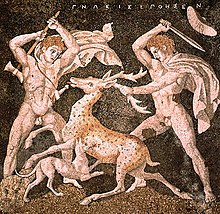
The first systematic excavations were made in 1957-1964. During excavations in 1957 by Greek archaeologists, two mosaic floors dating from the second half of the 4th century BC were discovered among the remains of a residential building. e. depicting a naked Dionysus riding a panther, a lion hunt, a griffin attack and a couple of centaurs. In 1961, in another house, mosaics of the same period were found depicting hunting for fallow deer, abductions of Helen and Amazonasomia [11] [3] . During the second stage of excavation, begun in 1976 and currently continuing, excavated agora, part of the palace, other buildings, fortifications, shrines and cemeteries [4] .
The modern city was first mentioned in the Ottoman period in the first half of the 15th century [12] . In the Ottoman period, the Turkish name of the city was Allah-Kilis tour. Allah Kilise “The Church of God” [10] . Until 1926, the city was called Aiyi Apostoli ( Άγιοι Απόστολοι ) [13] according to the church of the same name, which by the beginning of the 19th century had turned into ruins and not preserved [10] , the Bulgarian name of the city was Postol ( Bulgarian Postol ). In 1867, the church of the Apostles Peter and Paul was built, in 1871-1872 - a stone building of an elementary school, demolished in 1957 after the construction of a new building [10] .
During the Second Balkan War in 1913, Macedonia was annexed to the kingdom of Greece. In 1918 ( ΦΕΚ 152Α ), the Pela community was created [13] .
In the years 1918-1924, the population was replenished with refugees from Eastern Rumelia . During the Greek-Turkish population exchange in 1923, the population was replenished with refugees from Arnavutkoy , Gelibolu and Chataldzha . In 1926 ( ΦΕΚ 97Α ), the city of Ayi Apostoli was renamed Pela [13] . During the civil war in Greece in 1947, approximately 50 Karakach families from Florina moved to Pela.
In 2009, the Archaeological Museum of Pella was opened.
Population
| Year | Population |
|---|---|
| 1991 | 2318 [14] |
| 2001 | 2455 [14] |
| 2011 | ↘ 2398 [2] |
Notes
- ↑ 1 2 3 4 Απογραφή πληθυσμού - κατοικιών της 18ης μαρτίου 2001 (μόνιμος πληθυσμός) (Greek) . - Πειραιάς: Εθνική στατιστική υπηρεσία της Ελλάδας , 2009. - Τ. I. - Σ. 405 . - ISSN 1106-5761 .
- ↑ 1 2 3 4 Πίνακας αποτελεσμάτων Μόνιμου Πληθυσμού-Απογραφής 2011 (Greek) . Ελληνική Στατιστική Αρχή (20 Μαρτίου 2014). Date of treatment October 22, 2017.
- ↑ 1 2 3 Pella / Taruashvili L.I. // P - Perturbation function. - M .: Great Russian Encyclopedia, 2014. - P. 540. - ( Great Russian Encyclopedia : [in 35 vols.] / Ch. Ed. Yu. S. Osipov ; 2004—2017, vol. 25). - ISBN 978-5-85270-362-0 .
- ↑ 1 2 3 Ελισάβετ Τσιγαρίδα. Πέλλα. Ιστορικό (Greek) . Υπουργείο Πολιτισμού και Αθλητισμού (2012). Date of treatment July 6, 2018.
- ↑ Procopius of Caesarea . About the buildings. IV, 3
- ↑ Πέτκος, Α. Ρωμαϊκή Αποικία της Πέλλας (Greek) . Υπουργείο Πολιτισμού και Αθλητισμού (2012). Date of treatment July 6, 2018.
- ↑ Bottema, S. Late Quaternary vegatation history of Northwestern Greece, PhD Thesis,. - Groningen: Groningen University, 1974. - 190 p.
- ↑ Bintliff, J. The plain of Western Macedonia and the Neolithic site of Nea Nikomedeia (English) // Proceedings of the Prehistoric Society. - 1976. - Vol. 42 . - P. 241-262 .
- ↑ Λεκάνη Λουδία - Μογλενίτσα // Έλεγχος Χημικής Ποιότητας αρδευτικών υδάτων (επιφανειακών και υπόγειων oE κλίμακα λεκανών απορροής ποταμών Μακεδονίας-Θράκης-Θεσσαλίας -. Υπουργείο Αγροτικής Ανάπτυξης & Τροφίμων.
- ↑ 1 2 3 4 Η Πέλλα (Greek) . Δήμος Πέλλας (2017). Date of treatment July 6, 2018.
- ↑ Μαρία Λιλιμπάκη-Ακαμάτη. Οικίες αρχαίας Πέλλας. Περιγραφή (Greek) . Υπουργείο Πολιτισμού και Αθλητισμού (2012). Date of treatment July 6, 2018.
- ↑ Tsvetkova, Bistra. The cue ball is noticeable on the people. - Varna: Rusty Publishing House, 1969 .-- S. 125.
- ↑ 1 2 3 Διοικητικές μεταβολές δήμων και κοινοτήτων. Κ. Πέλλης (Πέλλης) (Greek) . ΕΕΤΑΑ. Date of treatment July 6, 2018.
- ↑ 1 2 Μόνιμος και Πραγματικός Πληθυσμός της Ελλάδος. Σύνολο Ελλάδος, νομοί, δήμοι / κοινότητες, δημοτικα / κοινοτικά διαμερίσμα και οικισμοί. Απογραφές πληθυσμού 2001 και 1991 (Greek) (unavailable link) . Ελληνική Στατιστική Αρχή . Date of treatment June 22, 2017. Archived July 16, 2006.