National Park "Axios-Ludias-Aljakmon Delta" ( Greek Εθνικό Πάρκο Δέλτα Αξιού - Λουδία - Αλιάκμονα ), also National Park "Delta Axios" ( Εθνικό Πάρκο ιι Greece
| National Park "Delta Axios-Ludias-Allakmon" | |
|---|---|
| Greek Εθνικό Πάρκο Δέλτα Αξιού - Λουδία - Αλιάκμονα | |
 Birds in the Axios Delta ( Vardar ) | |
| IUCN Category VI (Sustainable Management Area) | |
| basic information | |
| Square | 33 800 ha |
| Average height | 0-5 m |
| Established | year 2009 |
| Location | |
| A country |
|
| Periphery | Central macedonia |
| Nearest town | Thessaloniki |
axiosdelta.gr | |

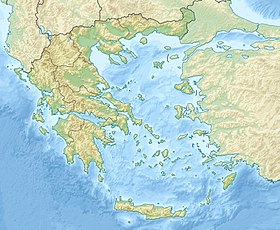

The estuaries of the Halikos , Axios ( Vardar ), Ludias and Alyakmon rivers are located nearby and form the area known as the Halikos-Axios-Ludias-Aljakmon delta ( Δέλτα των ποταμών Γαλλικού - Αξιού - ΛοΑαί.. Since 1971, the international importance of wetlands in the delta has been recognized by the Ramsar Convention . The national park was established in 2009 ( ΦΕΚ 220 ).
Climate
The climate is Mediterranean , summers are hot and dry, and winters are wet and cool. Snowfalls are rare, frosts are even rarer. The average annual rainfall reaches 442.5 mm, mostly it rains in the fall [1] .
Flora and Fauna

The park includes meadow-chernozem , saline and marsh soils , wetlands , small lagoons , sea plain , alluvial plain . On the alluvial plain grows a comb , alder and willow . It is an important habitat for wild animals and birds. Here, 298 bird species are observed (66% of the number of bird species in Greece), including 18 of the 25 endangered bird species observed in Greece. 106 species of birds nest in the park. 40 species of mammals live here, including: nutria , Bulgarian murra , otter , European ground squirrel , Eurasian wolf , jackal , as well as 18 reptiles , 9 amphibians and 7 invertebrate species [2] [3] . People are engaged in rice cultivation , cattle breeding, fishing and breeding mussels [4] [5] .
28 855.18 hectares of wetland in the Aksios-Ludias-Aljakmon delta, important for avifauna , including Aliki-Kitrus are part of the Natura 2000 network of conservation zones. In stagnant and slowly flowing waters along lagoons and artificial canals, common reed , tuberkamysh, and broadleaf cattail grow. Aquatic plants grow in canals and in rice fields: rdest , urut spiny , hornwort and others. Mussel banks , where mussels grow, occupy depths of 1-10 meters [6] .
The Axios-Ludias-Aljakmon Delta is an important site for breeding, migration , recreation and wintering of waterfowl , roaming and migratory birds. The diversity of habitats is one of the main features of the delta, formed by Axios, Ludias and Aljakmon. Delta maintains a diverse bird population, including endangered and rare species. River delta, as well as sea water less than 6 meters deep, serve as spawning grounds for fish populations of Thermaikos Bay and the Aegean Sea . The abundance of nutrients and shallow water depths favor aquaculture [6] . Aksios and Aljakmon are home to 26 native fish species, including Pachychilon macedonicum , four imported fish species live in Aljakmon [3] .
A white-eyed duck , a hollow , a large godwit , a thin-billed curlew and a curly pelican migrate. The white-tailed eagle and the great spotted eagle overwinter . More than 20,000 waterfowl regularly winter in the delta, including the small cormorant (5000), the wig (1000), the dunlin (2500), the black-headed gull (7000), and the laughter (5000). A magpie , a stilt , a shilokuvlka , a sea pike , a meadow bird , a black-headed gull , a small tern , a small white heron , a yellow heron , an ordinary heron , a small bittern , an ordinary spoonbill and a small lark, breed . Into the LIFE program includes species of small-billed curlew, small cormorant, and piscule [5] .
Aliki-Kitrus is a small but important wetland with extensive salt marshes and a shallow lagoon with well-developed dunes on the east side. Dunes include sandy wasteland , on which field wormwood and snowstorm grow. Reed beds dominated by one species ( Bolboschoenus maritimus , common reed, cattail broadleaf) are occupied by artificial ditches and canals. Aliki-Kitrus is considered a very important area for birds. A large number of protected and strictly protected species uses the site (including saline soils) for reproduction, nutrition and recreation. The largest black gull population in Greece nested in the past on small islands in the lagoon. In addition, Alyki Kitrous supports a rare herpetofauna. In Aliki-Kitrus, a rare marine pankration grows. This species is seriously threatened by human activity on the coast [6] .
The fauna is threatened by illegal construction, intensive agriculture, including animal husbandry, and freshwater pollution by industrial effluents [5] .
Notes
- ↑ Σφήκας, Γιώργος. Τα Εθνικά Πάρκα της Ελλάδος. - Αθήνα: Explorer, 2002. - P. 274. - 360 p. - ISBN 960-8303-04-4 .
- ↑ Προστατευόμενη περιοχή (Greek) . Εθνικό Πάρκο Δέλτα Αξιού (2018). Date of treatment July 4, 2018.
- ↑ 1 2 Βασίλης Γκούτνερ. Υδροβιότοποι "Στο Δέλτα του Αξιού" (Greek) // Επτά Ημέρες. - Η Καθημερινή , 1988. - Τ. ΚΕ . - Σ. 85 .
- ↑ Γιώργος Λιάλιος. Εο εθνικό πάρκο στο Δέλτα Αξιού, οι εκχερσώσεις και οι ... αποθήκες (Greek) . Η Καθημερινή (29 Νοεμβρίου 2014). Date of treatment July 4, 2018.
- ↑ 1 2 3 Σημαντικές περιοχές για τα πουλιά της Ελλάδας. Δέλτα Αξιού, Λουδία, Αλιάκμονα (Greek) (unavailable link) . Ελληνική Ορνιθολογική Εταιρεία. Date accessed July 4, 2018. Archived July 4, 2018.
- ↑ 1 2 3 N2K GR1220010 dataforms . Natura 2000 . Date of treatment July 4, 2018.
Links
- axiosdelta.gr - official website of the national park
- Βιότοπος CORINE - Εκβολές Αξιού-Λουδία-Αλιάκμονα (Greek) . Naturebank. Date of treatment July 4, 2018.
- Εθνικό Πάρκο Δέλτα Αξιού-Λουδία-Αλιάκμονα (Greek) . NaturaGraeca.com (2018). Date of treatment July 4, 2018.