The military cross of Karl ( German: Karl-Truppenkreuz ) is a military award from the First World War . The cross was established on December 16, 1916 by the emperor of Austria-Hungary, Charles I, to award the military. The cross was awarded until the end of World War I. Those who served at the front for at least 12 weeks and participated in at least one battle could be represented for the award.
| Charles Cross | |||
|---|---|---|---|
| him. Karl-Truppenkreuz | |||
| |||
| A country |  Austria-Hungary Austria-Hungary | ||
| Type of | cross | ||
| Who is handed | |||
| Status | not awarded | ||
| Statistics | |||
| Established | December 16, 1916 | ||
| Number of awards | 651000 | ||

Description
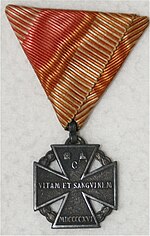
Karl’s Army Cross design was based on the Army Cross design from 1813/14 . The cross was made of zinc and had the shape of a web - shaped cross surrounded by a laurel wreath that is visible between the ends of the cross. The Latin inscription “GRATI PRINCEPS ET PATRIA, CAROLVS IMP.ET REX”, (Grateful ruler and fatherland, Carl, emperor and king) is depicted on the front side of the cross. On the reverse side are the Austrian imperial and Hungarian royal crowns above the letter “C” (Carolus) with the inscription “VITAM ET SANGVINEM” (life and blood) and the date MDCCCCXVI (1916).
The cross was worn on the left side of the chest on a red ribbon with two red-white stripes on the sides.
A total of 651,000 crosses were awarded.
Literature
- Johann Stolzer und Christian Steeb: Österreichs Orden vom Mittelalter bis zur Gegenwart. Akademische Druck- u. Verlagsanstalt Graz 1996, ISBN 3-201-01649-7 .