
L-forms - bacteria , partially or completely devoid of the cell wall , but retaining the ability to develop. First discovered in 1894 by N.F. Gamaley . The letter L is the first letter of the name Lister Institute of Preventive Medicine in London, where for the first time Emmy Kleineberg-Nobel drew attention to the development of morphologically very unusual cells in a bacterial culture of Streptobacillus moniliformis isolated from rat ear fluid. L-forms were later described in a wide variety of bacteria. It was shown that L-forms arise spontaneously or induced under the influence of agents that block the synthesis of the cell wall: antibiotics ( penicillins , cycloserine , cephalosporins , vancomycin ), enzymes ( lysozyme , amidase , endopeptidase ), ultraviolet and X- rays, glycine amino acids .
L-forms are formed as a result of unbalanced growth of normal bacterial cells in length and thickness and therefore polymorphic. In the cultures of L-forms, spherical, filiform or completely structureless cells are found in size from 0.2 to 50 microns. They calmly pass through bacterial filters [ clarify ] and are easily destroyed by mechanical stress. Unlike normal cells, L-forms often contain large vacuoles . Their metabolic activity is very low. Cell division occurs non-standardly, due to the formation of elementary bodies by budding from the cell surface or from the vacuole membrane.
L-forms can be cultivated only on special media that interfere with the osmotic destruction of cells. L-forms grow better in a dense than in a liquid medium. In a dense environment, they form colonies growing into agar and having the characteristic shape of an inverted hat. Colonies grow slowly, while sometimes reaching significant sizes.
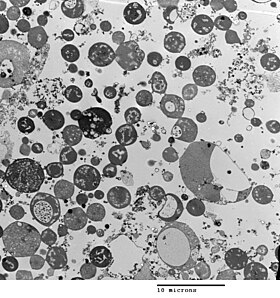
Distinguish between stable and unstable L-forms. Unstable L-forms have a complete genetic control system for cell wall synthesis and are able to turn into normal bacterial cells after excluding the action of the factor that caused their formation. In this case, all the basic biological properties of such a cell are restored, including pathogenicity. If the genetic control of cell wall synthesis is irreversibly impaired, the L-forms become stable, and in their morphological, cultural and other properties they become indistinguishable from mycoplasmas . They rarely return to their original bacterial forms and exist unchanged in various environmental conditions. The transition to the L-form can be considered as a way for bacteria to experience adverse conditions, especially in cases of pathogenic microorganisms.
All L-forms, regardless of the type of bacteria from which they arose, have common features:
- The similarity of morphological changes: the formation of filiform, fibrous, sausage, spherical and granular forms.
- Similar cultural properties: anaerobic or microaerophilic growth conditions, the need for cholesterol and whey protein, growth on solid media in the form of colonies of two types A and B. Type A colonies grow on the surface of the agar, have very small sizes. They consist mainly of granular structures devoid of cell walls, and are very similar to mycoplasmas. Type B colonies consist of a central zone growing in agar and a transparent scalloped peripheral zone. They are similar in appearance to colonies of the “fried” type, formed by mycoplasmas, but larger and coarser. In these colonies, large bodies are found that contain components of the cell wall, similar to the wall of the parent bacteria, but lacking rigidity . Many bacteria can form type A and B colonies, however gram - positive bacteria often form only type A colonies. L-forms from type B colonies are easily converted to their original forms. Type A colonies are more stable and revert to their original forms much less frequently.
- Gradual (as the synthesis of the cell wall is disturbed) conversion from gram-positive to gram-negative structures.
- The formation of stable and unstable L-forms (depending on the degree of completeness of the loss of the ability to synthesize the cell wall.)
- Change in antigenic properties (loss of K- and O-antigens, as a result of impaired cell wall synthesis).
- The decrease in virulence compared with the original parental forms due to the loss of various pathogenicity factors (adhesion, invasion, endotoxin , etc.)
- The ability to persistently (experience) in the body for a long time. The loss of the cell wall makes the L-forms insensitive to various chemotherapeutic agents and antibodies .
- Ability in case of incomplete loss of cell wall synthesis to return to the original bacterial form
Studies of L-forms are of significant interest for medical microbiology , since pathogenic bacteria can be preserved in this form in humans and animals. With the irrational use of antibiotics, leading to the formation of L-forms from bacteria, an improvement in the patient's condition may occur. However, after discontinuation of the medication, L-forms become bacteria of the original species with the restoration of their virulence, which leads to a relapse of the disease.
L-forms can be considered as a form of adaptation to adverse conditions (similar to spore formation ) that is characteristic of all bacteria, which helps to preserve the species in nature. The cell wall and its synthesis are sensitive to the action of antibodies and various chemotherapeutic agents. Exemption from it does not deprive the microorganism of vitality, but allows it to survive the action of these adverse factors, and after eliminating their effects, return to its original state.
Bacteria that lack a cell wall also exist in nature: these are mycoplasmas . The first representative of mycoplasmas described was the causative agent of bovine pleuropneumonia. Similar microorganisms were found in other animals - sheep, goats, rats, dogs, as well as in humans, all of them were given the common name PPLO (pleuropneumonia-like organisms). Mycoplasmas can also exist as saprophytes in vivo, and also cause diseases in plants.
Literature
- Dienes, Louis, and Howard J. Weinberger. “The L forms of bacteria.” // Bacteriological reviews 15.4 (1951): 245.
- Mattman, Lida H. Cell wall deficient forms: stealth pathogens . CRC Press, 2000. ISBN 978-0-8493-8767-8
- Schlegel G. General Microbiology. World, 1987, 567 pp.
- Gusev M.V. , Mineeva L.A. Microbiology, 4th ed., Academy, 2003, 464 pp., ISBN 5-7695-1403-5
- Timakov V.D. , Kagan G. Ya. , Family of Mycoplasrnataceae and the L-form of bacteria, M., 1967.
- Korotyaev A.I. , Babichev S.A. , Medical Microbiology, Immunology and Virology, St. Petersburg, SpecLit, 2008, 767 p. ISBN 978-5-299-00369-7