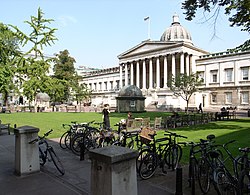
University College London ( Eng. University College London, UCL ) - University of London , part of the University of London . Located in the heart of the capital, on Gower Street [en] .
| University College London English University college london ( UCL ) | |
|---|---|
| London university 1826-1836 University College London 1836 - Present | |
 | |
 | |
| Motto | Cuncti adsint meritaeque expectent praemia palmae |
| Year of foundation | 1826 |
| Chancellor | Princess Anna |
| supervisor | Professor |
| Students | 37,905 |
| Teachers | 7,070 |
| Location | Gower Street, Bloomsbury , London , UK |
| Site | ucl.ac.uk |
Founded in 1826 as the University of London ( London University ), UCL became the very first university in London; its building was built by architect William Wilkins . In 1836, the University of London and the University of London ( King's University ) founded the University of London ( University of London ), which consisted of two colleges - University and Royal . As a result, UCL was named the University College of London, and because of the repetition of the word University in its name, it was renamed University College London.
In accordance with one of the most well-known university rankings in the world, the QS World University Rankings, UCL ranks 2nd in Europe and the UK and 4th in the world (according to the latest QS annual rating , released in September 2012).
In the UCL, 26 Nobel Prize winners have worked or studied, the last of which is currently Sir Charles K. Kao , who received this prize in 2009 in physics.
UCL was the first in England to start accepting students regardless of their religion or gender.
UCL consists of 10 faculties, within which there are more than 100 departments, institutes and research centers. UCL is a leading center for biomedical research.
The main campus of UCL is located in the Bloomsbury district of Central London. UCL has a Doha campus in Qatar specializing in archeology and museology, as well as an energy and resource school based in Adelaide, Australia .
The total annual income of the university is about 802 million pounds, with about 283 million obtained only from grants for research.
There are more than 4,000 academic and research workers and 648 professors working at UCL, and this is the largest number among all UK universities. Currently, the university has 46 fellows from the Royal Society , 55 scholars from the British Academy of Sciences , 10 scholars from the Royal Academy of Engineering and 99 from the Academy of Medical Sciences [ru] .
In 1893, the first student union in England emerged at UCL.
UCL is a member of the Association of Commonwealth Universities , Association of European Universities , G5 [en] , , Russell Group, and UK universities [ clarify ] . It belongs to the Golden Triangle , which is a group of the most elite British universities: University of Oxford, University of Cambridge and University College London.
Content
History
XIX century
UCL was founded on February 11, 1826 as the "University of London" as a secular alternative to the religious universities of Oxford and Cambridge. The philosopher Jeremy Bentham is considered the spiritual father of UCL, his radical ideas in the field of education and society were the inspiration for the founders of the Scottish institution, James Mill (1773–1836) and Henry Broome (1778–1868). In 1827, the first in England Department of Politics and Economics was established. In 1828, the university became the first in the world to offer to study English as an academic subject.
In 1830, UCL established its school at the University of London University (London University School), which was later renamed the University College School. In 1833, the first professor of geography in the UK was appointed - Captain Alexander McConnough. In 1834, the University College Hospital was opened as part of the UCL Medical Institute. In 1836, the University of London (London University) and the Royal University (King's University) created the University of London (Universty of London), which consisted of two colleges, University and Royal, so UCL and received its name University College, London University, because of the repetition of the word University in its name, it was renamed for consonance to University College London. In 1871 the School of Fine Arts Felix Slade (Slade School of Fine Art) was founded. In 1878, the UCL became the first British university to begin allowing women on equal terms as men. In 1898, Professor of Chemistry, William Ramsay discovered the elements of krypton , neon and xenon .
XX century
Sir Gregory Foster became the first vice-rector of UCL in 1906. In the same year, the Cruciform Building was built, which became a new home for the University College Hospital. In 1907, the University of London, King Edward VII officially gave the university the right to issue academic degrees. As part of this reorganization, all university colleges, including UCL, have lost their legal independence. UCL caused significant damage due to the bomb during World War II, the Great Hall and the Carey Foster Physics Laboratory were badly damaged. The first student journal UCL, Pi Magazine, was published for the first time on February 21, 1946. In 1959, the world's first Institute for the Study of Jewish Culture was founded. In 1966, the Mullard Space Science Laboratory was created. In 1973, the world's first email was sent to UCL.
In 1977, Queen Elizabeth II regained the legal independence of the UCL but, unfortunately, did not give a separate right to award its degrees. In 1986, the London Institute of Archeology (London Institute of Archeology) joined UCL. In 1988, the Department of Laryngology, Otology and Orthopedics appeared in the UCL, and the Institute of Urology, Nephrology and Medical Surgery also opened. From 1995 to 1997, the UCL founded the institutes of literature, ophthalmology, pediatrics and neurology. In 1998, the UCL Medical School was recognized in which all medical departments in the UCL merged. In 1999, the School of Slavonic and Eastern European Studies and the Eastman Dental Institute opened in UCL at the School of Eastern European and Slavic Cultures.
XXI century
In 2001, the Jill Dando Institute of Crime Science was opened, which is the only center in the world to develop programs aimed at reducing global crime. In 2003, the Imperial College of London and University College London together created the London Nanotechnology Center (The London Center for Nanotechnology).
In 2002, there were proposals to unite the University and Imperial colleges of London with the aim of creating "World University No. 1". This provoked strong opposition from the teaching staff, students, and unions of both universities, who criticized "indecent haste and disagreement with students and teachers." This led to the rejection of the proposal and the resignation of UCL Vice-Rector Sir Derek Roberts.
In 2005, Queen Elizabeth II awarded the UCL the right to award their degrees. In 2005, UCL built a new building for the University College Hospital, which became the largest and most modern hospital in London. The building is located on Euston Road, near the main campus of the university. In the same year, the Research Institute of Otolaryngology was opened. In 2006, the School of Eastern European and Slavic Cultures (School of Slavonic and Eastern European Studies) moved to a new, purpose-built building on Taviton Street.
In 2006, the Institute of Child Health (Institute of Child Health) was founded, which became the largest division of the newly established Faculty of Biomedical Sciences. In 2007, the Cancer Institute was established. In 2008, UCL became the first British university to sign an agreement on the establishment of a campus in Australia, where the School of Energy and Resources was created.
In 2009, UCL announced that it would join other elite higher education institutions in the UK, such as the University of Cambridge and the London School of Economics . They decided that for admission to their universities, students must pass all exams for at least 97%. In 2012, opened the School of Pharmacy (School of Pharmacy).
Religion denial
The college was specially created without an emphasis on religion, so that students of different denominations (in particular, Catholics and Protestants ) could study together without conflict. Until now, the UCL maintains its strict position against religion and, unlike most other universities in the UK, does not have official religious centers and clubs.
Campus
UCL is located in central London in the Bloomsbury area. The main campus is around Gower Street, where the institutes of biology, chemistry, economics, technology, geography, history, languages, mathematics, philosophy, politics, physics and medical school are located. London Nanotechnology Center (London Center for Nanotechnology), Felix Slade School of Fine Arts (Slade School of Fine Art), Student Union, main library, scientific library, Bloomsbury Theater, Egyptian Archeology Petrie . Easton Dental Institute, Eastman Dental Institute, Cancer Institute, Jill Dando Institute of Crime Science, London Institute of Archeology, Institute of Child Health of Child Health) and the Mullard Space Science Laboratory. In the same area are located the departments of the anthropogenic environment and law, the School of Pharmacy (School of Pharmacy) and the School for the Study of Eastern Europe and Slavic Cultures (School of Slavonic and Eastern European Studies).
The Institute of Ophthalmology (Institute of Ophthalmology), the Institute of Orthopedics and the Study of the Musculoskeletal System (Institute of Orthopedics and Musculoskeletal Science) are located in Clerkenwell, the main campus of the Medical School is located in Whittington. The School of Energy and Resources is located in Adelaide, Australia . Since September 2010, the university has been conducting preparatory programs in physics and mathematics at Nazarbayev University in Astana , Kazakhstan .
Notes
- Дже Jeremy Bentham's wax figure :: photo review :: Jeremy Bentham (Neopr . lichnosti.net. The appeal date is September 13, 2016.