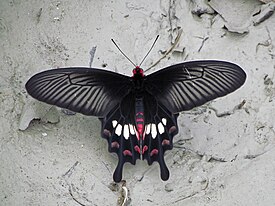
Medium sized butterflies, with elongated narrow hind wings with long wide ponytails. In the anal area of the hind wing there is a rather wide protrusion that is wrapped on the upper side of the wing. In males, it has long androconial hairs . The color is dark - black, black-brown or grayish-ash with contrasting, usually red or pinkish, lunate spots along the outer edge of the hind wing. Abdomen and chest with red spots, covered with short black hairs.
Tropical butterflies without a clear change of generations during the year, as a result of this, at the same time, one can observe in nature all stages of butterfly development - from eggs to adults . Most species are trophically associated with kirkazona .
Previously, this taxon was considered as a subgenus in the genus Atrophaneura . Munroe (1961) was proposed for the first time to isolate a taxon in a separate genus based on differences in the structure of the genitals [1] .
- Pachliopta adamas ( Zinken , 1831)
- Pachliopta aristolochiae (Fabricius, 1775)
- Pachliopta antiphus (Fabricius, 1793)
- Pachliopta atropos (Staudinger, 1888)
- Pachliopta hector (Linnaeus, 1758)
- Pachliopta jophon (Gray, [1853])
- Pachliopta kotzebuea (Eschscholtz, 1821)
- Pachliopta leytensis (Murayama, 1978)
- Pachliopta liris (Godart, 1819)
- Pachliopta mariae (Semper, 1878)
- Pachliopta oreon (Doherty, 1891)
- Pachliopta pandiyana (Moore, 1881)
- Pachliopta phlegon (C. & R. Felder, 1864)
- Pachliopta polydorus (Linnaeus, 1763)
- Pachliopta polyphontes (Boisduval, 1836)
- Pachliopta strandi (Bryk, 1930)