Filira pestle [1] [2] ( lat. Neptis philyra ) is a day butterfly from the nymphalid family .
Philira Pestle | ||||||||||||||||||
|---|---|---|---|---|---|---|---|---|---|---|---|---|---|---|---|---|---|---|
 | ||||||||||||||||||
| Scientific classification | ||||||||||||||||||
| ||||||||||||||||||
| Latin name | ||||||||||||||||||
| Neptis philyra Ménétriés , 1858 |
Content
- 1 Description
- 2 Area
- 3 Biology
- 4 notes
Description
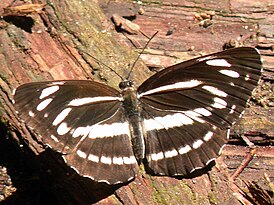
Fore wing length: males 25–33 mm, females 28–34 mm. Wingspan 49–63 mm. The background color of the wings is black-brown. Large elongated white spots on the front wing do not form a single transverse band. A thin white ray crosses the central cell, expanding slightly at the apex of the wing. Two bright white bandages pass on the hind wing: the outer one, divided into spots by dark veins, and the inner one, wider and almost continuous. Background of the underside of the redhead wings. The white pattern is more extensive. On the hind wing, the inner band is curved and widened at the front edge of the wing. Sexual dimorphism is not expressed - the female in color and pattern does not differ from the male, but larger than him, with wider wings [2] [1] .
Range
The Russian Far East , China , Taiwan , Japan , and the Korean Peninsula [1] .
Biology
It develops over the course of a year in one generation. Flight time from mid-June to early August. They are found mainly in broad-leaved and mixed forests. The caterpillar feeds on maple and hornbeam [1] .
Notes
- ↑ 1 2 3 4 Key to insects of the Far East of Russia. T. V. Caddis flies and lepidopterans. Part 5 / under the general. ed. P.A. Lera . - Vladivostok: Dalnauka, 2005 .-- S. 298. - 575 p. - 500 copies. - ISBN 5-8044-0597-7 .
- ↑ 1 2 Sochivko A.V. , Kaabak L.V. Key to butterflies of Russia. Day butterflies. - M .: Avanta +, 2012 .-- 320 s. - 5,000 copies. - ISBN 978-5-98986-669-4 .