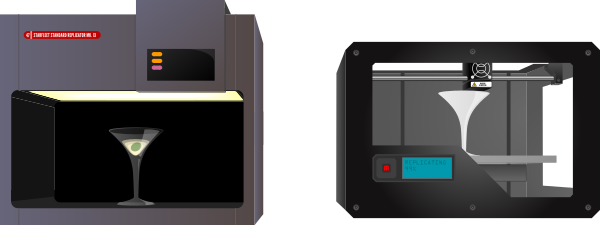
Replicator is a machine from the Star Trek sci-fi media franchise capable of creating (and processing) objects. Replicators initially appeared in the series for synthesizing food on demand, then they were used to create various other materials and objects.
Appearance History and Opportunity
Although science fiction authors pondered the development of “replication” or “duplication” of technology [1] , the term “replicator” itself was not used before the series Star Trek: The Next Generation . In the series, he is described as a food synthesizer of the XXIII century, which was first modernized in the series Star Trek: The Original Series , which was modernized in the XXIV century. In the Original Series, food was created in various colored cubes. In the animated series Star Trek: The Animated Series, various types of realistic food could be ordered, such as in an episode called The Joker. The mechanics of these devices have never been clearly explained in the series. In the prequel to the Star Trek: Enterprise franchise (events unfolding in the 21st century), the device was distinguished by a “protein recoverer” that could only “copy certain products”. The chef used the " hydroponic greenhouse" to grow fruits and vegetables. The replicator was used to process bio materials into useful material [2] .
According to the academic dissertation: “the so-called“ replicators ”can recreate matter and produce everything necessary from pure energy, regardless of whether food, medicine or spare parts are required [3] .” The replicator can create any non-living matter when the desired molecular structure is in the file, but it cannot create antimatter , dilithium , latin, or a living organism of any kind. Concerning the consciousness of living organisms, non-canonical works, such as the Star Trek: The Next Generation Technical Guide, argue that although replicators use the form of conveyor technology at very low resolution, creating living tissue is physical impossible.
In its theory, it works similarly to universal assembler .
Theory
The replicator rebuilds subatomic particles that are abundant throughout the universe to form molecules and organize them to make the desired object. For example, to create a pork chop, the replicator will first form carbon, hydrogen, nitrogen, etc. atoms, then arrange them into amino acids, proteins, and cells, and collect the particles into the shape of a pork chop.
This process requires a destructive conversion of bulk matter into energy and its subsequent transformation into a pre-scanned model of matter. Basically, it looks like a conveyor, but on a smaller scale. However, unlike transporters, which duplicate matter at the quantum level, replicators are able to create a large number of different materials. If the samples will be stored at the quantum level, then an impossible amount of data storage (or a set of original copies of materials) will be required. In order to solve this problem, data files are stored in memory at the molecular level.
The disadvantage of this approach is the inability to replicate objects with complex quantum structures, such as living beings, dilithium or latin. In fact, living things and / or the elements quoted are not necessarily more complex at the quantum level. The alleged “Extra Complexity” was invented by the authors in order to avoid questions such as “why can't the Star Fleet replicate people?” In the TV series “The Next Generation” in the episode “Loyalty,” the aliens used their version of replicators to create the Picard impostor. In addition, read and write errors cause a series of one-bit errors in replicated materials. Although, as a rule, what a person is not able to detect, a computer scan can reveal these discrepancies, and they can explain the frequent complaint (by some gourmets and connoisseurs) that the taste of replicated food and drinks is of poor quality. These errors can also lead to non-toxic material becoming toxic during replication or creating strains of deadly viruses and bacteria from previously harmless ones.
Usage
In the Star Trek universe, the replicator is used primarily to provide food and water aboard starships , thus eliminating the need for a large supply of provisions. (There are reserves on starships, star bases and other installations for emergency use in the event of a replicator failure or an energy crisis.) On Star Trek: Deep Space 9, it was found that as long as there is an energy source for life support, replication used to provide breathing air on ships and star bases (and to disassemble the carbon dioxide exhaled by the crew), thus providing a seemingly endless supply of oxygen and eliminating the need for transport be air reservoirs.
This technology is also used for the production of spare parts, which allows you to repair most damage to the ship without returning to the star base. The replicator is also used to make Starfleet uniforms, as well as toys and souvenirs [4] . Replication is used by the Holo-Deck program to produce food, clothing, and other items that will be used or consumed by participants.
Starfleet security protocols prevent unauthorized copying of dangerous objects such as weapons and toxic substances [5] .
Replicators can also convert matter to energy. Following this principle, the device can disassemble any object into subatomic particles. Subsequent energy can then be stored for future use or immediately applied in subsequent replication. This process is called “disposal” and applies to everything from dirty dishes to overgrown children's clothes [6] .
Replicator technology, even if it is produced on a large scale, cannot be used to create complex objects, such as a shuttle or starships (the authors of the series believe that the ability to copy entire starships “at the touch of a button” will greatly affect the dramatic potential). However, in the series Deep Space 9 in the episode Cause, industrial replicators are used to replicate large components of ships, shuttles, and other similar items that are later used in shipyards to build such ships. Thus, only 15 industrial replicators are enough to reproduce the components necessary to create a fleet of starships or to help civilization recover from a natural disaster throughout the planet.
In fact, eliminating material shortages, replication technology plays an important role in the Star Trek universe of a cash-free human economy.
When the starship USS Voyager in the series Star Trek: Voyager was moved to the Delta Quadrant , it became clear that the technology of replicator was unknown to some indigenous peoples of the region. During the first seasons, the Cossons and other races repeatedly tried to obtain technology. Captain Katherine Janeway feared that if this technology was acquired by civilization before it was ready, catastrophic consequences could ensue. For this reason, and because of the main Directive, Janeway refused to give up the technology at all costs. In addition, the energy restrictions on the Voyager ship on the way back to Alpha Quadrant meant that the supply of replicators had to be strictly controlled, as a result of the “soldering of replicators” became the unofficial currency of the ship. This is also the reason that Nilix (in addition to providing the crew with morale through the preparation of fresh products) began to be used as the chef of the ship. Some ingredients came from a hydroponics lab.
Elements in modern technology
In 2014, researchers at Nestlé said they were working on technology comparable to a replicator, with the goal of providing food adapted to human nutritional needs [7] .
In 2015, Star Trek-inspired Replicator-Emulator offers robots to grow, print, or collect not only food, but also housing, energy, transportation, and even entire cities. WPProjects has allocated 250 grants on renewable automation (one project in each country of the world). The company also laid out the important social programs necessary to protect incomes and strengthen the economy, which completed the 2-year cycle of automation of projects in the field of renewable sources [8] .
For comparison, 3D printers, which are now the main technology and have a number of impressive and important features (including the creation of prostheses or organs), are very different in that they do not create “ex nihilo” material (from nothing ), or, more precisely, from nuclei or atoms or programmed information templates, but instead, like conventional printers, they should use existing body materials. In addition, 3D printers are limited in the materials that they can print. Currently, 3D printer technology uses only materials that can be easily fused together through extrusion or sintering processes : plastics, metals and clays. However, food, concrete and some other materials have been successfully printed on a limited scale.
Physicists at Imperial College London have discovered how to create matter from light , which until then was considered impossible when the idea was first expressed 80 years ago. In just one day, a relatively simple method of physically proving the theory, first put forward by American scientists Breit and Wheeler in 1934, was developed in the laboratory of Imperial College [9] .
An Ohio startup company Beehex received a grant from NASA in 2013 to develop 3D printing technology for long-distance space flights. They began to build robots for printing food for possible future consumption [10] .
Links
Notes
- ↑ Confronting a New 'Era of Duplication'? 3D Printing, Replicating Technology and the Search for Authenticity in George O. Smith's Venus Equilateral Series . Durham University. Date of treatment July 21, 2013.
- ↑ Star Trek: Enterprise : " Breaking the Ice "
- ↑ Mieke Schüller. Star Trek - The Americanization of Space . - GRIN Verlag, October 2, 2005. - P. 5. - ISBN 978-3-638-42309-0 .
- ↑ Data's Day (episode) . Memory Alpha Date of treatment November 25, 2017.
- ↑ " Death Wish ". Voyager Season 2.No. 18. UPN . February 19, 1996
- ↑ Star Trek: Deep Space Nine, episode Hard Time .
- ↑ Nestle plans to create 'Star Trek-like food replicator' . BBC (24 June 2014).
- ↑ WP Transition Projects create 'Star Trek replicator emulator' . CSQ Research (December 25, 2015).
- ↑ Scientists discover how to turn light into matter after 80-year quest
- ↑ http://www.iflscience.com/technology/nasafunded-3d-pizza-printer-now-works-at-tourist-attractions/
See also
- Nanoassembler