Paracelsus ( Latin Paracelsus , real name Philippe Aureol Theophrast Bombast von Hohenheim [1] , Latin Philippus Aureolus Theophrastus Bombast von Hohenheim ; 1493 , city of Eig , canton of Schwyz - September 24, 1541 , Salzburg ) - Swiss alchemist , doctor, philosopher , natural scientist , natural philosopher of the Renaissance , one of the founders of iatrochemistry . Subjected to a critical review of the ideas of ancient medicine [2] . Contributed to the introduction of chemicals in medicine. It is considered one of the founders of modern science .
| Paracelsus | |
|---|---|
| lat Philippus Aureolus Theophrastus Bombast von Hohenheim | |
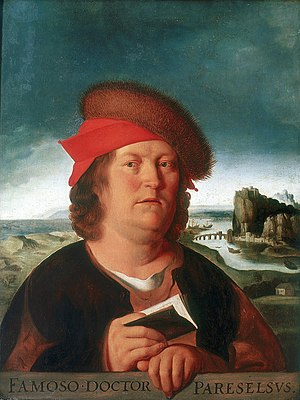 Portrait of Quentin Massey's work | |
| Birth name | |
| Date of Birth | 1493 |
| Place of Birth | Aig , canton of Schwyz , Swiss Union |
| Date of death | September 24, 1541 |
| Place of death | Salzburg , Austrian District , Holy Roman Empire |
| A country |  Switzerland Switzerland |
| Scientific field | medicine , alchemy , astrology |
| Place of work | University of Basel |
| Alma mater | University of Basel , |
| Academic rank | Professor of Physics , Medicine and Surgery |
| Known as | forerunner of pharmacology |
| Hermetic Articles Tightness
|
|---|
Pantheon General books Teachings and practices Hermetic Symbols |
The pseudonym Paracelsus, invented by himself [3] , translated from Latin as “couple - near, near” means “approaching Celsus ”, an ancient Roman encyclopedist and a connoisseur of medicine of the first century BC. e. [four]
Contemporaries compared the activities of Paracelsus with the activities of Luther , since, like Luther in religion, Paracelsus was a great reformer of medical science and practice.
Content
Biography
Paracelsus was born into a family of a doctor who came from an old, but impoverished noble family. Mother worked as a nurse in the abbey . He was very frail in appearance - a big head and slender, crooked legs. In the family, Paracelsus received an excellent education in medicine and philosophy. By the age of 16, he knew the basics of surgery , therapy and was well versed in the basics of alchemy . At 16, Paracelsus left home forever and went to study at the University of Basel . After that, he studied in Würzburg with the abbot Johann Tritemius , one of the greatest adherents of magic, alchemy and astrology [5] . Paracelsus received his education in Ferrara , where he was awarded the degree of Doctor of Medicine.
Wanderings
Since 1517, Paracelsus has taken numerous trips and may have been the forerunner or founder of secret societies that appeared in the 17th century in Europe ), attended various universities in Europe, participated as a medic in military campaigns, visited the imperial lands, France, England, Scotland, Spain, Portugal, the Scandinavian countries, Poland, Lithuania, Prussia, Hungary, Transylvania , Wallachia, the states of the Apennine Peninsula (rumors circulated that he had visited North Africa, Palestine, Constantinople, Russia and the Tatar captivity).
According to the testimony of Van Helmont , in 1521, Paracelsus arrived in Constantinople and received there the Philosopher's Stone . The adept from whom Paracelsus received this stone was, as mentioned in a certain book “Aureum vellus” (The Golden Fleece - lat.) (Printed in Rorschach in 1598), a certain Solomon Trismozin, or Pfeiffer, compatriot of Paracelsus. It is said that this Trismosin also had a panacea; claim that at the end of the XVII century he was still alive: he was seen by some French traveler .
Paracelsus traveled around the Danube countries and visited Italy, where he served as a military surgeon in the imperial army and took part in many military expeditions of that time. In his wanderings, he collected a lot of useful information, not only from doctors, surgeons and alchemists, but also communicating with executioners, barbers, shepherds, midwives and fortune tellers. He drew knowledge from the great and the small, among scientists and among the common people; he could be found in the company of cattle or vagabonders, on roads and in taverns, which gave rise to fierce reproaches and vilifications, which his enemies showered in their limitations. After spending ten years in wandering, then applying his doctor’s skill in practice, then teaching or studying, according to the custom of those times, alchemy and magic, at the age of thirty-two years, he returned to Germany, where he soon became famous after several amazing cases of healing of patients.
In 1526, he acquired the right of a burgher in Strasbourg , and in 1527, under the patronage of the famous book publisher Johann Froben, he became the city doctor of Basel . Also in 1527, on the recommendation of Oskolampadia, the city council appointed him professor of physics, medicine and surgery, putting a high salary. At the University of Basel, he taught a course of medicine in German , which was a challenge to the entire university tradition, which obliged teaching only in Latin . His lectures, unlike the speeches of his colleagues, were not a simple repetition of the views of Galen, Hippocrates and Avicenna, the presentation of which was the only occupation of medical professors of that time. His teaching was really his own, and he taught it regardless of other people's opinions, deserving the applause of the students and terrifying his orthodox colleagues by violating the established custom of teaching only what can be reliably supported by established, generally accepted evidence, regardless of whether it is compatible with reason and truth. In 1528, as a result of a conflict with the city authorities, Paracelsus moved to Colmar . At this time, he was excommunicated from the academy for almost 10 years.
In 1529 and 1530 visited Esslingen and Nuremberg. The "real" doctors from Nuremberg glorified him as a fraud, charlatan and impostor. To refute their allegations, he asked the city council to entrust him with the treatment of several patients whose diseases were considered incurable. Several patients with elephantiasis were sent to him, whom he cured in a short time, without asking for any fee. Evidence of this can be found in the city archive of Nuremberg.
Paracelsus has invented several effective drugs. One of his major achievements is an explanation of the nature and causes of silicosis (occupational disease of miners).
In the following years, Paracelsus traveled a lot, wrote, healed, researched, performed alchemical experiments, and carried out astrological observations. In 1530, in one of the castles of Beratshausen, he completed work on the Paragranum (1535). After a short stay in Augsburg and Regensburg, he moved to St. Gallen and at the beginning of 1531 finished here many years of work on the origin and course of the disease “Paramirum” (1532). In 1533 he stayed in Villach , where he wrote The Labyrinth of Misguided Physicians (1533) and The Chronicle of Cartinia (1535).
Paracelsus described the disease of miners ("Schneeberg pulmonary disease"; "Von der Bersucht und anderen Bergkrankheiten" he wrote allegedly in 1533-1534, but published only after the death of the scientist in 1567), which was later identified as lung cancer. The disease of the miners turned out to be associated with the effect of ionizing radiation of radon and short-lived decay products that accumulate in the air of poorly ventilated mines. [6]
Recent years
In the last years of his life, the treatises “Philosophy” (1534), “Secret Philosophy” (the first edition was translated into Flemish , 1533), “Great Astronomy” (1531) and a number of small natural philosophical works, including “The Book of nymphs, sylphs, pygmies, salamanders, giants and other spirits ”(1536).
After that, he visited Meren , Carinthia , Krajina and Hungary and eventually settled in Salzburg , where he was invited by the Duke Ernst, the Palatine Bavarian, a great lover of the secret sciences. There, Paracelsus was finally able to see the fruits of his labors and gain glory. Finally, he can do medical practice and write works, not caring that tomorrow, perhaps, he will have to move to another city. He has his own house on the outskirts, an office and a laboratory.
On September 24, 1541 , while in a small room of the White Horse Hotel on Salzburg Embankment, he died after a short illness (aged 48 and three days). He was buried in the cemetery of the city church of St. Sebastian.
The circumstances of his death are still not clear, but the most recent studies confirm the version of his contemporaries, according to which Paracelsus, during a dinner party, was treacherously attacked by bandits hired by one of the doctors, his enemies. As a result of a fall on a stone, he broke a skull, which a few days later led to death.
Posthumous fate. Monument
The German doctor S.T. von Semmering examined the skull of Paracelsus, which due to its unusual structure cannot be confused with any other, and noticed a crack passing through the temporal bone (the skull was often touched, and over time it grew and became clearly visible). He is sure that such a crack could have arisen only during the life of Paracelsus, since the bones of a solid, but old and dried skull could not be separated in this way.
The remains of Paracelsus were exhumed in 1572 during the reconstruction of the building of the church of St. Sebastian and reburied behind the wall that surrounds the courtyard in front of the chapel of St. Philip Neri, attached to the church, where he now stands a monument.
- Monument
- In the center of the white marble pyramid there is a recess with his portrait, and above there is an inscription in Latin : Philippi Theophrasti Paracelsi qui tantam orbis famam ex auro chymico adeptus est effigies et ossa donec rus circumdabitur pelle sua.
("Philip Theophrastus Paracelsus, who acquired such great glory of the world for the [discovery] of chemical gold, image and bones; and until again covered with his flesh"); - Under the portrait: Sub reparatione ecclesiae MDCCLXXII. ex sepulchrali eruta heic locata sunt.
(“Due to the repair of the church [in the year], 1772 from the grave decay due to the epidemic were excavated and placed here” [Paracelsus’s bones]); - Based on the monument: Conditur hic Philippus Theophrastus insignis Medicinae Doctor qui dira ilia vulnera Lepram Podagram Hydropsin aliaque insanabilia corporis contagia mirifica arte sustulit et bona sua in pauperes distribuenda locandaque honoravit. Anno MDXXXXI. Die xxiv. Septembris vitam cum morte mutavit.
(“Here lies Philip Theophrastus, the title of Doctor of Medicine, that he cured many of the ulcers, leprosy, gout, dropsy and some incurable contagious diseases of the body with miraculous art, and replaced the poor with distribution and return of their property. In 1541, on the 24th day of September, he replaced life to death ”).
Under this inscription is visible the Paracelsus coat of arms in the form of a silver ray, on which three black balls are located one after the other, and below the words:
- Pax vivis requies aeterna sepultis. ;
- The world is alive, the eternal rest of the dead.
On a black board in the left part of the monument there is a translation of these words into German. The last two inscriptions were clearly transferred from the original monument, and the one that refers to the portrait was added in 1572.
Teachings of Paracelsus
- Medieval medicine, which was based on the theories of Aristotle , Galen and Avicenna , he contrasted the “spagiric” medicine, created on the basis of the teachings of Hippocrates . He taught that living organisms consist of the same mercury, sulfur, salts and a number of other substances that form all other bodies of nature; when a person is healthy, these substances are in equilibrium with each other; illness means the predominance or, conversely, the lack of one of them. One of the first to use chemical agents in treatment.
- Paracelsus is considered the forerunner of modern pharmacology ; he owns the phrase: “Everything is poison, and nothing is without poison; only one dose makes the poison invisible ” (in the popular statement: “ Everything is poison, everything is medicine; both determine the dose ” ).
- According to Paracelsus, man is a microcosm in which all elements of the macrocosm are reflected; the link between the two worlds is the power "M" (the name of Mercury begins with this letter). According to Paracelsus, a person (who is also the quintessence , or fifth, the true essence of the world) is produced by God from the "extract" of the whole world and carries the image of the Creator. There is no knowledge forbidden for a person, he is capable and, according to Paracelsus, is even obliged to investigate all the essences that exist not only in nature, but also beyond its limits.
- Paracelsus' human nature includes 7 elements [7] [8] :
- “ Elementary body ” (material or physical body; “Chat” by the Egyptians and “ Guf ” by the Jews),
- " Archaeus " (an electro-magnetic body that gives phosphorous light; the beginning without which the physical body can neither exist nor move; the " Ankh " of the Egyptians and the "Coach-ha-guf" of the Jews);
- " Evestrum " (starry, astral body; "Ka" of the Egyptians and " Nephesh " of the Jews), whose homeland is the astral world ; it is an exact copy of the material body, can leave the physical body, accompanies the human spirit after his death;
- " Spiritus animalis " (animal soul, "Hati" or "Ab" of the Egyptians, " Ruach " of the Jews), where the lowlands, animals, egoistic instincts and passions are concentrated;
- “ Anima intelligens ” (rational soul, “Bai, Ba” of the Egyptians and “ Neshamah ” of the Jews) - the form in which the human soul is clothed in higher spheres at the time of reunion with the angelic world;
- " Anima spiritualis " (spirit soul, spiritual body; "Cheybi" of the Egyptians and the "Chaijah" of the Jews) - of divine origin, the seat of all the noblest and most sublime aspirations of man,
- The “man of the New Olympus ” is a spark of the Divine, a part of the divine “I” that resides in man.
- Paracelsus applied to medicine the ideas of Agrippa about sympathy and antipathy and based on them he built the doctrine of special means for each part of the body ( arcanum ) and the possibility of transferring the disease from a person to plants or animals, or burying it together with human secretions in the ground [7] .
- Paracelsus left a number of alchemical writings, including: “The Chemical Psalter, or the Philosophical Rules on the Stone of the Wise” [9] , “Nitrogen, or On the Wood and the Thread of Life” [10] , etc. In one of these compositions, the term gnome was used .
- It was he who gave the name metal to zinc , using the spelling “zincum” or “zinken” in Liber Mineralium II [11] . This word probably dates back to it. Zinke , meaning “tooth” (crystallites of metallic zinc are similar to needles) [12] .
Pupils and followers
- Turneysser, Leonard (1531-1596) - Swiss doctor.
- Weigel, Valentine ( Weigel ; 1533-1588) - German Protestant theologian and philosopher, who had many followers (Weigelians).
- Severinus, Peter ( Peder Soerensen ; Peder Soerensen ; 1540-1602) - Danish doctor, author of the books: Idea medicinae philosophicae (1571), Epistola scripta Th. Paracelso "(1572) [13] .
- Libavius, Andreas ( Libavius ; 1555-1616) - German doctor.
- Kunrat, Henry (1560-1605) - German philosopher and alchemist, author of the Amphitheater of Eternal Wisdom (1595).
- Türke de Mayerne ( Théodore Turquet de Mayerne ; 1573-1655) - Swiss doctor.
- Fludd, Robert ( Fludd ; 1574-1637) - English doctor [14] .
- Di Capua, Leonardo (1617-1695) - Italian doctor.
The doctrine of Paracelsus and his followers is called iatrochemistry [5] , which was also independently developed [15] :
- Van Helmont (1580-1644) - Dutch doctor;
- Tacheny, Otto ( Tachenius ; English Otto Tachenius ; 1610-1680) - German pharmacist;
- Sylvius, Francis (1614–1672) - Dutch doctor.
Also, Gustav of Sweden (1568-1607), the son of the Swedish king Eric XIV and a former servant, was nicknamed “the second Paracelsus” for his extensive knowledge [16] .
Proceedings
- Published in life
- Die große Wundarzney . Ulm , Hans Varnier, 1536; Augsburg , Haynrich Stayner (Steyner), 1536; Frankfurt , Georg Raben and Weygand Hanen, 1536.
- Vom Holz Guaico , 1529.
- Von der Frantzösischen kranckheit Drey Bücher , 1530.
- Vonn dem Bad Pfeffers in Oberschwytz gelegen, 1535.
- Prognostications , 1536.
- Posthumous Publications
- Wundt unnd Leibartznei . Frankfurt, , 1549; Christian Egenolff, 1555; Christian Egenolff (Jr.), 1561.
- Von der Wundartzney: Ph. Theophrasti von Hohenheim, beyder Artzney Doctoris, 4 Bücher . , 1577.
- Von den Krankheiten so die Vernunfft Berauben . Basel , 1567.
- Archidoxa . Krakow , 1569.
- Kleine Wundartzney . Basel, Peter Perna, 1579.
- Opus Chirurgicum, Bodenstein . Basel, 1581.
- Medical and philosophical treatises - four volumes, Basel, Huser, 1589.
- Surgical work. Basel, Huser, 1591 and Zetzner, 1605.
- Medical and philosophical treatises - Strasbourg edition, 1603.
- Kleine Wund-Artzney . Strasbourg, Ledertz, 1608.
- Opera omnia medico-chemico-chirurgica , 3 volumes. Geneva , 1658.
- Liber de Nymphis, sylphis, pygmaeis et salamandris et de caeteris spiritibus , 1566
- Philosophia magna, tractus aliquot , Cologne , 1567.
- Philosophiae et Medicinae utriusque compendium , Basel, 1568.
Memory
- Since 1941, the awarding [17] for its lifelong achievements.
- In 1970, the International Astronomical Union named Paracelsus a crater on the far side of the moon .
In fiction and film
- In the work of Jorge Luis Borges “The Rose of Paracelsus”, one of the heroes is Paracelsus.
- In the novel Frankenstein , the protagonist was heavily influenced by the works and ideas of Paracelsus.
- Paracelsus is one of the main characters of the Weiner brothers novel “A Cure for Nesmeyana” (“ A Cure Against Fear ”).
- Austrian filmmaker Georg Pabst in 1943 made the film " Paracelsus ".
- Paracelsus is one of the main characters in the movie " Entrance to the Maze ."
- Often mentioned in the stories of G.F. Lovecraft as the author of occult works and the alchemist, whose works, along with the works of other medieval occult scholars, are used by heroes for mystical purposes, for example, in the resurrection of the dead.
- Appears personally in one of the episodes of the 1987 series Beauty and the Beast.
- It is a prototype for the character of the manga and anime Fullmetal Alchemist , who has the name “Van Hohenheim” (and also could have the name “Theophrast Bombast” in the story)
- In the series, Vault 13 acts as one of the antagonists of the series, he killed 600 peasants to create a philosopher's stone for the sake of gaining immortality, but then was captured by the regents of the 9 vault and turned into a bronze statue.
Notes
- ↑ In modern transcription also - Hohenheim.
- ↑ Paracelsus . www.hrono.ru. Date of treatment November 25, 2015.
- ↑ Philosophical Encyclopedia // Academician.
- ↑ New Philosophical Encyclopedia, 2003
- ↑ 1 2 Paracelsus // Brockhaus and Efron Encyclopedic Dictionary : in 86 volumes (82 volumes and 4 additional). - SPb. , 1890-1907.
- ↑ Rosenberg G.S., Krasnoshchekov G.P. All calendars lie! .
- ↑ 1 2 Occultism // Brockhaus and Efron Encyclopedic Dictionary : in 86 volumes (82 volumes and 4 additional). - SPb. , 1890-1907.
- ↑ Hartmann F. The Life of Paracelsus . Page 102
- ↑ Search Results // Google Books
- ↑ Search Results // Google Books
- ↑ Hoover, Herbert Clark (2003), Georgius Agricola de Re Metallica , Kessinger Publishing, p. 409, ISBN 0766131971
- ↑ Gerhartz, Wolfgang (1996), Ullmann's Encyclopedia of Industrial Chemistry (5th ed.), VHC, p. 509, ISBN 3527201009
- ↑ Severinus, Peter // Brockhaus and Efron Encyclopedic Dictionary : 86 volumes (82 volumes and 4 additional). - SPb. , 1890-1907.
- ↑ “In medicine, he is a follower of Paracelsus” / Floodd, Robert // Brockhaus and Efron Encyclopedic Dictionary : in 86 volumes (82 volumes and 4 additional). - SPb. , 1890-1907.
- ↑ Iatrochemists and Iatrophysicists // Brockhaus and Efron Encyclopedic Dictionary : in 86 volumes (82 volumes and 4 additional). - SPb. , 1890-1907.
- ↑ Gustav, son of Eric XIV // Brockhaus and Efron Encyclopedic Dictionary : in 86 volumes (82 volumes and 4 additional). - SPb. , 1890-1907.
- ↑ Paracelsus Prize
Literature
- Volodarsky V.M. Social Utopia of Theophrastus Paracelsus // History of Socialist Studies: collection of articles. - M., 1985
- Volodarsky V. M. The image of nature in the work of Paracelsus // Nature in the culture of the Renaissance. - M., 1992.
- Volodarsky V.M. Leonardo da Vinci and Paracelsus on magic and alchemy // Leonardo da Vinci and the culture of the Renaissance. - M .: Nauka, 2004.- P.176-183. - ISBN 5-02-032668-2
- Gundolf F. Paracelsus / Per. L. Markevich, total. ed. and after V.N. Morozova. - St. Petersburg: Vladimir Dal, 2015 .-- 191 p. - ISBN 978-5-93615-154-5
- Zorina E.V. Paracelsus // Delphis No. 24 (4/2000)
- Koyre A. Paracelsus // Mystics, Spiritualists, Alchemists of Germany of the 16th Century / transl. A.M. Rutkevich. - Dolgoprudny: Allegro-Press, 1994. - 170 p. - ISBN 5-87859-067-0 .
- Mayer P. Paracelsus - a doctor and a seer. / Per. E. B. Murzina. - M., 2003.
- Jole Shackelford. A Philosophical Path for Paracelsian Medicine: The Ideas, Intellectual Context, and Influence of Petrus Severinus (1540-1602). - Copenhagen: Museum Tusculanum Press, 2004 .-- Pp. 519.
- Walter Pagel . Paracelsus: An Introduction to Philosophical Medicine in the Era of the Renaissance . - Karger Publishers Switzerland. - ISBN 3-8055-3518-X
Links
- Paracelsus // Chronos (website)