The economy of the Republika Srpska was formed after the Bosnian war. Its basis is industry and agriculture.
GDP
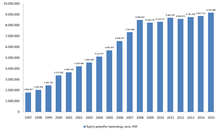
In 2015, the GDP of the RS increased by 2.6%, which shows the highest growth over the past seven years. Its volume is more than nine billion convertible marks. Of these, more than 1.5 billion falls on industrial production [1] .
Employment and well-being
The unemployment rate in 2016 amounted to 24.8%, which is 0.4% less compared to 2015. Unemployment among men was 21.6%, and among women - 29.5%. A third of the unemployed are under the age of 30; every fifth unemployed are older than 50. Among unemployed men, 19.3% graduated from elementary school, 72% - secondary school, 8.7% - high school or university. Among women, these indicators are 15.3%, 66.9% and 17.8%, respectively [2] .
Half of all employees work in the processing industry, trade, and government. One in six workers is under 30 years old, and 25% are employed over the age of 50. Among those employed, 50% graduated only from a heart school, and 25% have higher education [3] .
According to the Republican Institute of Statistics, in 2016, 253,305 people were employed, including 141,454 men and 111,851 women. This is 7330 people more than in 2015. According to the Republican Institute of Statistics, the distribution of employees by activity in 2016 was as follows [4] :
- agriculture, forestry and fisheries - 8468
- mineral mining - 5277
- processing industry - 52,116
- power engineering - 7854
- water supply, sewage and waste management - 4833
- construction - 11 542
- wholesale and retail trade, vehicle repair - 44 909
- transport and logistics - 11 761
- hotel business and catering - 12 106
- information and communication - 5150
- finance and insurance - 5558
- real estate - 559
- special, scientific and technical activities - 7423
- administrative and support activities - 2948
- management and defense, compulsory social insurance - 24 202
- education - 22,608
- health and social services - 17,198
- Arts, Entertainment, and Recreation - 3583
- other - 5250
In 2016, the average net salary amounted to 836 convertible marks (KM) [5] . In 2015, this indicator was 831 km. The highest salaries in insurance and finance, its employees (2.6% of the number of employees) receive an average of 1261 KM. The lowest salaries in the field of administrative management and consultations, where workers (1.3% of the number of employees) receive an average of 518 KM per month [5] . The average gross salary amounted to 1344 KM, which is 4 KM more than in 2015 [6] .
The volume of investments in 2015 amounted to more than 1.6 billion convertible marks. Of these, more than half were invested in the construction sector [7] .
Industry
In the Republic of Srpska, the share of industry is 16.4%. In 2015, it showed an increase of 3% compared to 2014. The most developed energy complex, timber processing industry, metallurgy, natural resource extraction and textile production [8] .
According to the reports of enterprises and firms, the total value of industrial products in 2015 amounted to more than 4.8 billion convertible marks, which is 6% less than in 2014. Of these, 72.2% were in the processing industry. Of the total cost of production, 38.1% is its export [9] .
The total number of firms and enterprises in the industry at the end of 2015 was 4436. Out of 89%, they were privately owned [10] . The volume of investments in industry amounted to 635 million convertible marks, which is 37.6% less than in 2014 [8] .
The industry employs 27.5% of the working population [10] .
The main industrial center of RS is Banja Luka, in the city there are such enterprises as Jelshingrad (metallurgy), Microelectronics, Hemofarm, etc. [11] .
Energy
The RS energy complex fully covers the Republic’s electricity needs, part of it is also exported. The total amount of electricity produced in 2015 amounted to 5610 gigawatts. 58.8% was generated at CHP plants, 40.4% at hydroelectric power plants, 0.8% from other sources. Electricity consumption in the PC has been growing since 2011 [12] .
The structure of electricity consumers in 2015 was as follows [13] :
- 53% - households
- 19.5% - industry
- 1.2% - agriculture
- 1% - construction industry
- 0.6% - transport
- 24.7% - other consumers
RS does not have its own reserves of natural gas, the demand for it is fully compensated by its import, while 91.7% of imported gas is consumed by industry [14] .
In 2015, investments in the RS energy sector amounted to 366 million convertible marks, about 12 thousand people were employed in it, which is 1.7% more than in 2014 [14] .
Construction
In 2015, construction showed a slight decline compared with the previous year - by 1.1%. This industry generated 4.7% of GDP and attracted 18.7% of the total investment. The total cost of construction work is more than 621 million km. In terms of cost, the construction of infrastructure facilities (217 million KM), offices and shopping centers (133 million KM), as well as housing (128 million KM) are allocated [15] .
4.5% of workers in the RS are employed in construction [16] .
In the construction of residential buildings, the most common are one-room apartments - 40.8%. The average cost of new housing is 1520 KM per square meter [16] .
Agriculture
Agriculture plays a significant role in the economy of the RS, but its share in the GDP of the Republic is gradually decreasing. In 2011, the agricultural sector accounted for 8.9% of GDP, in 2015 this indicator amounted to 7.8% of GDP [17] . At the same time, 29.1% (91 thousand people) of the employed population work in agriculture. This indicator has also been falling since 2011, when 32.7% of the employed population worked in this area [18] .
The foreign trade turnover of agricultural products in 2015 amounted to 293.8 million convertible marks, which is 30.4 million higher than in 2014. The share of agricultural products in exports is 2.3%, and in imports - 5.4%. The bulk of exports are apples, pears and quinces, their main buyer is Russia. The import is dominated by corn, mainly from Serbia [19] .
In 2015, 306 thousand hectares of agricultural land were sown with various crops. They managed to collect 127 thousand tons of wheat, 561 thousand tons of corn, 48 thousand tons of apples, 67 thousand tons of plums [20] .
In the same year, the number of cattle totaled 229 thousand animals, pigs - 452 thousand, sheep - 486 thousand, poultry - more than 11 million [20] .
2015 was a record year in the field of honey production, 1974 tons were collected [19] . Of these, 240 tons were collected in Bielina [21] .
Trade
Foreign Trade
The main foreign trade partners of RS are Serbia, Italy and Russia. The associated export and import make up 40% of the total foreign trade turnover of the RS [22] .
In 2015, RS exported products to Italy (18.3%), Serbia (13.1%), Germany (10.6%), Slovenia (9.7%), Croatia (8.8%), etc. While Serbia (17.5%), Russia (15.7%), Italy (12.2%), Germany (7.8%) and China (6.3%) became the main suppliers to the RS [ 23] . The value of exports amounted to 2.6 billion convertible marks, the value of imports - 4.4 billion convertible marks [24] .
The structure of exports is dominated by clothing, fabrics, products of the wood processing complex, including charcoal, as well as products of the metallurgical industry. It imports RS mainly in energy resources, metals, machine tools, etc. [22] .
Domestic Trade
Tourism
The tourist potential of Republika Srpska is quite large due to the presence of rich natural resources and attractions. Mountain tourism, spa tourism, religious, adventure and ecological tourism are developed in the Republic. Among the many attractions and objects visited by tourists, mountains and thermal springs (spa resorts) stand out - 17.2% and 16.2% of the total number of tourists in 2016, respectively [25] .
In Republika Srpska, the Ministry of Trade and Tourism is responsible for tourism. Within its framework, there is a Tourism Organization of the Republika Srpska, whose tasks are to popularize the Republic as a tourist destination, create its positive image, participate in various tourist festivals and other events, etc. The branches of the Organization operate in a number of settlements of the Republic of [26] .
The number of tourists in Republika Srpska has been continuously growing since 2009, when it was visited by 150,256 people, including 54,979 foreigners. In 2015, the number of tourists amounted to 294 781 (including 136 210 foreign), and in 2016 - 323 908 (including 157 845 foreign) [27] .
In 2016, the largest number of foreign tourists arrived from Serbia (45 209), Croatia (19 594) and Slovenia (16 701) [28] .
Transport and Communications
Transport
In 2015, transport companies in the RS transported about 30 million passengers, which is 0.6% less than in 2014. 77.2% of passengers were transported within the city and regional routes. At the same time, the volume of transported goods increased by 40.6% compared to the previous year. Of these, 57% of the cargo was transported by rail [29] .
The length of roads on which transportation is carried out is 14 191 kilometers. In 2015, 29 568 000 passengers used motor vehicles [29] .
As of the end of 2016, several main roads are under construction with a total value of 2.397 billion euros [30] :
- Banja Luka - Doboy (72 km)
- Glamochani - Banja Luka - Mrkonjić Grad - administrative border with the Federation of Bosnia and Herzegovina (110 km)
- Doboy - Yakesh (46 km)
- Banja Luka - Novi Grad (71 km)
- Jakesh - Bielina - border with Serbia (98 km)
According to the plans of the RS Government, the construction and maintenance of these highways will yield 8,000 new jobs [30] . Also, bypass roads are being built near major cities: Banja Luka, Priedora, Modrici, Bielina, Trebinj and Gatsk. The purpose of their construction is to improve road safety, as well as the direction of transit flows around cities [30] .
In 2015, the number of registered cars increased by 1.7% compared to the previous year [31] .
The length of the railroads is 426 kilometers, 178,000 passengers were transported along them [29] . All railway transport and related infrastructure are managed by the state company Zheznice Republika Srpske . The main railways are Shamats - Doboy - Maglai and Novi Grad - Doboy - Zvornik. The modernization of both tracks and passenger trains is ongoing. The railway development plan provides for the purchase of 200 new cars [30] .
In 2015, 22 793 people used air transport [29] .
Postal service
Postal communication in the RS is carried out by the state-owned company Poshte Srpske. It was created on December 10, 1996 by dividing the mail, telegraph and telephone systems of the PC into two enterprises - Poshte Srpsk and Telecom Srpsk. On December 25, 2002, the company was transformed into a joint-stock company, where the state owns 65% of the authorized capital [32] .
The structure of Poshte Srpske includes 226 units of the territorial postal network, the company employs 2,288 employees. On average, one post is responsible for 111.04 km² of the Republic and 6627 inhabitants. One postman accounts for 2325 residents of the RS [33] . According to the Republican Institute of Statistics, in 2016, Poshte Srpske delivered 24,000 letters and 44,000 parcels [34] .
Social Sphere
Health
Education
The education system in Republika Srpska is regulated by the Republican Ministry of Education and Culture. It consists of preschool institutions intended for children from 3 to 7 years old; primary schools for children from 7 to 15 years old; general secondary schools and gymnasiums for students from 15 to 19 years old; special secondary schools (technical, pedagogical, musical and others), vocational schools and universities. According to the Republican Institute of Statistics, in the 2015-2016 academic year, there were 124 pre-schools in the Republika Srpska (9093 students), 708 primary schools (94 064 students), 94 secondary schools and gymnasiums (42 089 students), 21 vocational schools and University (37,390 students) [35] .
Higher education institutions in the Republika Srpska include universities - Banja Luka University, East Sarajevo University, Priedorsk Higher Medical School, Trebin Higher School of Hotel Business and Tourism, etc. Banja Luka University is the largest of them, in the 2015-2016 academic year 15 513 students studied under the supervision of 1300 teachers and researchers [36] .
Financial Sector
See also
- Economy of Bosnia and Herzegovina
Notes
- ↑ Ovo je Republika Srpska, 2016 , p. 27.
- ↑ Statistical girls godishkak, 2017 , p. 138.
- ↑ Ovo je Republika Srpska, 2017 , p. 24.
- ↑ Statistical girls godishkak, 2017 , p. 116.
- ↑ 1 2 Ovo je Republika Srpska, 2017 , p. 21.
- ↑ Statistical girls godishkak, 2017 , p. 131.
- ↑ Ovo je Republika Srpska, 2016 , p. 31.
- ↑ 1 2 Ovo je Republika Srpska, 2016 , p. 52.
- ↑ Ovo je Republika Srpska, 2016 , p. 55.
- ↑ 1 2 Ovo je Republika Srpska, 2016 , p. 53.
- ↑ Industrija (Serb.) . Date of treatment December 27, 2016.
- ↑ Ovo je Republika Srpska, 2016 , p. 56.
- ↑ Statistical women godishkak, 2016 , p. 322.
- ↑ 1 2 Ovo je Republika Srpska, 2016 , p. 58.
- ↑ Ovo je Republika Srpska, 2016 , p. 60.
- ↑ 1 2 Ovo je Republika Srpska, 2016 , p. 61.
- ↑ Ovo je Republika Srpska, 2016 , p. 40.
- ↑ Ovo je Republika Srpska, 2016 , p. 41.
- ↑ 1 2 Ovo je Republika Srpska, 2016 , p. 42.
- ↑ 1 2 Statistics Godishak, 2016 , p. 245.
- ↑ Ovo je Republika Srpska, 2016 , p. 44.
- ↑ 1 2 Ovo je Republika Srpska, 2016 , p. 63.
- ↑ Ovo je Republika Srpska, 2016 , p. 62.
- ↑ Statistical women godishkak, 2016 , p. 340.
- ↑ Statistical women bilten - to tourism (Serb.) . Republikki plant for statistics. Date of treatment June 4, 2018.
- ↑ Tourist organization (Serb.) . Tourist organization of the Republic of Srpsk. Date of treatment June 4, 2018.
- ↑ Statistical girls godishkak, 2017 , p. 393.
- ↑ Statistical girls godishkak, 2017 , p. 396.
- ↑ 1 2 3 4 Ovo je Republika Srpska, 2016 , p. 69.
- ↑ 1 2 3 4 The infrastructure of the Republika Srpskoj (Serb.) . Date of treatment December 21, 2016.
- ↑ Ovo je Republika Srpska, 2016 , p. 70.
- ↑ Organization (Serb.) . "Send Srpske." Date of appeal May 30, 2018.
- ↑ Posta danas (Serb.) . "Send Srpske." Date of appeal May 30, 2018.
- ↑ Statistical girls godishkak, 2017 , p. 415.
- ↑ Statistical girls godishkak, 2017 , p. 426.
- ↑ Statistical girls godishkak, 2017 , p. 433.
Literature
- Statisticians godishkak Republic of Srpsk 2016 . - Baha Luka: Republikki plant for statistics Republika Srpske, 2016. - 679 p.
- Statisticians godishkak Republic of Srpsk 2017 . - Baha Luka: Republikki plant for statistics Republika Srpske, 2017 .-- 524 p.
- Ovo je Republika Srpska, 2016 . - Бања Лука: Republikki plant for statistics Republika Srpske, 2016. - 109 p.
- Ovo je Republika Srpska, 2017 . - Baha Luka: Republiki plant for statistics Republika Srpske, 2017. - 114 p.
- Gradov and Opshtina Republic of Srpsk. - Baha Luka: Republican factory for statistics, 2017. - 267 p.
- Popis stanovitanstva, dominance and stanov at BiH 2013. Republika Srpska . - Baha Luka: Republikki plant for statistics, 2014. - 68 p.
Links
- Privredna komora Republike Srpske (Serb.) . Date of treatment June 9, 2018.