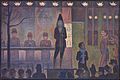
“ Circus ” - a picture of Georges-Pierre Seurat , written in the style of neo - impressionism . The last work of the artist, remaining unfinished at the time of his death in March 1891 [1] . Currently stored in the Orsay Museum in Paris .
| ||
| Georges-Pierre Seurat | ||
| Circus 1890-1891 | ||
| fr Le Cirque | ||
| Canvas, oil. 185 × 152 cm | ||
| Orsay Museum , Paris | ||
| ( Inv. ) | ||

The picture is the third major work of Seurat on the theme of spectacular performances after the “Parade” (1887–1888) and “Kankana” (1889–1890). It depicts a circus actress standing on a horse in the Paris circus Fernando, renamed Medrano in 1890 in honor of the famous clown [1] . The circus, located on the corner of Martyrs' Street ( Rue des Martyrs ) and Boulevard Rochechouart, near Seurat, was very popular with Parisians and was captured in the paintings of artists such as Renoir (“ Acrobats in Circus Fernando ”), Degas (“ Miss Lala in the circus Fernando ") and Toulouse-Lautrec (" In the circus Fernando - horsewoman ").
As in earlier works, Søra synthesized in the picture artistic creativity and a scientific approach [2] . Before writing it, he made several preparatory studies, concentrating on the development of dynamic lines and the limited use of color. In the course of his work, Seurat was guided by the theories of the famous editor and librarian Charles Henri on the emotional and symbolic meaning of lines and color, as well as the works of chemist Michel Chevrel and the physicist Ogden Ruda on complementary colors . The work bears echoes of the Japanese prints and graphic works by Jules Shere , who also had an impact on the Seurat.
The picture is made in the technique of pointillism , which allows the artist to achieve optical illusion in the perception of color due to the dense placement of many multicolored strokes. The work is dominated by white and three primary colors , mostly red and yellow, with blue hues. Along the edges of the canvas depicts a solid bulk dark blue frame.
The composition of the painting is divided into two parts: the lower right is occupied by circus artists, depicted with a predominance of curves and wavy lines that create a sense of movement, the upper left shows straight rows of spectators, divided into social classes - from the elegantly dressed high society in the first row (man in the cylinder - a friend and colleague of Sera Charles Angran ) to the common people in the gallery.
The feeling of space is created by a white clown, who has his back in the foreground and turned away from the audience in the hall. Acrobatics show two other clowns on the right behind the ringmaster.
The unfinished “Circus” was first exhibited at the Salon of the Independent in March 1891 [1] . Seura worked on the painting until the last days: in some places there remained an unfilled base and a grid of blue lines, which Seura needed to develop the composition. The first critics complained about the stiffness of characters that look like automatons . Later it was called the anticipation of cubism .
At the end of the exhibition, the picture was returned to the mother of Seurat, and she left her in a room on the boulevard Magenta, in which the artist died. Around 1900, Paul Signac acquired the painting; American collector John Quinn bought it from him, who later donated it to the Louvre in 1927. “Circus” was exhibited in the Museum in the Luxembourg Gardens , in the State Museum of Modern Art , in the national gallery of Jeu de Pom, and from 1977 to this day, the picture is in the Orsay Museum [3] .
Parade (1887–1888)

Cancan (1889–1890)

Notes
- ↑ 1 2 3 Article Seurat , in Encyclopædia Universalis (2004).
- ↑ Fiche de l'œuvre sur le catalog en ligne du Musée d'Orsay (not available link) . The appeal date is June 8, 2018. Archived on June 25, 2016.
- ↑ Notice détaillée de l'œuvre sur le catalog en ligne du Musée d'Orsay