Clever Geek Handbook
📜 ⬆️ ⬇️

Rhinelepis

Rhinelepis (lat.) Is a genus of ray-finned fish from the chain-mail catfish family that lives in South America . The scientific name comes from the Greek. rhinos - “nose” and Greek. lepis - "scales."

Rhinelepis
R. aspera.jpg
Rhinelepis aspera
Scientific classification
Domain:Eukaryotes
Kingdom:Animals
Kingdom :Eumetazoi
No rank :Bilateral symmetrical
No rank :Secondary
Type of:Chordate
Subtype :Vertebrates
Infratype :Maxillary
Group :Fish
Group :Bone fish
Grade:Rayfin fish
Subclass :Freshfishes
Infraclass :Bony fish
Squadron :Bone Bubble
Series :Otophyses
Subseries :Siluriphysi
Squad:Catfish
Family:Chain Catfish
Subfamily :Hypostominae
Gender:Rhinelepis
International scientific name

Rhinelepis Agassiz , 1829

Content

  • 1 Description
  • 2 Lifestyle
  • 3 Reproduction
  • 4 Distribution
  • 5 Classification
  • 6 notes
  • 7 References
  • 8 Literature

Description

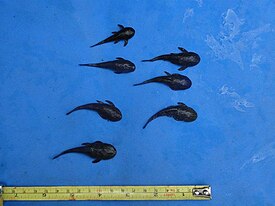
The total length of representatives of this genus ranges from 33 to 40 cm. The head is long and powerful with large bony plates. There are no odontodes (leather teeth) on the cheeks. Gill openings rather large. The eyes are not large, located on the sides at the top of the head. The mouth is wide, with a short mustache. The body is cylindrical, covered with large and dense bone plates, on the belly to a lesser extent. The ribs are short. Adipose fin missing. The pectoral fins are elongated, the ventral fins are short and wide. Anal fin wide, with a short base. The caudal fin is short and very wide.

The color of the back is monophonic - dark gray, the belly is white.

Lifestyle

Biology is not well understood. These are bottom fish. They prefer to live in fresh and transparent reservoirs. During the day they hide among stones, snags or in caves. Active at dusk and at night. They feed mainly on algae , as well as aquatic organisms, less commonly invertebrates .

Reproduction

The female does not lay eggs from caviar, but releases it into a fast stream. Parents do not care about caviar and fry.

Distribution

They live in the river basins of Uruguay , San Francisco and Parana .

Classification

As of May 2018, 2 species are included in the genus [1] :

  • Rhinelepis aspera Spix & Agassiz, 1829
  • Rhinelepis strigosa Valenciennes, 1840
Notes

  1. ↑ Rhinelepis in the FishBase database.

Links

  • Armbruster, Jonathan W. Rhinelepis Agassiz, 1829 (neopr.) . (Retrieved June 7, 2018)

Literature

  • Armbruster, Jonathan W. Phylogenetic Relationships of the Suckermouth Armored Catfishes of the Rhinelepis Group (Loricariidae: Hypostominae) (English) // Copeia : journal. - American Society of Ichthyologists and Herpetologists 1998. - Vol. 1998 , no. 3 . - P. 620-636 . - DOI : 10.2307 / 1447792 .
Source - https://ru.wikipedia.org/w/index.php?title=Rhinelepis&oldid=101879397


More articles:

  • Lavriki (platform)
  • Lovelace, Stacy
  • Kuneevsky, Yuri Sergeevich
  • Bonisoli, Alberto
  • Neyelov, Pavel Filippovich
  • Grozin, Arthur Alekseevich
  • Degtyarev, Pavel Mikhailovich
  • Delgado, Dolores
  • Ozawa, Eitaro
  • Osone Family Morning

All articles

Clever Geek | 2019