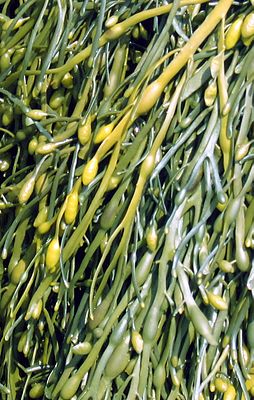
Askofillum [1] ( lat. Ascophyllum ) is a monotypic genus of brown algae of the family Fucaceae . The only species is Ascophillum nodosum [1] ( Ascophyllum nodosum ), common in the Atlantic Ocean on the northwestern coast of Europe (from Spitsbergen to Portugal ), on the east coast of Greenland and the northeastern coast of North America [2] .
| Askofillum | |||||||||||||||||
 | |||||||||||||||||
| Scientific classification | |||||||||||||||||
|---|---|---|---|---|---|---|---|---|---|---|---|---|---|---|---|---|---|
| |||||||||||||||||
| International Scientific Name | |||||||||||||||||
Ascophyllum 1809 | |||||||||||||||||
| Single species | |||||||||||||||||
Ascophyllum nodosum ( L. ) , 1863 | |||||||||||||||||
| Area | |||||||||||||||||
| |||||||||||||||||

Appearance
Ascophyllum has long, rigid, irregularly dichotomous branched belt-like branches with bubbles (blooms) that help it to float up during tide and photosynthesize . Thall can reach 1.5-2 m [1] [3] in length, attached by rhizoids to a stone or boulder. The branches are olive green and somewhat flattened.
Reproduction
Its life cycle has one diploid plant and gametes . Each individual plant is male or female. Gametes are produced in spring in oval yellowish processes - prestacles - on short branches [4] .
Ecology
Ascophillum occurs mainly in the littoral zone .
This species is often the dominant species in the intertidal zone. As a rule, it is found on stony shores and rarely on open [3] , and if found, the thallus is small and severely damaged. These algae grow quite slowly and can live 10-15 years. Ascophillum may overlap in distribution with Fucus vesiculosus and Fucus serratus . Its distribution is also limited by salinity, wave action, temperature, drying, and general stress. Algae can grow for about five years before becoming capable of breeding.
Special substances - florotans - in Ascophyllum act as a chemical defense against the marine herbivore snail, Littorina littorea .
Polysiphonia lanosa is a small red algae , usually found in dense bunches on the ascophyllum, whose rhizoids penetrate into the host. Some consider it a parasite ; however, since it receives only structural support from this species (does not parasitize), this alga is considered an epiphyte [2] [3]
Spread
This species was found in Europe in Ireland , on the Faroe Islands, in Norway , in the United Kingdom and on the Isle of Man, in the Netherlands , in North America in the Bay of Fundy, Nova Scotia, on Baffin Island , in the Hudson Strait , Labrador and Newfoundland . It was also registered as an accidental phenomenon near San Francisco , California, but was eradicated as a potential invasive species . In Russia, the askofillum occurs in the White and Barents Seas [1] .
Use
Ascophyllum is collected for use in alginates, fertilizers and the production of flour from seaweed for consumption by animals and humans [5] . It has long been used as an organic and basic fertilizer for many varieties of agricultural crops due to its combination of both macronutrients (N, P, and K) and micronutrients (Ca, Mg, S, Mn, Cu, Fe, Zn, etc. d.) It also contains cytokinins, auxin-like gibberellins, betaines, mannitol, organic acids, polysaccharides, amino acids and proteins, which are very useful and widely used in agriculture [6] .
Ascofillum is often used as a packaging material for delivering bait and lobster from New England to various domestic and international areas [7] . This species itself was introduced into California, and several species that are often found in waste batches, including Carcinus maenas and Littorina saxatilis , may have been introduced into the San Francisco Bay area in this way [7] .
Use in Toxicology
Since the age of various parts of Ascophyllum can be identified by its shoots, it has also been used to monitor the concentration of heavy metals in seawater.
Controversy
There are controversies regarding the impact of commercial harvesting of ascopillum for use in garden or agricultural fertilizers and feed additives in North America and Europe. Some studies have focused on by-catch and impact on tidal communities [8] . Opponents of its wild harvest indicate a high habitat of algae for more than 100 marine species, including benthic invertebrates, commercially important fish, wild ducks and seabirds.
Subspecies
Several different subspecies of this species have been described: Ascophyllum nodosum minor and Ascophyllum nodosum mackaii .
Ascophyllum nodosum minor was described by Larne Loch in Northern Ireland [9] . There are free-floating forms of this species, for example, Ascophyllum nodosum mackaii , which is found in the salt lakes of Scotland and Ireland [10] .
Notes
- ↑ 1 2 3 4 Askofillum / Belyakova G. A. // Ankylosis - Bank. - M .: The Great Russian Encyclopedia, 2005. - P. 363. - (The Great Russian Encyclopedia : [in 35 t.] / Ed. Yu. S. Osipov ; 2004–2017, t. 2). - ISBN 5-85270-330-3 .
- ↑ 1 2 Handbook of Ecology
- ↑ 1 2 3 O. Morton. Ascophyllum nodosum - knotted wrack Neopr . Priority species in Northern Ireland . Ulster Museum . The appeal date is January 30, 2007.
- ↑ WR Taylor. Marine Algae of the Northeastern Coast of North America. - Ann Arbor, University of Michigan Press , 1962. - ISBN 978-0-472-04904-2 .
- ↑ Production, Trade and Utilization of Seaweeds and Seaweed Products .
- ↑ J. Norrie; DA Hiltz. Seaweed Extract Research and Applications in Agriculture (English) // Agro Food Industry Hi-tech: journal. - 1999.
- 2 1 2 Establishment of Failure in Biological Invasions: A Case History of Littorina littorea in California, USA // PLOS One . - T. 6 , No. 1 . - S. e16035 . - DOI : 10.1371 / journal.pone.0016035 '' . Error in footnotes ? : Invalid
<ref>: the name “Chang 2010” is defined several times for different content - ↑ T. Trott & PF Larsen (2008) Evaluation of the short-term changes in rockweed (Ascophyllum nodosum) and associated epifaunal communities following a cutter rake harvesting in Maine. Archived copy . The appeal date is July 14, 2011. Archived on October 13, 2012. Maine Department of Marine Resources Retrieved 2011-07-13
- ↑ MJ Lynn. A rare alga from Larne Lough (Undecided) // Irish Naturalists' Journal . - 1949. - V. 9 . - p . 301-304 .
- ↑ DC Gibb. The free-living forms of Ascophyllum nodosum (L.) Le Jol (Eng.) // Journal of Ecology : journal. - Wiley-Blackwell , 1957. - Vol. 45 , no. 1 . - P. 49-83 . - DOI : 10.2307 / 2257076 .
Links
- Handbook of Ecology
- Knotted wrack Ascophyllum nodosum . AlgaeBase: listing the algae . Galway: AlgaeBase (2009).
- Knotted wrack Ascophyllum nodosum . Marine Life Information Network Sub-program . Plymouth: Marine Biological Association of the United Kingdom (2007).
- O. Morton. Ascophyllum nodosum - knotted wrack Neopr . Priority species in Northern Ireland . Ulster Museum . The appeal date is January 30, 2007.