Pulmonary ulcers ( Latin Pulmonata ) - a detachment of gastropods . The detachment includes representatives who deviated from the common trunk of their class in the process of evolution farther than the rest [1] . All representatives of the detachment either lead a land lifestyle (mainly species of the suborders Eupulmonata and beanless ), or live in fresh water bodies ( sitting-eyed ); only a few prefer life at sea , but only in very desalinated areas. [one]
Pulmonary snails | ||||||||
|---|---|---|---|---|---|---|---|---|
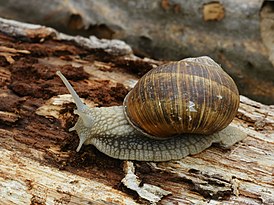 Helix pomatia L. (1758) - Grape Snail | ||||||||
| Scientific classification | ||||||||
| ||||||||
| Latin name | ||||||||
| Pulmonata Cuvier , 1817 | ||||||||
| Suborders | ||||||||
|
Content
- 1 Appearance. Physiological features
- 1.1 Sink
- 1.1.1 Form
- 1.1.2 Estuary
- 1.2 Sense organs
- 1.3 Circulatory system
- 1.4 Nervous system
- 1.5 Reproduction
- 1.5.1 Reproductive system
- 1.5.2 Mating
- 1.5.3 Eggs
- 1.6 Travel
- 1.7 Breath
- 1.8 Power
- 1.8.1 Digestive system
- 1.1 Sink
- 2 Classification
- 2.1 Modern classification
- 2.1.1 Suborder Basommatophora Keferstein (1864)
- 2.1.2 Suborder Eupulmonata Haszprunar et Huber (1990)
- 2.1.2.1 Infraorder Archaeopulmonata = Acteophila Dall (1885)
- 2.1.2.2 Clade Stylommatophora Schmidt (1856) [11]
- 2.1.2.2.1 Elasmognatha Underlay
- 2.1.2.2.2 Lining Orthurethra Pilsbry (1900) [17]
- 2.1.2.2.3 Sigmurethra Informal Group
- 2.1.2.3 Infraorder Trimusculiformes Minichev et Starobogatov (1975)
- 2.1.3 Suborder Systellommatophora Pilsbry (1948)
- 2.2 Obsolete classifications
- 2.2.1 Classification by Ponder and Lindbergh
- 2.2.1.1 Suborder Systellommatophora Pilsbry (1948)
- 2.2.1.2 Suborder Basommatophora Keferstein in Bronn (1864)
- 2.2.1.3 Suborder Eupulmonata Haszprunar et Huber (1990)
- 2.2.1.3.1 Infraorder Archaeopulmonata = Acteophila Dall (1885)
- 2.2.1.3.2 Infraorder Trimusculiformes Minichev et Starobogatov (1975)
- 2.2.1.3.3 Infraorder Stylommatophora Schmidt (1856)
- 2.2.1 Classification by Ponder and Lindbergh
- 2.1 Modern classification
- 3 Impact on humans and their environment
- 4 See also
- 5 Links
- 6 notes
Appearance. Physiological Features
- 1 - sinks
- 2 - digestive gland
- 3 - easy
- 4 - anus
- 5 - with a pneumatic bridge
- 6 - eye
- 7 - tentacle
- 8 - brain
- 9 - happy
- 10 - mouth
- 11 - goiter
- 12 - salivary gland
- 13 - gonopore
- 14 - penis
- 15 - vagina
- 16 - mucous gland
- 17 - egg conduit
- 18 - bag of love arrows
- 19 - leg
- 20 - stomach
- 21 - kidney
- 22 - mantle
- 23 - heart
- 24 - vas deferens
- 2 - digestive gland
Sink
Form
Mostly there are representatives with a spiral shell , the forms of which are very diverse: from a tower-like or valky to a flat-disk . In snails leading lifestyles in rivers with a fast flow , the shape of the shell may take the form of a cap covering the entire body; in some other representatives, this cap is rather a rudiment of a shell due to its small size; in land forms, there are cases in which the entire shell is covered with a mantle , and sometimes, as a result, completely disappears. In the direction of swirling, dexiotropic shells (right-handed) are most often found, however, groups of pulmonary snails with leotropic (i.e. left-handed) shells are opposite in this sense. In both cases there are exceptions. [one]
Mouth
In all representatives of the pulmonary snails, with the exception of the Amphibolidae family, the lid covering the mouth of the shell disappeared during evolution, and only the epiphragm saves them from adverse conditions. However, among representatives of the ancient family of Clausiliids ( Clausiliidae ), the mouth is also closed by a special valve (the so-called Clausiliids ). [one]
Sense organs
Of the senses, there are touch organs, represented by one (in aquatic forms) or two (in land inhabitants) pairs of tentacles, and in addition, on land representatives, also by the skin of the front of the head.
Also, many representatives of the orders Eupulmonata and bezrakovny at the ends of the posterior pair of tentacles have organs of vision, most often able to only distinguish day from night.
Of the other sensory organs, some forms have equilibrium organs (the so-called statocysts ), and the inhabitants of reservoirs also show osfradia , which, it should be noted, is poorly developed. [one]
Circulatory system
The heart of the pulmonary snails consists of one ventricle and one atrium . [one]
Nervous system
The nervous system is eutineural [2] . Nerve ganglia are more or less clearly concentrated in the periopharyngeal ring [1] .
Reproduction
The reproductive system
The reproductive apparatus of the pulmonary snails reaches particular complexity. The sex gland is hermaphroditic (it produces both sperm and eggs ). The common duct, departing from it, is then disconnected into the male and female parts of the reproductive apparatus, both of which have a number of accessory formations. In the female part, the protein and shell glands , the receptor , and sometimes a number of other glandular appendages are formed. The sepriemnik at the most highly organized representatives of the detachment directly goes into the male copulative organ . For some, the formation of spermatophores (special containers for the seed) is characteristic. [one]
Mating
When mating, both partners mutually fertilize each other, and mating itself is usually preceded by the so-called. love game. During mating, some forms launch special calcareous bodies into the partner’s body, the so-called " Love arrows " used for sexual arousal . [one]
Eggs
Eggs of pulmonary snails are laid either in the general gelatinous cocoon of one form or another (in freshwater forms), or disconnected, although in a common clutch (in terrestrial). Each egg cell is surrounded by a significant supply of nutrient material. Development, as a rule, takes place without the formation of a free-floating larva , and an almost formed snail usually leaves the egg. [one]
Movement
All pulmonary snails are characterized by a smooth glide on the sole of the leg, in front of which there is a highly developed gland that secretes mucus . The latter moistens the sole and protects its skin from damage, reducing friction on the hard surface of the substrate . [one]
The movement of the cochlea is due to the wave-like contraction running along the sole from the back to the front, due to the interaction of the longitudinal and transverse muscles . [one]
Breath
A characteristic feature of the structure, which determined the name of the detachment, is the arrangement of the respiratory organs , the transformation of the mantle cavity into a lung , moreover, a more or less narrow opening through which the cavity of the latter communicates with the external environment, can be closed; on the arch of the mantle cavity a dense plexus of vessels is developed. Gill in pulmonary snails is found only as an exception. Thus, most freshwater forms breathe atmospheric air , and therefore snails must from time to time rise to the surface of the water, gaining a supply of air into their pulmonary cavity. [1] In order not to die from dehydration , the skin has a relief surface that retains water (from these folds, apparently, a lung was formed). Because of the need to maintain skin moisture, mollusks love dampness, and small land species avoid being in the sun.
Nutrition
Herbivorous , omnivorous , and carnivorous species are found among pulmonary snails. Predatory forms feed on other snails (smaller than them), and some on worms . [one]
Digestive system
In the pulmonary snails, the radula is well developed, and in herbivores there is also an unpaired horseshoe jaw . The pharynx is well developed, and the teeth on the radula plates are especially long and pointed and resemble vertebral fangs in shape. Ducts of the usually well-developed salivary glands open into the throat, and the digestive gland - hepatopancreas (“liver”) opens into the muscular stomach . The intestine forms a loop and usually opens near the respiratory opening on the right side of the body. Next to the anus is usually the outlet of a single kidney , which is connected to the pericardial sac - the pericardium . [one]
Classification
Modern classification
About 35 thousand species are known, which are usually attributed to the order of pulmonary snails. The following is a list of squad families.
Suborder Basommatophora Keferstein (1864)
- superfamily Acroloxoidea Thiele (1931)
- Acroloxidae Thiele family (1931) [3]
- superfamily Amphiboloidea Gray (1840) [4]
- family Amphibolidae H. Adams et A. Adams , 1855 [5]
- family Maningrididae RE Golding , WF Ponder et M. Byrne (2007)
- family Phallomedusidae RE Golding , WF Ponder et M. Byrne (2007)
- superfamily Chilinoidea Dall (1870)
- family Chilinidae Dall (1870) [6]
- family Latiidae
- superfamily Glacidorboidea Ponder (1986)
- family Glacidorbidae
- superfamily Lymnaeoidea Raf. (1815)
- Lymnaeidae Raf family . (1815)
- superfamily Planorboidea Raf. (1815)
- Physidae Fitzinger family (1833)
- family Planorbidae Raf. (1815) [7]
- superfamily Siphonarioidea Gray (1840)
- Siphonariidae family
- † Acroreiidae family
Suborder Eupulmonata Haszprunar et Huber (1990)
Infraorder Archaeopulmonata = Acteophila Dall (1885)
- superfamily Ellobioidea L. Pfeiffer (1854 (1822)) [7] [8] [9]
- family Ellobiidae L. Pfeiffer (1854 (1822)) [10]
Clade Stylommatophora Schmidt (1856) [11]
Elasmognatha Lining
- superfamily Athoracophoroidea P. Fischer (1883 (1860)) [12]
- Athoracophoridae family [13] [14] [15]
- superfamily Succineoidea Beck (1837)
- family Hyalimacinae Godwin-Austen (1882) ) = Oxylomatinae Schileyko et Likharev (1986) = Succineidae Beck (1837) [7] [16]
Orthurethra Pilsbry Pod (1900) [17]
- superfamily Achatinelloidea Gulick (1873)
- Achatinellidae family [18]
- superfamily Cochlicopoidea Pilsbry (1900 (1879))
- Amastridae family [19]
- family Cionellidae Pfeiffer (1879) = Zuidae Bourguignat (1884) = Cochlicopidae Pilsbry (1900 (1879)) [7] [17]
- superfamily Enoidea
- family Cerastidae
- family Enidae [20] [21] [22]
- superfamily Partuloidea Pilsbry (1900)
- family Draparnaudiidae
- Partulidae Pilsbry family (1900) [17] [23] [24]
- superfamily Pupilloidea Turton (1831)
- family Argnidae
- family Chondrinidae
- family Lauriidae
- family Orculidae
- family Pleurodiscidae
- Pupillidae family [25]
- family Pyramidulidae Kennard et Woodward (1914) [26]
- family Spelaeoconchidae
- family Spelaeodiscidae
- family Strobilopsidae Wenz (1915) [23] [27]
- family Valloniidae Morse (1864) [28]
- family Vertiginidae Fitzinger (1833) [7] [29]
- † Cylindrellinidae family
Sigmurethra Informal Group
(part of Orthurethra Pilsbry (1900) )
- superfamily Acavoidea Pilsbry (1895)
- Acavidae Pilsbry family (1895) [30]
- family Caryodidae Thiele (1926) [31]
- family Dorcasiidae Connolly (1915) [32]
- Macrocyclidae Thiele family (1926) [31]
- Megomphicidae HB Baker family (1930) [7] [33]
- family Strophocheilidae Pilsbry (1902) [7] [34]
- superfamily Achatinoidea Swainson (1840)
- Achatinidae family
- family Coeliaxidae
- family Ferussaciidae
- Glessulidae family
- family Subulinidae
- family Thyrophorellidae
- superfamily Aillyoidea Baker (1955) [35]
- Aillyidae Baker family (1955) [23] [35]
- superfamily Arionoidea Gray in Turton (1840)
- family Anadeniidae Pilsbry (1948) [7] [36] [37] [38]
- family Ariolimacidae Pilsbry et Vanatta (1898) [7] [38] [39]
- Arionidae Gray family (1840) [40]
- the Binneyidae Cockerell family (1891) [7] [36] [38] [41]
- Oopeltidae Cockerell family (1891)
- family Philomycidae Gray (1847) [7] [38] [42]
- superfamily Buliminoidea Clessin (1879)
- family Buliminidae
- family Cerastuidae
- superfamily Clausilioidea Gray (1855) [43]
- family Clausiliidae Gray (1855)
- † Anadromidae family
- family † Filholiidae
- family † Palaeostoidae
- superfamily Dyakioidea Gude et Woodward (1921)
- Dyakiidae family Gude et Woodward (1921)
- superfamily Gastrodontoidea Tryon (1866)
- family Chronidae
- family Euconulidae HB Baker (1928) [7] [44]
- family Gastrodontidae Tryon (1866) [45]
- family Oxychilidae Hesse in Geyer (1927 (1879)) [7] [46]
- family Pristilomatidae Cockerell (1891) [41]
- family Trochomorphidae Möllendorff (1890)
- superfamily Helicarionoidea Bourguignat (1877)
- family Ariophantidae
- family Helicarionidae
- Urocyclidae family
- superfamily Helicoidea Raf. (1815) [47]
- family Bradybaenidae
- family Camaenidae Pilsbry (1895) [7] [30] [48] [49] [50] [51]
- family Cepolidae Ihering (1909) [7] [23] [52]
- Cochlicellidae Schileyko family (1972) [23] [53] [54]
- family Elonidae Gittenberger (1979) [23] [55]
- Epiphragmophoridae family
- family Halolimnohelicidae
- family Helicidae Raf. (1815) [7] [47]
- family Helicodontidae Kobelt (1904) [56]
- Helminthoglyptidae Pilsbry family (1939)
- Humboldtianidae family
- Hygromiidae Tryon family (1866) [7] [45] [57] [58]
- Monadeniidae Nordsieck family (1972) [59]
- family Pleurodontidae
- Polygyridae Pilsbry family (1895) [30]
- Sphincterochilidae Zilch family (1960) [60]
- family Thysanophoridae Pilsbry (1926) [23] [36]
- family Trissexodontidae Nordsieck (1987) [7] [61] [62]
- Xanthonychidae family
- superfamily Limacoidea Raf. (1815)
- family Agriolimacidae H. Wagner (1935) [63] [64]
- family Boettgerillidae Van Goethem (1972) [65]
- Limacidae family = Bielziidae Likharev et Wiktor (1980) [66]
- family Vitrinidae Fitzinger (1833) [23] [29]
- superfamily Oleacinoidea H. Adams et A. Adams , 1855
- Oleacinidae family
- family Spiraxidae
- superfamily Orthalicoidea Albers (1860) [7]
- family Cerionidae Pilsbry (1901) [23] [34]
- family Coelocionitidae
- family Megaspiridae
- family Orthalicidae [67] [68] [69] [70]
- family Placostylidae [71]
- Urocoptidae family
- family † Grangerellidae
- superfamily Papillodermatoidea
- superfamily Parmacelloidea
- superfamily Plectopylidoidea Möllendorf (1898)
- family Corillidae
- family Plectopylididae
- Sculptariidae family
- superfamily Punctoidea Morse (1864)
- Charopidae Hutton family (1884) [7] [72]
- family Cystopeltidae
- family Patulidae Tryon (1866) = Discidae Thiele (1931 (1866)) [73]
- family Endodontidae Pilsbry (1893)
- family Helicodiscidae Pilsbry in HB Baker (1927) [23] [74]
- Oreohelicidae Pilsbry family (1939) [36]
- Punctidae family
- family Thyrophorellidae
- † Anastomopsidae family
- superfamily Rhytidoidea Pilsbry (1893)
- Chlamydephoridae Cockerell family (1935) [75]
- Haplotrematidae HB Baker family (1925) [76]
- family Rhytididae Pilsbry (1893) [23] [77] [78]
- family Scolodontidae HB Baker (1925) [79]
- superfamily Sagdidoidea = Sagdoidea Pilsbry (1895)
- Sagdidae family
- superfamily Staffordioidea Thiele (1931)
- family Staffordiidae
- superfamily Streptaxoidea Gray (1860)
- family Streptaxidae Gray (1860) [7] [80]
- superfamily Strophocheiloidea Thiele (1926)
- family Dorcasiidae Connolly (1915) [32]
- family Megalobulimidae
- family Strophocheilidae Pilsbry (1902) [7] [34]
- superfamily Testacelloidea Gray in Turton (1840) [81]
- Testacellidae Gray in Turton family (1840) [81]
- superfamily Trigonochlamydoidea Hesse (1882)
- family Milacidae
- Papillodermidae family
- Parmacellidae family
- family Trigonochlamydidae
- superfamily Zonitoidea Mörch (1864)
- Zonitidae Mörch family (1864) [7] [23] [82]
Infraorder Trimusculiformes Minichev et Starobogatov (1975)
- superfamily Trimusculoidea JQ Burch (1945 (1840)) [83]
- family Trimusculidae
Systellommatophora Pilsbry Suborder (1948)
- superfamily Onchidioidea Raf. (1815)
- family Onchidiidae [84]
- superfamily Otinoidea H. Adams et A. Adams , 1855
- family Otinidae
- Smeagolidae Climo family (1980) [85] [86]
- superfamily Rathouisioidea Sarasin (1889)
- family Rathouisiidae
- Veronicellidae Gray family (1840)
Outdated Classifications
Previously, pulmonary snails were called a subclass belonging to the class of gastropods (see [1] , [2] ).
Ponder and Lindbergh classification
Later, according to the taxonomy of the gastropods of Ponder and Lindberg (1997), the following superfamilies were included in the squad of pulmonary snails:
Systellommatophora Pilsbry Suborder (1948)
- superfamily Onchidioidea Raf. (1815)
- superfamily Otinoidea H. Adams et A. Adams , 1855
- superfamily Rathouisioidea Sarasin (1889)
Suborder Basommatophora Keferstein in Bronn (1864)
- superfamily Acroloxoidea Thiele (1931)
- superfamily Amphiboloidea Gray (1840)
- superfamily Chilinoidea H. Adams et A. Adams , 1855
- superfamily Glacidorboidea Ponder (1986)
- superfamily Lymnaeoidea Raf. (1815)
- superfamily Planorboidea Raf. (1815)
- superfamily Siphonarioidea Gray (1840)
Suborder Eupulmonata Haszprunar et Huber (1990)
Infraorder Archaeopulmonata = Acteophila Dall (1885)
- superfamily Melampoidea Stimpson (1851)
Infraorder Trimusculiformes Minichev et Starobogatov (1975)
- superfamily Trimusculoidea Zilch (1959)
Infrastructure Squad Stylommatophora Schmidt (1856)
- Infrastructure Orthurethra
- superfamily Achatinelloidea Gulick (1873)
- superfamily Cochlicopoidea Pilsbry (1900)
- superfamily Partuloidea Pilsbry (1900)
- superfamily Pupilloidea Turton (1831)
- Infrastructure Sigmurethra
- superfamily Acavoidea Pilsbry (1895)
- superfamily Achatinoidea Swainson (1840)
- superfamily Aillyoidea Baker (1960)
- superfamily Arionoidea Gray in Turnton (1840)
- superfamily Buliminoidea Clessin (1879)
- superfamily Camaenoidea Pilsbry (1895)
- superfamily Clausilioidea Mörch (1864)
- superfamily Dyakioidea Gude et Woodward (1921)
- superfamily Gastrodontoidea Tryon (1866)
- superfamily Helicoidea Raf. (1815)
- superfamily Helixarionoidea Bourguignat (1877)
- superfamily Limacoidea Raf. (1815)
- superfamily Oleacinoidea H. Adams et A. Adams , 1855
- superfamily Orthalicoidea Albers-Martens (1860)
- superfamily Plectopylidoidea Moellendorf (1900)
- superfamily Polygyroidea Pilsbry (1894)
- superfamily Punctoidea Morse (1864)
- superfamily Rhytidoidea Pilsbry (1893)
- superfamily Sagdidoidera Pilsbry (1895)
- superfamily Staffordioidea Thiele (1931)
- superfamily Streptaxoidea Gray (1806)
- superfamily Strophocheiloidea Thiele (1926)
- superfamily Trigonochlamydoidea Hese (1882)
- superfamily Zonitoidea Mörch (1864)
- ? superfamily Tracheopulmonata = Athoracophoroidea Fischer (1883)
- ? superfamily Heterurethra = Succineoidea Beck (1837)
Human exposure and its habitat
- On the role of aquatic pulmonary snails in human life, see Sydia .
- On the role of the grape snail in human life, see Grape snail and man
Many representatives of the detachment cause significant damage to agriculture . Some types are used in the food industry . Many are used by humans as pets . [87]
See also
- Powelliphanta augusta
Links
Notes
- ↑ 1 2 3 4 5 6 7 8 9 10 11 12 13 14 15 16 Zenkevich L. A. Life of animals. - M .: Education, 1968. - T. 2. Invertebrates.
- ↑ 1 2 Dogel V.A. Invertebrate Zoology: Textbook for high-tech / Ed. prof. Polyansky Yu. I. - 7th ed., Rev. and add. - M .: Higher. school, 1981
- ↑ Handb. syst. Weichtierk. 2 : 484
- ↑ Golding, RE; Ponder, WF; Byrne, M. 2007: Taxonomy and anatomy of Amphiboloidea (Gastropoda: Heterobranchia: Archaeopulmonata). Zootaxa Abstract & excerpt
- ↑ Gen. rec. Moll.
- ↑ Dall, WH 1870. On the genus Pompholyx and its allies, with a revision of the Limnaeidae of authors. Annals of the Lyceum of Natural History of New York
- ↑ 1 2 3 4 5 6 7 8 9 10 11 12 13 14 15 16 17 18 19 20 21 22 23 Bouchet, P. & J.-P. Rocroi. 2005. Classification and nomenclator of gastropod families. Malacologia
- ↑ Pfeiffer, L. 1854. Synopsis Auriculaceorum. Malakozoologische blätter
- ↑ Frias Martins, AM de 1996. Anatomy and systematics of the western Atlantic Ellobiidae. Malacologia
- ↑ Frias Martins, AM de 2007. Morphological and anatomical diversity within the Ellobiidae (Gastropoda, Pulmonata, Archaeopulmonata). Vita malacologica
- ↑ Barker, GM 1999: Naturalized Terrestrial Stylommatophora (Mollusca: Gastropoda) . Fauna of new zealand
- ↑ Fischer, P. 1883-1887. Manual de conchyliologie et de paléontologie conchyliologique
- ↑ Burton, DW 1963: A revision of the New Zealand and subantarctic Athoracophoridae. Transactions of the Royal Society of New Zealand, zoology BUGZ Archived May 29, 2014 on Wayback Machine
- ↑ Burton, DW 1980: Anatomical studies on Australian, New Zealand, and subantarctic Athoracophoridae (Gastropoda: Pulmonata). New Zealand journal of zoology BUGZ Archived May 29, 2014 on Wayback Machine
- ↑ Burton, DW 1981: Pallial systems in the Athoracophoridae (Gastropoda: Pulmonata). New Zealand journal of zoology BUGZ Archived May 29, 2014 on Wayback Machine
- ↑ Beck, Henrik H. 1837-1838. Index Molluscorum praesentis ævi Musei principis augustissimi Christiani Frederici
- ↑ 1 2 3 Pilsbry, HA 1900. On the zoological position of Partula and Achatinella . Proceedings of the Academy of Natural Sciences of Philadelphia
- ↑ Pulmonary snails (English) according to the United Taxonomy Information Service (ITIS).
- ↑ Pulmonary snails (English) according to the United Taxonomy Information Service (ITIS).
- ↑ Altaba, CR 2007: A new genus and species of Enidae (Gastopoda: Pulmonata) from the Quaternary of the Balearic Islands (Western Mediterranean). Zootaxa Abstract & excerpt
- ↑ Castillo, C .; Yanes, Y .; Alonso, MR; Ibáñez, M. 2006: Napaeus lajaensis sp. nov. (Gastropoda: Pulmonata: Enidae) from a Quaternary Aeolian Deposit of Northeast Tenerife, Canary Islands. Zootaxa Abstract & excerpt
- ↑ Wu, M .; Zheng, W. 2009: A review of Chinese Pupinidius Moellendorff (Gastropoda, Stylommatophora: Enidae), with the description of a new species. Zootaxa Abstract & excerpt
- ↑ 1 2 3 4 5 6 7 8 9 10 11 12 Schileyko, AA 1999. Treatise on Recent terrestrial pulmonate molluscs. Ruthenica
- ↑ Pulmonary snails (English) according to the United Taxonomy Information Service (ITIS).
- ↑ Zhang, Z.-Q. 2007: Nomenclatural notes on Gastrocopta fulongensis Chen, Zhang & Zhang 2002 (Mollusca: Pulmonata: Stylommatophora: Pupillidae). Zootaxa PDF
- ↑ Kennard, AS & Woodward, BB 1914. List of British non-marine Mollusca
- ↑ Wenz, W. 1915. Jahrbücher des Nassauischen Vereins für Naturkunde in Wiesbaden
- ↑ Morse, ES 1864. Observations on the terrestrial Pulmonifera of Maine, including a catalog of all the species of terrestrial and fluviatile Mollusca known to inhabitat the state. Journal of the Portland Sociey to Natural History
- ↑ 1 2 Fitzinger, LI 1833. Systematisches Verzeichniss der im Erzherzogthume Oesterreich vorkommenden Weichthiere, als Prodrom einer Fauna desselben. Beiträge zur Landeskunde Oesterreich's unter der Enns
- ↑ 1 2 3 Pilsbry, HA 1895. Guide to the study of Helices. Manual of Conchology, Second Series (Pulmonata)
- ↑ 1 2 Thiele, J. 1926. Mollusca = Weichtiere. In: W. Kükenthal & T. Krumbach, eds., Handbuch der Zoologie
- ↑ 1 2 Connolly, M. 1915. Notes on South African Mollusca. Annals of the south african museum
- ↑ Pilsbry, HA 1930. Anatomy and relationships of some American Helicidae and Polygyridae. Proceedings of the Academy of Natural Sciences of Philadelphia
- ↑ 1 2 3 Pilsbry, HA 1902 (1902-1903). Manual of Conchology, Second Series: Pulmonata
- ↑ 1 2 Baker, HB 1955. Heterurethrous and aulacopod. The nautilus
- ↑ 1 2 3 4 Pilsbry, HA 1948. Land Mollusca of North America (north of Mexico). Academy of Natural Sciences of Philadelphia, Monographs
- ↑ Leonard, WP, L. Chichester, J. Baugh, & T. Wilke. 2003. Kootenaia burkei , a new genus and species of slug from northern Idaho, United States (Gastropoda: Pulmonata: Arionidae). Zootaxa
- ↑ 1 2 3 4 Wiktor, A., D.-W. Chen, & W. Ming. 2000. Stylommatophoran slugs of China (Gastropoda: Pulmonata): prodromus. Folia malacologica
- ↑ Pilsbry, HA, & EG Vanatta. 1898. Revision of the North American slugs: Binneya, Hemphillia, Hesperarion, Prophysaon, and Anadenulus. Proceedings of the Academy of Natural Sciences of Philadelphia
- ↑ Gray, JE 1840. A manual of the land & fresh-water shells of the British Islands, with figures of each of the kinds. By William Turton , MD A new edition, thoroughly revised and much enlarged
- ↑ 1 2 Cockerell, TDA 1891. On the geographic distribution of slugs. Proceedings of the Zoological Society of London
- ↑ Gray, JE 1847. A list of genera of Recent Mollusca, their synonyma and types. Proceedings of the Zoological Society of London
- ↑ Gray, JE 1855. Catalog of Pulmonata or air-breathing Mollusca in the collection of the British Museum, Part I:
- ↑ Baker, HB 1928. Minute American Zonitidae. Proceedings of the Academy of Natural Sciences of Philadelphia
- ↑ 1 2 Tryon, GW 1866. Monograph of the terrestrial Mollusca of the United States. American journal of conchology
- ↑ Hesse, P. 1927. Unsere Land- & Süsswasser-Mollusken
- ↑ 1 2 Rafinesque, CS 1815. Analyse de la nature ou tableau de l'universe et des corps organisés
- ↑ Clark, SA 2009: A review of the land snail genus Meridolum (Gastropoda: Camaenidae) from central New South Wales, Australia. Molluscan research
- ↑ Cuezzo, MG 2006: On a new species of Isomeria Beck and redescription of species of Labyrinthus Beck from South America (Gastropoda: Stylommatophora: Camaenidae). Zootaxa Abstract & excerpt
- ↑ Stanisic, J. 2009: Crikey steveirwini gen. et sp. nov. from montane habitats in the Wet Tropics of northeastern Queensland, Australia (Gastropoda: Eupulmonata: Camaenidae). Zootaxa Abstract & excerpt
- ↑ Wu, S.-p .; Lin, Y.-s .; Hwang, C.-c. 2007: A new Satsuma species (Pulmonata: Camaenidae) endemic to Taiwan. Zootaxa Abstract & excerpt
- ↑ Ihering, H. von 1909. System und Verbreitung der Heliciden. Verhandlungen der Kaiserlich-Könighlichen Zoologisch-Botanischen Gesellshaft in Wien
- ↑ Ibáñez, M .; Groh, K .; Alonso, MR; Castillo, C .; Yanes, Y. 2006: The subgenus Monilearia ( Lyrula ) Wollaston, 1878 (Gastropoda: Helicoidea: Cochlicellidae) from Lanzarote and Fuerteventura (Canary Islands), with the description of Monilearia ( Lyrula ) tubaeformis sp. nov. Zootaxa Abstract & excerpt
- ↑ Schileyko, AA 1972. Some aspects of study of Recent continental gastropod mollusks. Results Sci. Technol. Invertebr. Zool.
- ↑ Gittenberger, E. 1979. On Elona (Pulonata, Elonidae fam. Nov.). Malacologia
- ↑ Kobelt, W. 1904. Iconographie der Land- und Süsswasser-Mollusken
- ↑ Alonso, MR; Ponte-Lira, CE; Castillo, C .; Yanes, Y .; Groh, K .; Ibáñez, M. 2006: A new Canariella species (Gastropoda: Helicoidea: Hygromiidae) of the new subgenus Majorata , both endemic to the Jandía Peninsula (Fuerteventura, Canary Islands). Zootaxa Abstract & excerpt
- ↑ Ibáñez, M .; Siverio, F .; Alonso, MR; Ponte-Lira, CE 2006: Two Canariella species (Gastropoda: Helicodea: Hygromiidae) endemic to the Northwest Tenerife (Canary Islands). Zootaxa Abstract & excerpt
- ↑ Nordsieck, H. 1982. Revision des Systems der Helicoidea (Gastropoda: Stylommatophora). Archiv für molluskenkunde
- ↑ Zilch, A. 1960. Gastropoda Teil 2. Euthyneura. Handbuch der paläozoologie
- ↑ Nordsieck, H. 1987. Revision des Systems der Helicoidea (Gastropoda: Stylommatophora). Archiv für molluskenkunde
- ↑ Arrébola, JR, CE Prieto, AI Puente & A. Ruiz. 2006. Hatumia , a new genus for Oestophora riffensis Ortiz de Zárate, 1962, Oestophora cobosi Ortiz de Zárate, 1962 and Hatumia pseudogasulli n. sp. (Pulmonata: Helicoidea: Trissexodontidae). Journal of conchology
- ↑ Wagner, H. 1935. Diagnosen neuer Limaciden aus dem Naturhistorischen Museum in Wien. Zoologischer anzeiger
- ↑ Wiktor, A. 2000. Agriolimacidae (Gastropoda: Pulmonata) - a systematic monograph. Annales Zoologici (Warszawa)
- ↑ Van Goethem, JL 1972. Contribution à l'étude de Boettgerilla vermiformis Wiktor, 1959 (Mollusca, Pulmonata). Bull. Inst. roy. Sci. nat. Belg.
- ↑ Likharev, IM, & A. Wiktor. 1980. The fauna of slugs of the USSR and adjacent countries (Gastropoda Terrestria Nuda). Fauna USSR
- ↑ Breure, ASH 2009: New Orthalicidae (Mollusca, Gastropoda) from Venezuelan Guayana: unravelling secrets from the Lost World. Zootaxa Abstract & excerpt
- ↑ Breure, ASH; Borrero, FJ 2008: An annotated checklist of the land snail family Orthalicidae (Gastropoda: Pulmonata: Orthalicoidea) in Ecuador, with notes on the distribution of the mainland species. Zootaxa Abstract & excerpt
- ↑ Orono, ES 2007: Taxonomic review of the Spixia pyriformis species complex (Gastropoda: Pulmonata: Odontostominae). Zootaxa Abstract & excerpt
- ↑ Pizá, J .; Cazzaniga, NJ 2003: Redescription, shell variability and geographic distribution of Plagiodontes dentatus (Wood, 1828) (Gastropoda: Orthalicidae: Odontostominae) from Uruguay and Argentina. Zootaxa Abstract & excerpt
- ↑ Neubert, E .; Chérel-Mora, C .; Bouchet, P. 2009: Polytypy, clines, and fragmentation: the bulimes of New Caledonia revisited (Pulmonata, Orthalicoidea, Placostylidae). In : Grandcolas, P. (ed.), Zoologia Neocaledonica 6. Biodiversity studies in New Caledonia. Memoires du muséum national d'histoire naturelle
- ↑ Hutton 1884. Revision of the land Mollusca of New Zealand. Transactions of the New Zealand Institute
- ↑ Thiele, J. 1931. Handbuch der systematischen Weichtierkunde
- ↑ Baker, HB 1927. Minute Mexican land snails. Proceedings of the Academy of Natural Sciences of Philadelphia
- ↑ Cockerell, TDA 1935. African Slugs. The nautilus
- ↑ Baker, HB 1925. The Nautilus
- ↑ Pilsbry, HA 1893. Helicidae, VI. Manual of Conchology, Second Series
- ↑ Spencer, HG; Brook, FJ; Kennedy, M. 2006: Phylogeography of Kauri Snails and their allies from Northland, New Zealand (Mollusca: Gastropoda: Rhytididae: Paryphantinae). Molecular phylogenetics and evolution
- ↑ Baker, HB 1925. Agnathomorphous Aulacopoda. The nautilus
- ↑ Oke, CO 2007: A new species of Streptaxidae (Mollusca: Gastropoda: Pulmonata) from southeastern Nigeria. African zoology
- ↑ 1 2 Turton, W. 1840: A manual of the land and freshwater shells of the British Islands
- ↑ Mörch, OAL 1864. Synopsis Molluscorum terrestrium et fluviatilium Daniae
- ↑ Burch, JQ 1945. Minutes of the Conchological Club of Southern California
- ↑ Dayrat, B. 2009: Review of the current knowledge of the systematics of Onchidiidae (Mollusca: Gastropoda: Pulmonata) with a checklist of nominal species. Zootaxa Abstract & excerpt
- ↑ Climo, FM 1980: Smeagolida, a new order of gymnomorph mollusc from New Zealand based on a new genus and species. New Zealand Journal of Zoology
- ↑ Haszprunar, G .; Huber, G. 1990: On the central nervous system of Smeagolidae and Rhodopidae, two families questionably allied to the Gymnomorpha (Gastropoda, Euthyneura). Journal of zoology
- ↑ Briefly on the main Archived copy of October 3, 2011 on the Wayback Machine - industrial breeding of snails.