Paraloricaria [1] ( lat. Paraloricaria ) is a genus of ray-finned fish from the chain-mail catfish family that lives in South America . The scientific name comes from the Greek. para - “near”, “c” and lat. lorica - "leather armor".
| Paraloricaria |
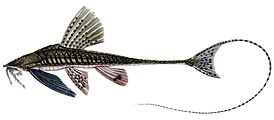
Paraloricaria vetula |
| Scientific classification |
|---|
| No rank : | Bilateral symmetrical |
|
| International scientific name |
|---|
Paraloricaria Isbrücker , 1979 |
|
The total length of representatives of this genus ranges from 10.8 to 55.4 cm. The head and trunk are strongly flattened. The head has a triangular shape, the snout is slightly pointed. There are small postorbital notches on the head. Fringe mustache. On the upper jaw, the mustache is long and branched. In mature males, the lower lip is longer and wider than in females. At the intersection of the head and trunk there is a large bulge. The body is stocky, with moderate bony plates. Dorsal fin high, wide, moderately long. The pectoral fins are quite long. The ventral fins are inferior in size to the pectoral fins. Anal fin strongly elongated, with a short base. Adipose fin missing. Caudal stalk thin, caudal fin wide.
Color brown with various shades.
Biology is not well understood. These are bottom fish. They prefer fresh and clean water. They hold different shelters: thickets of plants, snags and stones, mainly near the bottom. They feed on algae , small aquatic invertebrates .
The mason guards the male.
They live in the basins of the Paraguay , Uruguay and La Plata .
As of April 2018, 3 species are included in the genus [2] :
- Paraloricaria agastor Isbrücker, 1979 - Papaloricaria [1]
- Paraloricaria commersonoides (Devincenzi, 1943)
- Paraloricaria vetula (Valenciennes, 1835)
