Dinheirosaurus (lat.) Is a genus of herbivorous four-legged dinosaurs from the family Diplodocidae , known for fossils from the Upper Jurassic deposits of Portugal , which is a fragmentary skeleton [1] [2] .
| † Dinheirosaurus | |||||||||||||||||||||||||||||||||||||||||||||||
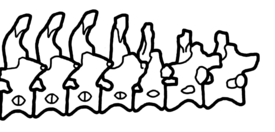 Spinal vertebra | |||||||||||||||||||||||||||||||||||||||||||||||
| Scientific classification | |||||||||||||||||||||||||||||||||||||||||||||||
|---|---|---|---|---|---|---|---|---|---|---|---|---|---|---|---|---|---|---|---|---|---|---|---|---|---|---|---|---|---|---|---|---|---|---|---|---|---|---|---|---|---|---|---|---|---|---|---|
| |||||||||||||||||||||||||||||||||||||||||||||||
| International scientific name | |||||||||||||||||||||||||||||||||||||||||||||||
Dinheirosaurus Bonaparte , , 1999 | |||||||||||||||||||||||||||||||||||||||||||||||
| Single view | |||||||||||||||||||||||||||||||||||||||||||||||
† Dinheirosaurus lourinhanensis (Bonaparte, Mateus, 1999) | |||||||||||||||||||||||||||||||||||||||||||||||
| Geochronology The Titon Age 152.1-145.0 Ma
◄ Nowadays◄ Cretaceous-Paleogene extinction◄ Triassic extinction◄ Mass Permian Extinction◄ Devonian extinction◄ Ordovician-Silurian extinction◄ Cambrian explosion | |||||||||||||||||||||||||||||||||||||||||||||||
A typical sauropod , Dinheirosaurus was a large animal with a long neck and tail. In many ways resembling the American dinosaur Supersaurus vivinae , Dinheirosaurus is considered by some researchers to be a new species of the genus Supersaurus [3] .
Content
Discovery and study
The first fossils in the Lorignan quarry were discovered back in 1979 by amateur paleontologists , whose finds later formed the backbone exposition ( port. Museu da Lourinhã ) [4] . Eight years later, a significant find was made by Carlos Anunsichao ( port. Carlos Anunciação ): having seen several large bones, he contacted the management of the local museum. Excavations organized by the museum’s curator lasted five years, a long period was due to the fact that heavy equipment was required to remove the surrounding rock [5] .
The find, consisting of several vertebrae , ribs, and parts of the pelvis , received catalog number ML 414 and was left in the museum vault. Researchers became interested in her only in 1998, describing sauropod , who came from the same region. It was believed that ML 414 is an instance of Lourinhasaurus , but Jose Bonaparte and Octavio Mateus found significant differences between them; in addition, they determined that ML 414 is close to the American Diplodocidae from . After publishing a description of Lourinhasaurus in 1998, with an interval of one year, Bonaparte and Mateus set about describing a new sauropod, whom they named Dinheirosaurus [5] . Bonaparte and Mateus also described one paratype - ML 418, now it is considered a separate new species [6] .
In 2015, the work of authorship by Emanuel Chopp, Octavio Mateus and Roger Benson was published, devoted to the systematics of diplodocus- related dinosaurs, where the authors suggested synonyms for Dinheirosaurus and Supersaurus [3] . In a reference book published a year later, Gregory Paul suggested that Dinheirosaurus and Lourinhasaurus are synonyms [7] . However, at the moment, the validity of the first kind is not disproved, thus the name Dinheirosaurus is often used in cladograms and publication tables of Chopp, Mateus and Benson [3] .
Description
Dinheirosaurus is about 25 meters long, roughly equivalent to the size of its closest relative, the Super-Saur. Dinheirosaurus sizes were typical for all members of the family [8] .
Due to the small amount of known skeletal material, little can be said about the appearance of this animal. Most likely, like other representatives of this branch of the sauropod, Dinheirosaurus was a large herbivorous dinosaur. According to the general descriptions of the family, representatives of this genus had a large barrel-shaped body, rather slender by the standards of the sauropod. The legs were short and thick (the front is longer than the hind), as a result, the animals resembled dachshunds . The neck was long, the tail was long and flexible, of 70-80 vertebrae. The head was small, had a narrow jaw with long peg-shaped teeth [9] in the front part; the nostrils were probably located in the lower part of the muzzle directly above the upper jaw [10] .
The cervical rib clearly lay well below the front edge of the cervical center - the middle of the body of the cervical vertebra - and it seems that the head and tubercle were directed horizontally back. There was a short and thin anterior process, tapering to the back, ending at the articular condyle of the cervical center. The head ended close to the rear end of the center, the distal surface indicated that the rib probably continued somewhat behind, because there are no signs of a shaft narrowing (tubercle and rib head) to a single point [11] . On the edges of the tuberculum nearest the head (small cones and tubercles on the surface of the bone) and capitals (attachments for muscles) were more pronounced than on the ribs in the back of the chest . The far side was flatter anteroposterior, slightly convex distally. The far part of the shaft had an asymmetric cross section similar to the letter “T”, with a transverse shaft (“letter” bar), this “T” is thin in the transverse part. A short, strong “T” rod formed a ridge located close to the front edge. This created two depressions at the end of the shaft, while the front one was smaller than the back. Passing along the shaft, the median ridge expanded and became lower, and gradually disappeared on the axial surface of the shaft [12] .
Dinheirosaurus vertebral proportions were similar to those of Diplodocus and Supersaurus . The sizes of the cervical vertebrae increased as they moved to the body. The superior processes of the cervical vertebrae almost did not rise above the vertebral body; the lateral processes were curved, angular, and branched. The condyles on them were very large and stood a little, they had a rounded shape and, thus, allowed the dinosaur to move its neck in all directions [13] . The thoracic vertebrae had very thick and curved upper nerve processes, strongly inclined backward, the lateral processes were also very massive. In the area of the withers, the processes of the spine protruded especially strongly upward, forming a rounded bend, to which the spinal muscles were probably attached [14] .
Systematics
Originally, the genus was placed in the family Diplodocidae , without a clear systematic position [15] , in an article for the book “Dinosauria” the genus Dinheirosaurus is given an intermediate position in the group Diplodocoidea . Since 2012, Dinheirosaurus has been in the subfamily Diplodocinae and is considered a sister taxon of the genus Supersaurus , forming with it a treasure from the most basic members of the previously mentioned family. According to the table created by Philip Mannion on the basis of Whitlock ( [16] ) data, Dinheirosaurus was more primitive than Tornieria , but Apatosaurus was not inferior in development [17] . In later works, researchers support the ideas of Mannion [3] , with the exception of the authors of the description of the South American genus Leinkupal , who placed a clade consisting of the genera Supersaurus and Dinheirosaurus outside the Diplodocinae subfamily due to a more primitive organization compared to Apatosaurus [18] .
As of the late 2010s, paleontologists are actively considering ideas about the synonyms of Supersaurus and Dinheirosaurus . This problem is raised in a 2015 paper where Dinheirosaurus is called Supersaurus lourinhanensis [3] . The author of the Princeton Dinosaur Guide, Gregory Paul, considers the synonymy of Dinheirosaurus and Lourinhasaurus possible [19] .
The genus Dinheirosaurus is monotypic . The only species in its composition is Dinheirosaurus lourinhanensis [15] .
Cladogram compiled by Tschopp, Mateus, and Benson (2015) [3] :
| Diplodocidae |
| |||||||||||||||||||||||||||||||||||||||||||||||||||||||||||||||||||||||||||||||||||||||||||||||||||
Evolution and paleobiogeography
The habitat of Dinheirosaurus in the Upper Jurassic (about 150 million years ago) was the territory of the current Lorignan quarry. At that time, she, like most of today's Europe, represented a huge island. Perhaps a number of islands were connected by land bridges over which dinosaurs from the Morrison and formations could migrate [20] .
The discovery of representatives of , previously considered endemic to Europe in the Upper Jurassic Tendaguru Formation and the Early Jurassic deposits of Utah , initiated the idea that the Iberian Peninsula in the Kimmeridge was “between” North America and Africa [21] .
When the Tethys ocean level rose in the Berriasian tier , most of the Dinheirosaurus habitats were flooded. Being unable to adapt to changing conditions, the last individuals of the genus died about 145 million years ago [20] .
Paleobiology and paleoecology
Dinheirosaurus was a herbivorous dinosaur, feeding on gymnosperms , including conifers , ferns , cycas and araucaria ; its jaw is well adapted to plucking stunted greens [16] . His pencil-like teeth were adapted for plucking and tearing hard plant material. Under each tooth, 5-6 teeth per shift grew. Digestion was facilitated by gastrolites [22] , although according to the new hypothesis they could use gastrolites to absorb minerals [23] .
The dinosaur was quadruped (four-legged). Due to the fact that the front legs were shorter, the hips of the dinosaur rose above the withers [24] . The tails were extremely long, probably representatives of the genus Dinheirosaurus used them to drive away predators, quickly (at supersonic speeds) waving them like a whip [25] .
Studying sauropod fossils, paleontologists often find the remains of several individuals in a rather small area, which indirectly indicates the herd of these dinosaurs, including Dinheirosaurus . Thus, adults could have less difficulty finding a sexual partner, while cubs could count on the protection of their elders [26] .
Representatives of the genus Dinheirosaurus lived in herds in open woodlands on an island with arid and wet seasons, on the territory of the Lorignan formation in Portugal in the Kimmeridge - Titonian tiers of the late Jurassic (about 150-145 million years ago), whose flora and fauna were similar to those of Morrison formations (USA ) and ( Tanzania ). Of the known animals, in addition to Dinheirosaurus , thyrophores , ornithopods , small coelurosaurs, and the giant brachiosaurus lived there. The paleofauna of Lorignana was rife with mammals of the order Docodonta and . The niches of large predators were occupied by ceratosaurs , torosaurs and allosaurs [27] .
Notes
- ↑ Bonaparte & Mateus, 1999 .
- ↑ Mannion et al., 2012 .
- ↑ 1 2 3 4 5 6 Tschopp, Mateus & Benson, 2015 , Results.
- ↑ Mateus, 2010 , Introduction to the Museum of Lourinhã.
- ↑ 1 2 Bonaparte & Mateus, 1999 , History of the Discovery and Antecedents.
- ↑ Mannion et al., 2012 , Additional material referred to Dinheirosaurus.
- ↑ Paul, 2016 , Lourinhasaurus alenquerensis.
- ↑ Mateus, 2010 , Dinheirosaurus lourinhanensis.
- ↑ Upchurch, Barret & Dodson, 2004 , Anatomy.
- ↑ Witmer, 2001 .
- ↑ Mannion et al., 2012 , Cervical ribs.
- ↑ Mannion et al., 2012 , Thoaric ribs.
- ↑ Mannion et al., 2012 , Cervicial vertebrae.
- ↑ Mannion et al., 2012 , Dorsal vertebrae.
- ↑ 1 2 Bonaparte & Mateus, 1999 , Systematic paleontolgy.
- ↑ 1 2 Whitlock, 2011 .
- ↑ Mannion et al., 2012 , Analyses and results.
- ↑ Gallina et al., 2014 , Phylogenetic analysis.
- ↑ Paul, 2016 , Lourinhasaurus alenquerensis .
- ↑ 1 2 Royo-Torres et al., 2007 , Paleobiogeographical implications of the sauropods from Riodeva.
- ↑ Mateus, Mannion & Upchurch, 2014 , Introduction.
- ↑ Sander et al., 2011 , Dentition and digestive system.
- ↑ Wings & Sander, 2007 .
- ↑ Upchurch, Barret & Dodson, 2004 , Paleobiology, Taphonomy, and Paleoecology.
- ↑ Myhrvold & Currie, 1997 .
- ↑ Upchurch, Barret & Dodson, 2004 , Examples of Dinosaur Taphonomy Studies.
- ↑ Mateus, Dinis & Cunha, 2017 .
Literature
- Bonaparte J., Máteus O. A New Diplodocid, Dinheirosaurus lourinhanensis gen. et sp. nov., from the Late Jurassic Beds of Portugal // Revista del Museo Argentino de Ciencias Naturales "Bernardino Rivadavia": Journal. - Instituto Nacional de Investigaciones de las Ciencias Naturales, 1999 .-- Vol. 5 , no. 2 . - P. 13–29 . - ISSN 0524-9511 . Archived on September 28, 2007.
- Gallina PA, Apesteguía S., Haluza A., Canale JI A Diplodocid Sauropod Survivor from the Early Cretaceous of South America // PLoS One: Journal / Frake AA. - Public Library of Science , 2014 .-- May 14 ( vol. 9 , iss. 5 ). - P. e97128 . - DOI : 10.1371 / journal.pone.0097128 . - . - PMID 24828328 .
- Mannion PD, Upchurch P., Mateus O., Barnes RN, Jones ME New information on the anatomy and systematic position of Dinheirosaurus lourinhanensis (Sauropoda: Diplodocoidea) from the Late Jurassic of Portugal, with a review of European diplodocoids (English) / / Journal of Systematic Palaeontology: Journal. - Taylor & Francis , 2012 .-- September ( vol. 10 , iss. 3 ). - P. 521–551 . - ISSN 1478-0941 . - DOI : 10.1080 / 14772019.2011.595432 .
- Mateus O. Paleontological Collections of the Museum of Lourinhã (Portugal) // Brandao JM, Callapez PM, Mateus O. Colecções e museus de Geologia: missão e gestão: collection of articles. - Lourinhã: Universidade de Coimbra e Centro de Estudos e Filosofia da História da Ciência Coimbra, 2010. - P. 121–126 .
- Mateus O., Dinis J., Cunha PP The Lourinhã Formation: the Upper Jurassic to lower most Cretaceous of the Lusitanian Basin, Portugal - landscapes where dinosaurs walked (English) // Ciências da Terra / Earth Sciences Journal: Journal. - 2017 .-- 28 September ( vol. 19 , iss. 1 ). - P. 75–97 . - ISSN 2183-4431 . - DOI : 10.21695 / cterra / esj.v19i1.355 .
- Mateus O., Mannion PD, Upchurch P. Zby atlanticus, a new turiasaurian sauropod (Dinosauria, Eusauropoda) from the Late Jurassic of Portugal ( Journal of Vertebrate Paleontology: Journal. - Society of Vertebrate Paleontology, 2014 .-- April ( vol. 34 , iss. 3 ). - P. 618-634 . - DOI : 10.1080 / 02724634.2013.822875 .
- Myhrvold NP, Currie PJ Supersonic sauropods? Tail dynamics in the diplodocids // Paleobiology. - Paleontological Society, 1997.- T. 23 , no. 4 . - S. 393–409 . - DOI : 10.1017 / S0094837300019801 .
- Paul GS Sauropods // The Princeton field guide to dinosaurs. - 2nd. - Princeton University press, 2016 .-- P. 207, 211-212, 214. - 360 p. - (Princeton field guides). - ISBN 978-0-691-16766-4 .
- Royo-Torres R., Cobos A., Aberasturi A., Espílez E., Fierro I., González A., Luque L., Mampel L., Alcala L. Riodeva sites (Teruel, Spain) shedding light to European Sauropod phylogeny (Eng.) // Geogaceta: Journal. - 2007. - Vol. 41 . - P. 183–186 . - ISSN 0213-683X .
- Sander PM, Christian A., Clauss M., Fechner R., Gee CT, Griebeler E.-M., Gunga H.-C., Hummel J., Mallison H., Perry SF, Preuschoft H., Rauhut OWM, Remes K., Tütken T., Wings O., Witzel U. Biology of the sauropod dinosaurs: the evolution of gigantism (Eng.) // Biological Reviews of the Cambridge Philosophical Society: journal. - Cambridge: Cambridge University Press, 2011 .-- February ( vol. 86 , iss. 1 ). - P. 117–155 . - DOI : 10.1111 / j.1469-185X.2010.00137.x . - PMID 21251189 .
- Tschopp E., Mateus O., Benson RJB A specimen-level phylogenetic analysis and taxonomic revision of Diplodocidae (Dinosauria, Sauropoda) (English) // PeerJ: journal / Farke AA. - Open Access Scholarly Publishers Association, 2015 .-- April 7 ( vol. 3 ). - P. e857 . - DOI : 10.7717 / peerj.857 . - PMID 25870766 .
- Upchurch P., Barrett PM, Dodson P. Sauropoda (Eng.) // Weishampel DB, Dodson P., Osmólska H. The Dinosauria (2nd Edition): collection of articles. - University of California Press, 2004. - P. 273—322 . - ISBN 9780520941434 .
- Whitlock JA Inferences of Diplodocoid (Sauropoda: Dinosauria) Feeding Behavior from Snout Shape and Microwear Analyses (Eng.) // PloS ONE: Journal / Frake AA. - PLOS , 2011 .-- April 6 ( vol. 6 , iss. 4 ). - P. e18304 . - DOI : 10.1371 / journal.pone.0018304 . - . - PMID 21494685 .
- Wings O., Sander MP No gastric mill in sauropod dinosaurs: new evidence from analysis of gastrolith mass and function in ostriches // Proceedings of the Royal Society B: journal. - Royal Society Publishing, 2007 .-- March 7 ( vol. 274 , iss. 1640 ). - P. 635-640 . - DOI : 10.1098 / rspb.2006.3763 . - PMID 17254987 .
- Witmer LM Nostril Position in Dinosaurs and Other Vertebrates and Its Significance for Nasal Function (Eng.) // Science : Journal. - The American Association for the Advancement of Science , 2001 .-- 3 August ( vol. 293 , iss. 5531 ). - P. 850-853 . - DOI : 10.1126 / science.1062681 . - PMID 11486085 .
Links
- Dinheirosaurus . prehistoric-wildlife.com .