Kalman Kanya ( Hungarian Kálmán Kánya ; November 7, 1869 , Sopron , Kingdom of Hungary , Austria-Hungary - February 28, 1945 , Budapest , Hungary ) - Hungarian political, state and diplomatic figure. Hungarian Foreign Minister (from February 4, 1933 to November 28, 1938 ).
| Kalman Kanya | |||||||
|---|---|---|---|---|---|---|---|
 | |||||||
| Predecessor | Gyula Gömbös | ||||||
| Successor | Bela Imredi | ||||||
| Birth | |||||||
| Death | |||||||
| Awards |  | ||||||

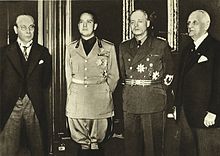
from left to right Foreign Minister of the Second Czechoslovak Republic Frantisek Hvalkovsky , Galeazzo Ciano , Joachim von Ribbentrop , Kalman Kanya. 1938
Biography
He began his diplomatic career as an assistant consul in Constantinople . In 1904 he was appointed consul, since 1905 he served in the Ministry of Foreign Affairs of Austria-Hungary. In 1913 he was ambassador of Austria-Hungary to Mexico . From 1920 to 1925 - Deputy Minister of Foreign Affairs. Since 1925 - Ambassador in Berlin .
In 1933-1938 - Minister of Foreign Affairs of Hungary. During his work in this post, preparations were made for the conclusion of the Berlin Pact . K. Kanya tried to balance the hegemony of Germany with the expansion of cooperation with Italy. On the other hand, he sought to maintain good relations with the countries of the Little Entente - the alliance of Czechoslovakia , Romania and Yugoslavia .
On October 4, 1935, Horthy appointed him a permanent member of the Upper House of Parliament of Hungary.
Together with Prime Minister Bela Imredi flew to Berchtesgaden with a request to Hitler to support the territorial claims of Hungary.
In October 1938, K. Kanya led the Hungarian delegation, which participated in negotiations with Czechoslovakia in Komarom , as a result of which the city transferred under the Trianon Treaty of 1920-1921. Czechoslovakia was returned to Hungary.
On November 21, 1938, K. Kanya was forced to resign when he realized that he could not influence the growing German-Italian influence in Hungarian politics, and by the fall of 1938, Hungarian foreign policy had become largely pro-German and pro-Italian. The impetus was the German-Italian demarche, when the plans for the occupation by Hungary of Transcarpathian Ukraine failed.
Rewards
- Cavalier of the Order of the White Eagle (1938).