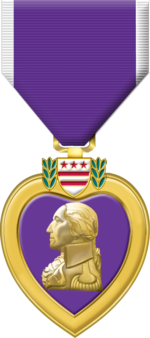
Purple Heart ( Engl. Purple Heart ) - US military medal , awarded to all American soldiers who died or were injured as a result of enemy actions.
| Purple heart | |||
|---|---|---|---|
| |||
| A country |  USA USA | ||
| Type of | Medal | ||
| To whom is handed | all american servicemen | ||
| Foundations | dead or injured as a result of enemy actions | ||
| Status | handed over | ||
| Statistics | |||
| Establishment Date | February 22, 1932 | ||
| Sequence | |||
| Senior award | Bronze star | ||
| Junior reward | Medal "For meritorious service" | ||
History
The sign "Purple Heart" was established by George Washington in 1782 . Officially, only three such awards were presented and until 1861 it was no longer used. Initially, it was made simply from silk matter, which was stretched onto a silver heart-shaped brace. In 1861, the US Congress decided to establish a “ Medal of Honor ”, which thus became the highest distinction in the country only because there were no orders in the United States. The medal was made of gold in the form of a five-pointed star with a trefoil at the ends of its rays. In view of this, "Purple Heart" was in second place in importance.
The modern Purple Heart medal was created on February 22, 1932 by a directive signed by the US Army Chief of Staff Douglas MacArthur , in honor of the 200th anniversary of the birth of George Washington. She was stamped from a sheet covered with purple enamel. Until 1942, the Purple Heart was awarded only to US Army personnel. Initially, the award was made for military merit, and the combat wound was also regarded as merit. Since 1943, the medal has been awarded exclusively for combat wounds. After the war in Korea and Vietnam, “Purple Heart” began to be issued to each seriously injured person without special solemnity, simply according to the relevant hospital lists.
Criteria
The “Purple Heart” medal can be awarded to any member of the US Armed Forces who died or were injured as a result of the action of the enemy forces. Since 1984, the medal has also been awarded to military personnel who have been killed or injured as a result of terrorist acts that did not take place in the course of hostilities . Thus, the criterion for awarding does not include injured or dead as a result of non-combat incidents, self-injuries and “ friendly fire ”. It should be noted, however, that for various reasons, not all soldiers who received combat wounds were awarded this medal.
There are precedents when a foreigner was awarded a medal. July 29, 1989, the medal "Purple Heart" was awarded to veteran of the Great Patriotic War, Vladimir Terent'evich Kuts : hijacked to forced labor in Germany. Released by the advancing American forces, he served in March — April 1945 as a machine gunner for the reconnaissance platoon of the 4th infantry division . During his visit to the United States, his colleague Thomas Stotler handed him the medal, and the award was signed by Colonel of the United States Marine Corps John Barr [1] .
Re-awarding
When re-awarding a military award the second sign of the award (medal) is not awarded, and the second and subsequent awards are indicated by additional signs of the award (oak leaves) that are worn on the medal block or the award bar.
It is assumed that the soldier should be awarded for each combat injury. In the history of the known one soldier who had nine, and five soldiers who had eight awards "purple heart" . Nine received Albert Ireland (five in World War II and four in the Korean War). Robert Friderik got the Eight in World War II , David Hackworth three in the Korean War and five in the Vietnam War; Joe Hooper, Robert Howard, and William Waugh got everything in the Vietnam War.
Notes
Links
See also
- US Military Awards
- Sign of injury