Burgas [2] ( Bulgarian Burgas ) is the largest city in South-Eastern Bulgaria and the fourth largest in the country after Sofia , Plovdiv and Varna . Burgas is an important economic, transport, administrative and cultural center of South-Eastern Bulgaria. The city is the administrative center of the eponymous community and region.
| City | |||||
| Burgas | |||||
|---|---|---|---|---|---|
| bolg Burgas | |||||
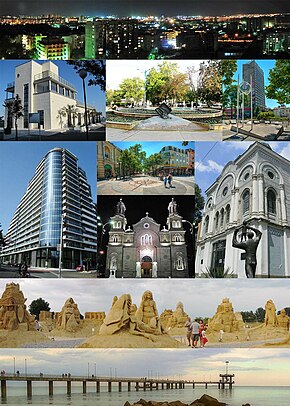 | |||||
| A country |  Bulgaria Bulgaria | ||||
| Region | Southeastern | ||||
| Region | Burgas region | ||||
| Community | Burgas | ||||
| Kmet | Dimiter Nikolov | ||||
| History and geography | |||||
| Former names | Pyrgos | ||||
| Square | 253.6 km² | ||||
| Center height | 30 m | ||||
| Timezone | UTC + 2 , in the summer UTC + 3 | ||||
| Population | |||||
| Population | 211,752 people ( 2016 ) | ||||
| Katoykonim | borgassets, burgas [1] | ||||
| Digital identifiers | |||||
| Telephone code | (+359) 56 | ||||
| Postcode | 8,000 | ||||
| Car code | BUT | ||||
| burgas.bg/ru/index/index | |||||


As of March 15, 2016, the population of the city was 211,752 people [3] .
Content
Geographical position
Bourgas is located on the western shore of the Bourgas Bay of the Black Sea , in the easternmost point of the Bourgas lowland . The city is surrounded by the Burgas , Atanasov lakes and the Mandra lake to the west, southwest and northeast. The city is located at a distance of 385 km from Sofia, 267 km from Plovdiv and 133 km from Varna.
History
The predecessor of the modern city is the city of Pirgos ( Greek Πυργος "tower"), founded by the Greeks from the south of Apollonia (modern Sozopol ).
The city of Burgas was founded in the XVII century on the site of a fishing village, located on the site of the Greek colony Pyrgos [4] .
During the Russian-Turkish war of 1828–1829 in July 1829, Burgas was taken by Russian troops [5] [6] . On July 12, 1829, the 1st Brigade of the 1st Uhlan Division ( St. Petersburg and Kharkov Uhlan regiments commanded by Major General A. A. Nabel ) went to Burgas. The Turkish garrison left the city, but was overturned by the Russian lancers, lost two guns and withdrew to the city. Two Ulan regiments broke into Burgas after the retreating enemy, captured 10 guns, a lot of property and food. On December 6, 1829, General A. A. Nabel for the capture of Burgas received the Order of Saint George of the 3rd degree.
During the Russian-Turkish war of 1877-1878. in February 1878, a detachment of Russian troops under the command of Colonel A. M. Lermontov [7] occupied the city without a fight [5] . After the end of the war in 1878, the development of the city began, which became more active after the completion of the construction of the railway from Burgas to Sofia in 1890 [4] [7] .
In 1890, there were 5,000 people in the city (Bulgarians, Greeks and Turks), there were customs and sanitary administration, two mosques, an Orthodox Greek church, an Armenian church and a Roman Catholic church. Trade was mainly concentrated in the hands of the Greeks. The main export goods were wool, butter, cheese [6] .
In 1903 [7] —1904, the French firm Batignol carried out work to improve the harbor and the construction of the port , which contributed to the further development of the city [4] . In the 1900s, industrial enterprises for the processing of agricultural raw materials (flour milling, butter, sugar production) arose in the city [7] . Soon, 18 foreign firms operated in Burgas.
By 1910, the population of Burgas was about 9 thousand people [5] .
After the end of the First World War, the value of Burgas increased, in the 1920s it became the main export port for southern and middle Bulgaria. In 1926, the population of the city was 31 thousand people, there were several industrial enterprises and one of the largest steam mills in Bulgaria [8] .
During the civil war in Russia in 1918-1920, Burgas, along with Varna, was one of the main points through which Russian émigrés arrived in Bulgaria, and a Russian community emerged in the city. In 1920, a Russian kindergarten began operating in Burgas, in 1932 - an elementary school, in 1934 - a boarding school for children over five years old.
On August 28, 1932, the Burgas Cossack village was founded in the city (in 1938, the ataman was Lt.-General P. I. Grekov), on March 8, 1936, the Cossack cultural and educational charitable society named after Yermak . On October 24, 1937, a monument to the Russian emigrants who died in Burgas was solemnly consecrated at the city cemetery (after 1960, the fate of the monument is unknown).
In the Burgas Cathedral of Saints Cyril and Methodius, Russian priest Leonid Trailin served, and the Russian choir sang (later known as the choir of the Don Cossacks by Sergey Zharov ). In 1939, the Russian public of Burgas presented to the cathedral the icons “The Most Holy Theotokos Kasperovskaya” and “The Mother of God Protector”, which remain in the cathedral to this day.
In 1924, a stationery factory began operating in the city [7] .
In the middle of May 1940, in the territory of Bulgaria, under the guise of “meteorological stations” , three Abwehr radio interception centers were opened, which were under the operational control of the “Delius Bureau”. One of the radio interception centers was opened in Burgas [9] . Also in 1940, the Germans began re-equipping the port of Burgas to accommodate the crigsmarine warships [10] . On March 1, 1941 , documents were signed in Vienna on the accession of Bulgaria to the Rome-Berlin-Tokyo Pact , according to which Bulgaria allowed the deployment of German military units on the territory of Bulgaria. On March 2, 1941, German troops were introduced into Bulgaria [11] . Later, until September 1944, the ships of the German Navy were based in Burgas. In September 1944, a landing force of the Black Sea Fleet of the USSR was landed to capture the German ships in the port, which met no resistance from the Bulgarian armed forces in connection with the transfer of Bulgaria to the side of the Anti-Hitler Coalition [12] .
In 1945, an art gallery was opened [7] .
In 1947, on the basis of small workshops for the production of electrical products , the cable plant Vasil Kolarov was built [13] .
In 1948, eight small fish canneries of Burgas were nationalized and merged into the state enterprise Slavyanka, which received new equipment (due to the mechanization of production processes, the annual production volumes increased three times by 1954 compared to 1944, in addition to canned fish mastered the production of canned meat, jam and compotes ). Slavyanka was the first enterprise in the canning industry in Bulgaria with a continuous (non-seasonal) work cycle [14] [15] .
In the 1950-1970s, the city quickly developed as an industrial center and resort [7] .
In 1963, a refinery built with the help of the USSR was put into operation, in 1974 a ship repair yard was built [7] .
In 1976, the village Meden mine was included in the city and a residential neighborhood "Meden mine" was built here.
Since 1998, the International Theater Festival "On the Shore" has been held in Burgas [7] .
In 2000, the city hosted the Rock Exploziya festival, where the Bulgarian band BTR won the first place . ".
Demographics
| Year | Population |
|---|---|
| 1986 | 182 570 [4] |
| 1992 | 195 686 |
| 1997 | 198 400 [16] |
| 2006 | 196,500 [7] |
| 2013 | 206 371 |
Climate
Due to the fact that the warmest part of the Black Sea water area is located in its southeastern part, and the Black Sea coast is moving counterclockwise, in winter the warm air masses take off over the sea from south and southeast to northeast. As a result, the flow of cold water from the bays adjacent to the plains of the Odessa and Kherson regions of Ukraine is brought to the Black Sea coast of Bulgaria. As a result, the climate in more southern Burgas turns out to be colder than in Anapa , located though much further north in latitude, but in the warmer part of the Black Sea.
| Climate Burgas | |||||||||||||
|---|---|---|---|---|---|---|---|---|---|---|---|---|---|
| Indicator | Jan. | Feb | March | Apr | May | June | July | Aug | Sen | Oct. | Nov. | Dec | Year |
| Average maximum, ° C | five | 7.3 | 10.4 | 15.7 | 20.9 | 25.3 | 28.2 | 28 | 24.2 | 19.2 | 13.3 | 7.9 | 17.1 |
| Average temperature, ° C | 1.8 | 3.4 | 6.0 | 10.8 | sixteen | 20.4 | 23.1 | 23 | 19.4 | 14.6 | 9.6 | 3.3 | 12.7 |
| Average minimum, ° C | −1,3 | −0,3 | 2.3 | 7 | 12.2 | 16,1 | 18.2 | 18.3 | 14.8 | 10.5 | 6.3 | 1.5 | 8,8 |
| Precipitation rate, mm | 44 | 37 | 48 | 70 | 50 | 62 | 48 | 28 | 46 | 52 | 68 | 45 | 598 |
| Water temperature, ° C | 6.4 | 5.1 | 7.2 | 12.2 | 18.1 | 24.0 | 26.3 | 27.2 | 23.8 | 18.7 | 13.9 | 10.2 | 16,1 |
| Source: www.strigmeteo.com | |||||||||||||
Policy
Kmet ( Mayor ) of the community of Burgas - Dimitar Nikolov ( Citizens for the European Development of Bulgaria , GERB) according to the results of the elections of 2007, 2011 and 2015.
Economy
Built in the 1960s , the Burgas Petrochemical Plant is the largest industrial complex in Southeast Europe. On March 15, 2007 in Athens, an agreement was signed between the governments of Russia, Greece and Bulgaria on the construction of the Novorossiysk -Burgas- Alexandroupolis oil pipeline .
There are also enterprises in the food, textile, and machine-building industries. Fishing is developed. In the Burgas region there is a resort zone ( Sunny Beach , Nessebar ), a balneo-mud resort “Bourgas mineral baths”.
Transportation
An important transportation hub in the country is a railway junction, a bus station, a seaport, a marina, an international airport .
Urban public transport consists of twenty-six bus and two trolleybus lines served by Burgasbus. Other lines in the city are served by "Comfort". There are two bus stations in Bourgasbus in the city (bus station to the west of the railway station Vladimir Pavlov and bus station south of the central railway station Burgas).
Ten kilometers northeast of the city center is Bourgas Airport .
In the western part of the Black Sea coast, in the eponymous bay, the port of Burgas is located. The port has a total of twenty berths with a maximum draft of 12.3 meters.
Built in 1903 , the central railway station in Burgas was one of the first railway stations in Bulgaria. The building is declared a monument of architecture.
City Attractions
The center of Burgas is very interesting in architectural terms. It has preserved many Art Nouveau apartment buildings erected at the beginning of the 20th century, and functionalism houses built in the 1930s.
Seaside Park
One of the most famous sights of the city is the Seaside Park created in 1910 . The park, with a total area of 60 hectares, is bordered on the east by the beach, on the south by the port of Bourgas. It is considered one of the most beautiful parks in Bulgaria, in which plants grow from all continents; Here you can see trees such as sycamore , linden , elm , birch , albition , Lebanese cedar , cypress , cryptomeria [17] . The old part of the Primorsky Park is declared a monument of park art [1] . On its territory there are sculptural monuments to many famous personalities, including the monument to Alexander Pushkin opened in 1952 and the monument to Adam Mitskevich , opened in 1949 . Among the recently discovered monuments is the statue of George Kaloyanchev, a famous theater and cinema actor, established in 2015 near the Summer Theater. Famous stage and musical groups and soloists perform at the Summer Theater. Various festivals are held here, including the International Folklore Festival, the National Song Contest “Burgas and the Sea”, the opera festival “The Burgas Musical Festivals named after Emil Chakyrov ”, etc. [19]
Museums
The Archaeological Museum is located in the very center of the city (Bogoridi St., 21), the exposition of which acquaints visitors with the findings relating to ancient Thrace , Greek and Roman colonies. The historical museum represents the political, cultural and economic history of the city from ancient times to the present day. The exposition of the Museum of Natural Science (30 Fotinov Street) is devoted to the history and modern state of nature in Southeast Bulgaria. An interesting collection of the Ethnographic Museum (st. Slavyansk, 69), where you can see samples of the costume of various ethnographic groups in the region and get acquainted with the original local customs (including Nestinarity ).
Temples
In Burgas, there are temples of various religious denominations. One of the symbols of the city is the Cathedral of Saints Cyril and Methodius , built in the neoclassical style , built in 1897-1907 according to the plan of the Italian architect Ricardo Toscani. The windows above the portal are made in modern style [20] . Among other Orthodox churches is the Church of the Most Holy Mother of God built in 1840-1860 (Lermontov st. 5). In addition, on the same street (13) stands the Armenian church “Surb Khach” (“Holy Cross”), built in the 17th century and rebuilt several times. In 1878 , major general A.M. attended the solemn liturgy dedicated to the liberation of Bulgaria in the temple . Lermontov [21] . There is also a Catholic church of the Virgin Mary (St. Tsar Peter, d. 5).
Education and culture
There are two universities in the city: the private one, founded in 1991 by the Free University of Burgas [22] and the only state university in South-East Bulgaria - the University “Prof. Dr. Asen Zlatarov (established in 1963 ). Since 1888 , the largest P. Yavorov Library in this region has been operating, in 1988 it received the status of scientific. There are several theaters in the city: the Drama Theater named after Adriana Budevskaya (since 1912 , the artist’s name was given in 1953 ), the State Puppet Theater, the State Opera Theater, the Philharmonic Society [7] , the Art-Atelier Theater. Cultural events are also organized in the Sea Casino located on the territory of the Seaside Park. From 2016 , the International Film Festival (BIFF) is held here, where films from the Black Sea countries ( Bulgaria , Romania , Moldova , Ukraine , Russia , Georgia , Armenia , Greece , Turkey ) are presented [23] .
Twin Cities
- Alexandroupoli , Greece
- Batumi , Georgia
- Bratislava , Slovakia
- Gomel , Belarus
- Gdansk , Poland
- Krasnodar , Russia
- Orenburg , Russia
- Poti , Georgia
- Rotterdam , the Netherlands
- Yantai , China
- Yaroslavl , Russia [24]
In titles
In honor of the capture of Burgas by Russian troops in 1829, the 60-gun frigate of the Russian fleet was named. " Burgas ", which became part of the Black Sea Fleet in November 1832, participated in the Caucasus campaign and in 1842 was converted into a bloody unit .
Notes
- ↑ Gorodetskaya I.L., Levashov E.A. Burgas // Russian names of residents: Dictionary reference book. - M .: AST , 2003. - p. 59. - 363 p. - 5000 copies - ISBN 5-17-016914-0 .
- ↑ F.L. Ageenko. Dictionary of own names of the Russian language . - M .: Peace and Education, 2010.
- ↑ Official population statistics, information is updated 6 times a year, as of March 15, 2016
- 2 1 2 3 4 Burgas // The New Encyclopedia Britannica. 15th edition. Macropaedia. - Chicago, 1994. - Vol. 2. - P. 644.
- ↑ 1 2 3 Burgas // Military Encyclopedia : [in 18 t.] / Ed. VF Novitsky [et al.]. - SPb. ; [ M. ]: Type. t-islands I. D. Sytin , 1911-1915.
- ↑ 1 2 Burgas // Encyclopedic dictionary of Brockhaus and Efron : in 86 tons (82 tons and 4 extra). - SPb. , 1891. - T. V. - p. 13.
- ↑ 1 2 3 4 5 6 7 8 9 10 11 Burgas / E. V. Aigina // Greater Caucasus - the Grand Channel. - M .: The Great Russian Encyclopedia, 2006. - p. 354-355. - (The Great Russian Encyclopedia : [in 35 t.] / Ch. Ed. Yu. S. Osipov ; 2004–2017, Vol. 4). - ISBN 5-85270-333-8 .
- ↑ Burgas // Great Soviet Encyclopedia : in 66 t. (65 t. And 1 add.) / Ch. ed. O. Yu. Schmidt . - M .: Soviet Encyclopedia , 1927. - T. VIII. - pp. 135-136.
- ↑ G. D. Gochev. The bureau of Dr. Delius. - M .: Politizdat, 1970. - p. 19.
- ↑ The History of the Second World War 1939-1945 (in 12 volumes) / redkloll., Ch. ed. A. A. Grechko . - M .: Military Publishing, 1974. - T. 3. - p. 326.
- ↑ The New Encyclopedia Britannica. 15th edition. Macropaedia. - Chicago, 1994. - Vol. 29. - P. 995.
- ↑ N. G. Kuznetsov. The course to victory. - M .: Military Publishing, 1987. - P. 394—396.
- ↑ K. Lazarov. Economic development of the People’s Republic of Bulgaria. - M .: Publishing House of Foreign Literature, 1963. - P. 39-40.
- ↑ Paulina Stancheva. Fish canning industry // “Bulgaria”: magazine. - 1955. - № 4 . - pp . 26-27 .
- Official site of fish cannery “Slavyanka AD”
- ↑ Burgas // Brockhaus. Die Enzyklopädie in 24 Bänden. 20., überarb. und akyualisierte Ausfl. - Bd.4 - Leipzig, Mannheim: Brockhaus, 1997. p.173
- ↑ Morskata gradina. Bourgas Flora
- ↑ In Burgas otkryvat skulptura on golemia bulgar actor Georgi Kaloyanchev
- ↑ Everything about Burgas in one place: the official tourist guide for Burgas.
- ↑ I.V. Timofeev. Bulgaria. Orange guide. - M.: Eksmo, 2012. - p. 132.
- ↑ Armenska carrot
- ↑ Bourgaska University is free
- ↑ Burgas International Film Festival
- ↑ Portal of municipalities of the city of Yaroslavl. News. On the City Day an agreement was signed on the establishment of partnership relations between Yaroslavl and the Bulgarian city of Burgas . The appeal date is May 30, 2016.
Links
- Burgas website
- Population statistics
- Burgas - the green pearl of the Black Sea // “Bulgaria”, № 1, 2012.
- Russian-speaking Burgas