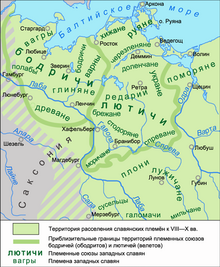
Wends ( German: Wenden ), also Winds and they are Vendes - the medieval German collective name of all Slavs neighboring Germans [1] (mainly those who did not have their own state). To date, the name has been fixed to all the Slavic Slavs and, in a narrower sense, to the Lusatian Serbs and Kashubians . Historically, the Slavic Slavs formed three tribal unions: the Luzhichans (Sorbians) in the south, the Lutichs (Wilts, Velets) in the central regions, and the Bodrichs (encouraged, regres) in the northwest [2] [3] .
Wends
The German word “Venda” dates back to Wends, or Eastern Venets ( lat. Venedi, Venethae, Venethi ; Greek. Ούενέδοι ) - a tribal group known from the 1st to the 6th century. and mentioned by ancient historians Herodotus , Pomponius Mela , Pliny the Elder , Tacitus , Claudius Ptolemy , Jordan . Antique authors localized the Wends east of the Vistula - from the Baltic coast to the Carpathians and the lower Danube . Based on these sources, many researchers consider the Wends to be the immediate ancestors of the ancient Slavs of the VI – VIII centuries [4] [5] . Hypotheses about the connection of eastern venets with even more ancient southern, or Adriatic, venets , as well as with Celtic western venets or with German vendels (vandals) , remain debatable.
Wend History
In the chronicles of Fredegar, the Slavic population of the Samo state , which separated in 623 from the Avar Kaganate , is called the Wends. In 630, the Vendians robbed the Frankish merchants passing through their territory, which caused the punitive raid of Dagobert I. In response, the Vendians devastated Thuringia [6] .
An attempt to conquer the Wends, namely the Sorbians (Lusatian Serbs) , was made by Charlemagne , but the army he sent was destroyed by the Saxons . Thus, the beginning of the onslaught of German feudal lords against the Slavs, known as Drang nach Osten - “Onslaught to the East” was laid. In the 9th century, part of the land of the Vendian-Sorbians became part of Great Moravia for a short time.
Vendian raids on German territories occurred until the time when Emperor Henry I of Ptitselov did not launch a large-scale attack on the Vendian Slavic tribes, turning them into his tributaries. The Wends subjugated by the Germans, however, continued to resist and repeatedly revolted - some, as in 983, had temporary success, but most were suppressed by the conquerors.
From the 1040s until about 1129 there was an early feudal Vendian Empire (Principality of Obodrite), uniting tribal unions of encouraged , Lutich and some Pomeranians to repel the aggression of the Saxons and Danes [7] . In the 1050s, his prince Gotshalk actively pursued an aggressive policy in the neighboring lands of the Slavs: part of the Lutichs and the Clans were taxed. Under him, new cities, churches and monasteries were built. At the request of the prince, bishops were appointed to Mecklenburg , Oldenburg, and Ratzeburg. In 1066, the nobility led the movement against the prince’s Christian circle: Gottschalk was killed, and missionaries and converts were expelled or executed.
The youngest son of Gottschalk, Henry at the turn of the XI-XII centuries, strengthened the state. He was paid tribute to Brizan and Stodoran . Henry moved with his family from Mecklenburg to Old Lübeck, which already under Henry turned into an early city center with settlements of merchants and artisans. The new capital became the residence for Christian priests. After the death of Henry, feuds began. From the end of the 12th century, the Rostock, Mecklenburg and other principalities, which were ruled by the descendants of the Obodrit prince, were developing on the basis of the Obodrit principality, depending on the Saxon duke. In the XIII century, these principalities underwent Germanization [8] .
In 1068/1069, German knights destroy the Vendian Sanctuary of Retra . The religious center of the pagan Vendians moves to the city of Arkon - the capital of the Ruyan tribe, which was part of the union of encourages , which for a long time, before King Waldemar I, paid tribute to Denmark . But a century later, in 1168, King Waldemar I the Great and Bishop Absalon eventually destroyed Arkona, overthrowing the idol of the god Svyatovit .
In 1147, the Vendian Crusade ( Wendenkreuzzug ) took place, in which the 150,000th German-Polish army led by Heinrich Leo took part. The collection point of the troops of the Saxon princes with the participation of Polish and Danish feudal lords became Magdeburg . The first victim of the Crusaders was the Vendian Malchow and Haflenberg, where pagan shrines were ravaged, then Dymin and Szczecin [9] . Having conquered the pagan Slavic tribes of encouraged and Lutich , the crusaders forced them to accept Christianity ; the mass extermination of the Slavic population facilitated the processes of assimilation and colonization by German settlers.
The title of the Danish monarchs included the words “king of the Wends and Goths”, and the Swedish from 1540 to 1973 - “the hereditary king of the Swedes, Goths and Wends” ( Swedish. Svears, Götes och Wendes Konung ; in the Latin version, which is remarkable - vandals, lat. Suecorum, Gothorum, Vandalorum Rex ).
Vend Name
Among the Franks , all the Slavic Slavs were called so. Throughout the Middle Ages, the Germans generically called the Wends all neighboring Slavic peoples (except, probably, Czechs and Poles ): Luzhich , Lyutich , encouraged , Pomeranians , Kashubians , Silesians and Slovenes .
In Danish annals under the name of "Vendian" the Slavic Slavs usually appear, and the Pomeranians , in particular the Rouge , with whom the Danish King Waldemar I the Great waged war.
In Germany, this name is preserved in use to this day. Currently, the Germans call Vendians the Luzhichans, descendants of the indigenous Slavic population of Germany, and sometimes the Kashubians , the descendants of the Pomeranians.
A large number of words with the root -wend- were found in the lands of the east of Germany : Wendhaus , Wendberg , Wendgraben (grave), Wardenheim (homeland), Windischland (land of Wends), etc.
In the high and late Middle Ages, the word "Wend" often served as the name of the inhabitants of the German states of Zaelbya of Slavic origin.
For more information about the history of the Wends, see the article Slavic Slavs , Luga Serbs , Kashubians
Toponyms
- Wendeburg ( city of Wends )
- Wendorf ( Wendian village ) is a city in German Pomerania.
- Wendorf ( Wendian village ) is a city in German Saxony.
Gallery
Image of Wends in the Saxon Mirror (XIV c.)
Vendian ( Sorbian ) wedding in Spreewald (1931)
Sorbian peasant woman in national furniture (1948)
See also
- Venets
- Vandals (people)
- Wends (Livonia)
- Vendian Power
- Ruyan
- Pomeranians
- Lyutichi
- Luzhichans
- Encouraged
- Princes of Encouragement
- History of Luzhans
- Ryusen culture
- Praise
- Crusade against the Slavs
- Vineta
Notes
- ↑ Online Enzyklopädie
- ↑ Annalista Saxo . - Monumenta Germaniae Historica . SS. - Hannover: Impensis Bibliopolii Avlici Hahniani, 1844 .-- T. VI. - P. 609. - 842 p.
- ↑ Saxon Annalist. Years 745-1039 . Eastern literature . Archived on May 2, 2012.
- ↑ Braichevsky M. Yu. Veneda // Soviet Historical Encyclopedia . - M.: Soviet Encyclopedia , 1963. - T. 3. - Stb. 320.
- ↑ Venedas // Great Soviet Encyclopedia : [in 30 vol.] / Ch. ed. A.M. Prokhorov . - 3rd ed. - M .: Soviet Encyclopedia, 1969-1978.
- ↑ Fredegar. Chronicle Publication on the portal "Eastern Literature"
- ↑ See the article “Vendian Power” in: Ed. Zhukova, E. M. The Soviet Historical Encyclopedia. - M .: Soviet Encyclopedia, 1973-1982.
- ↑ Ronin, V.K. et al. State and society among the Slav and Pomeranian Slavs // Early feudal states and nationalities (southern and western Slavs of the VI — XII centuries) . - M .: Nauka, 1991 .-- S. 123-125.
- ↑ Das Haus Biegon . Biegon (2009).
Literature
- Adam of Bremen , Helmold from Bosau , Arnold of Lubeck . Slavic chronicles / Per. with lat. I.V.Dyakonova, L.V. Razumovskaya. - M .: SPSL; Russian panorama, 2011 .-- 584 p. - (MEDIÆVALIA: medieval literary monuments and sources). - ISBN 978-5-93165-201-6 .
- Hilferding A.F. History of the Baltic Slavs. - M .: Russian panorama, Russian-Baltic Information Center "BLITZ", 2013. - 704 p. - (Returned Heritage: Monuments of Historical Thought). - ISBN 978-5-93165-227-6 .
- Pavinsky A.I. Polaba Slavs in the fight against the Germans. VIII-XII centuries - M.: Book House LIBROCOM, 2015 .-- 178 p. - (Academy of Basic Research: History). - ISBN978-5-397-04989-4 (Original publication: St. Petersburg, 1871).
- Uspensky F. I. The First Slavic Monarchies in the Northwest . - SPb .: Publishing house of Glories. beneficent. committee, 1872. - 266; XIII p.
- Herrmann Joachim . Encouraged, lyutichi, ruddy / Per. with him. G. S. Lebedeva // Slavs and Scandinavians: Sat. / Ed. E. A. Melnikova . - M .: Progress, 1986. - S. 338-359.
- Shore T.W. Chapter VI. Rugi, Wends and native Slavic settlers // Origin of the Anglo-Saxon Race: A Study of the Settlement of England and the Tribal Origin of the Old English People . - London, 1906. - S. 84-102.