The Romanian national opera house in Cluj-Napoca ( rum. Opera Naţională Română Cluj-Napoca ) is a state-owned opera and ballet company, founded in 1919. It is housed in a building, together with the National Theater named after Lucian Blaga .
| Romanian National Opera House | |
|---|---|
| room. Opera Naţională Română | |
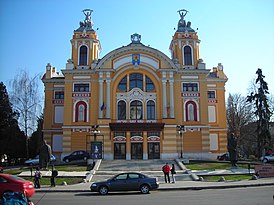 Facade of the building in 2007 | |
| Theater Type | musical |
| Based | 1919 year |
| Genres | opera , ballet |
| Theater building | |
| Location |  Romania , Cluj-Napoca Romania , Cluj-Napoca |
| Address | Yanku Avram Square, 2 |
| Architectural style | baroque , art nouveau |
| Architect | Ferdinand Fellner , Hermann Helmer |
| Building | 1904 - 1906 |
| Capacity | 928 places |
| Status | architectural monument |
| Site | operacluj.ro |
History
The building of the Baroque opera house with art nouveau elements in the design was built in 1904-1906 according to the project of Austrian architects Ferdinand Fellner and Hermann Gelmer . At that time, the city of Cluj-Napoca was part of the Kingdom of Hungary , which was part of Austria-Hungary . On September 8, 1906, the debut production of the Hungarian National Theater by Ferenc Herceg 's play “Exiles” took place on its stage. In 1919, the city of Cluj-Napoca was incorporated into the Kingdom of Romania .
The official opening of the Romanian National Theater in the former building of the Hungarian National Theater took place on September 18, 1919. At the same time, the National Theater named after Lucian Blaga and the George Dim Music Academy were opened in the city. On May 13 and 14, 1920, a Romanian theater orchestra made its debut on stage, giving two symphony concerts. The orchestra was conducted by Czech musician and composer Oscar Nebdal .
The opera company debuted on May 25, 1920 with the production of the opera Aida by composer Giuseppe Verdi. The orchestra was conducted by Alfred Novak. The performance was staged by Konstantin Pavel, the tenor and the first director of the theater. From the very beginning, the Italian conductor Ejisto Tango , the Romanian composer Bredicianu, the baritone Dimitrie Popovisi-Bayreuth, collaborated with the troupe.
In a short period of time, the company managed to significantly expand its theater repertoire. In 1919-1921, ninety-nine premieres took place in the theater, including operas by Verdi , Guno , Puccini , , Mascagni , Wagner , and fifteen symphonic concerts were also given.
In 1940, after the Second Vienna Arbitration , the theater, like other Romanian institutions, was transferred to the Romanian part of divided Transylvania . The troupe moved to the city of Timisoara and became known as the Romanian National Opera House from Cluj-Napoca in Timisoara. In December 1945, at the end of World War II , when Cluj-Napoca became part of Romania again, the theater returned to the city and resumed its activities. During its existence, the troupe of the Romanian National Theater has staged over two hundred musical works by foreign and more than forty Romanian composers. The theater hosted the premieres of the operas by George Enescu and The Master of Manole by .
Links
- Opera Națională Română Cluj . www.cluj.com. - Cluj - Ghid Local. Date of appeal May 15, 2018. (rum.)