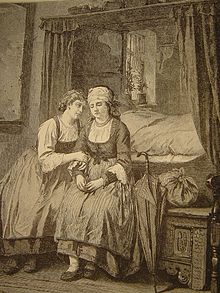
Consolation is a term that refers to the psychological support given to someone who has suffered a grievous, traumatic loss, such as the death of a loved one. It usually turns out to be a manifest regret for this loss and emphasis on the hope of positive events in the future. Consolation is an important topic present in history , art , philosophy and psychology .
In medicine, comfort is simplistically described as follows:
Before basic medicine offers those who suffer, diagnoses, medications and surgeries, and after that, it should offer comfort. Consolation is a gift. Consolation warms when loss is already occurring or inevitable. This support can make a person’s loss more bearable, prompting him to accept that he has to live a life that includes suffering as well. Thus, consolation implies a transitional period: preparation for the time when existing suffering will subside. Consolation attunes to such a change. [one]
In some contexts, especially in religious terminology, consolation is described as contrasting or opposing a feeling of “devastation,” or total defeat. [2]
Content
Concept History
The desire to console others is an expression of empathy , and in primates it manifests itself instinctively . The Dutch primatologist Frans de Waal observed acts of comfort occurring among non-human primates such as chimpanzees . [3] A formal concept of comfort as a social practice has existed since ancient times. For example, the study of letters from ancient Rome indicates such a culture:
Comforting the mourners was an important duty. Both the person who offered solace and the grieving one had to behave in a certain way and say certain things, and the comforter should provide support both emotionally and practically. [four]
Although “death was the most common reason for comfort,” ancient comforting literature also addressed other reasons for comfort, including “exile, poverty, political failure, illness, shipwreck, and old age.” [5] Papyrus letters of this era “often use such standard consolation, like "everyone is subject to death," as well as frequent mention of sending products. " [4] It is noted that food could be offered as additional comfort to the mourners, or may have had a religious purpose. [4] It is reported that in the 5th century BC, the sophist Antiphon from Ramnut set up a booth on the popular agora , where he offered comfort to the mourners. [5] In addition, “consolation visits in antiquity also extended to the level of the people,” including the visits of philosophers who intended to encourage the villages that faced the invasion. [6]
In both Ancient Greece and Ancient Rome, Consolation or comforting speech was a type of ceremonial speech , used, as a rule, to support the mourners at the funeral with words . This has become one of the most popular topics in classical rhetoric . [7] [8] The Platonic philosopher Crantor of Salt (325-275 BC), a member of the Platonic Academy , was the first to write works on this particular tradition. Despite the fact that only fragments of these works were preserved, its influence was noted in the writings of later writers, in particular in the Tusculan Conversations by Cicero and the Consolation of Apollonius by Plutarch . [9] Seneca the Younger (4 BC - 65) created the most recognizable examples of the genre of consolation in his three consolations : “To Marcius”, “To Polybius” and “To Helvia”. The most recognizable example of the genre of consolation in poetic form was written by pseudo-Ovid, " Consolation to Libya ." [10] The works of Plutarch include three works built in the tradition of the consolation genre: De exilio , Consolatio ad uxorem , Consolatio ad Apollonium . [ten]
Historically and philosophically, comfort plays an important symbolic role in the work of the sixth century, Consolation from Philosophy . Its author, Boethius , describes himself as comforted by the “Lady Philosophy” ( personification of philosophy ), having been sentenced to death for his alleged crimes against the state. [11] After being captured, Boethius consoles himself from the pangs of knowledge that a decree has been issued on his death, thereby philosophizing.
Religious figures are often portrayed as comforting to their followers during grief. For example, in the Mahabharata, the Hindu avatar Krishna comforts his brother Balarama and Princess Satya Bamu after being humiliated for their pride. [12] It is better known in the Bhagavad Gita , when Arjuna found out that Krishna was dying from trauma, Krishna comforted him with touching philosophy. [13] In Christianity, one of the iconic Standings of the Cross is sometimes called "Jesus comforting the daughters of Jerusalem." [14] There is a fair amount of Christian literature designed to give comfort to the followers of their faith because of the various adversities that befall them in life. One of the branches of Christianity, the Cathars , practiced the sacrament en: consolamentum , which required consolation due to the inevitable regret of life in order to move closer to God or closer to heaven. [15]
In art
Consolation is also a classic theme in art. [16] For example, the poetic form of elegy is described as “a verbal representation or staging of emotions in which an individual speaker draws an audience in order to achieve some form of intimate comfort”. [16] Examples of literary devices that can be used to express solace include prosopope , in which the author or speaker can express a representation of the current thoughts or opinions of a deceased person. [16]
In competitions
In some types of competitions, losers will receive some kind of reward or approval as consolation for their loss. It can be in the form of a consolation prize awarded to a runner-up participant or a comforting match in a sports tournament in which the two best teams compete for first and second places and the other two teams compete for a third-place prize.
An example of this happens in the Illiad , where Homer writes about the case when Achilles judges the rivalry held among the Greeks during the funeral of Patroclus . During the chariot race, Eumel, who was known as the great chariot rider, suffers a fall due to which he comes last. Achilles expresses a desire to give Eumel an award for second place in recognition of the merit of the losing member as a charioter. This aspiration to present a consolation prize will be hindered by the participant who has truly taken the second place, Antilochus , who successfully protests that the award should go to the participant whose performance meets the requirements for receiving the prize. [17]
See also
- Support
- Woe (emotion)
- Regret
- Mourning
- Jubatu
Notes
- ↑ Arthur W. Frank, The Renewal of Generosity: Illness, Medicine, and How to Live (2009), p. 2.
- ↑ David A. Leeming, Kathryn Madden, Stanton Marlan, Encyclopedia of Psychology and Religion (2010), p. 240.
- ↑ Frans de Waal, The Age of Empathy: Nature's Lessons for a Kinder Society (2009), p. 194.
- ↑ 1 2 3 Valerie M. Hope, Death in Ancient Rome: A Sourcebook (2007), p. 200-201.
- ↑ 1 2 Michael Gagarin, The Oxford Encyclopedia of Ancient Greece and Rome , Volume 1 (2010), p. 281.
- ↑ Abraham Smith, Comfort One Another: Reconstructing the Rhetoric and Audience of 1 Thessalonians (1995), p. 48.
- ↑ Ernst Robert Curtius , European Literature and the Latin Middle Ages , trans. WR Trask (Princeton: 1953) section 5.1 Topics of Consolatory Oratory pp. 80-2
- ↑ Petrie, Graham (1970) " A Rhetorical Topic in 'Tristram Shandy'" , Modern Language Review , Vol. 65, No. 2, April 1970, p. 262
- ↑ Baltussen, Han. “Personal grief and public mourning in Plutarch's consolation to his wife,” American Journal of Philology 130 (2009): 67-67. July-Aug. 2009.: "Introduction: Beginnings of consolation."
- ↑ 1 2 Scourfield, JHD Consoling Heliodorus: a commentary on Jerome , Letter 60. Np: Oxford UP, 1993. Google Books. Web July 19, 2009. pp. 15-22
- ↑ John Marenbon, The Cambridge Companion to Boethius (2009), p. 308.
- ↑ M. Padmanabhan, Meera Ravi Shankar, Tales of Krishna from Mahabharatha (2004), p. 46.
- ↑ Hullasa Behera, 50 Flowers From Bhagavad Gita (1998), p. 17.
- ↑ Ján Majerník, Joseph Ponessa, Laurie Watson Manhardt, The Synoptics: On the Gospels of Matthew, Mark, Luke (2005), p. 188.
- ↑ Emmanuel Le Roy Ladurie. Montaillou: The Promised Land of Error. - Random House / editions Gilmard, 1975.
- ↑ 1 2 3 Karen E. Smythe, Figuring Grief: Gallant, Munro, and the Poetics of Elegy (1992).
- ↑ David Potter, The Victor's Crown: A History of Ancient Sport from Homer to Byzantium (2011), p. 28-29.
Links
- Consolation , Encyclopædia Britannica (11th ed.), 1911