African lenses [1] ( lat. Poiana ) - a genus of mammals from the family civeros . The genus is common in West and Central Africa. The generic name comes from Fernando Póo, the old name of the island of Bioko , where the first known specimen was mined.
| African lenses |
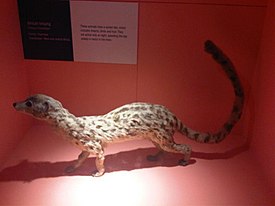
African leansang |
| Scientific classification |
|---|
| No rank : | Bilateral symmetrical |
|
| International scientific name |
|---|
Poiana Gray , 1864 |
|
Content
The average length of the head and body is 384 mm, the average length of the tail: 365 mm. The overall color of the body, from light brownish gray to rusty yellow. The fur is covered with spots and stripes, the color of which is from dark brown to black. Some individuals have alternately wide and narrow black stripes on the tail, while other individuals have only wide stripes. This genus differs from the Asian lens lenses ( Prionodon ) in that the spots are smaller and do not show a tendency to merge into groups or stripes, with the exception of the areas of the head and shoulders. They also differ from them, and resemble a gene ( Genetta ), in that it has narrow lines of bare skin on the soles of the hind legs [2] .
Lead a nocturnal lifestyle. They build a rounded nest from plant materials, in which several individuals sleep for several days, and then move to a new place and build a new nest. The nests are located at least two meters above the ground, although usually higher. Food consists of cola nuts, other plant foods, insects and young birds. A female can bring two broods a year, two to three cubs. One African Linsang lived in captivity for 5 years and 4 months [2] .
- Poiana leightoni
- Poiana richardsonii - African Lensang
- ↑ Sokolov V.E. The pagan dictionary of animal names. Mammals Latin, Russian, English, German, French. / edited by Acad. V. E. Sokolova. - M .: Rus. lang., 1984. - S. 102-107. - 10,000 copies.
- ↑ 1 2 Ronald M. Nowak Walker's carnivores of the world - JHU Press, 2005, p. 191
