Baryancistrus (lat.) Is a genus of ray-finned fish from the chain-mail catfish family that lives in South America . The scientific name comes from the Greek. barys - “heavy”, Greek. agkistron - "hook".
| Baryancistrus |
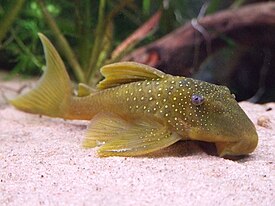
Baryancistrus demantoides |
| Scientific classification |
|---|
| No rank : | Bilateral symmetrical |
|
| International scientific name |
|---|
Baryancistrus Rapp Py-Daniel, 1989 |
|
The total length of representatives of this genus ranges from 8.1 to 22.4 cm. In appearance, similar to representatives of the genus Hemiancistrus . Head moderately large, muzzle slightly elongated. On the sides there are large odontodes (leather teeth). The eyes are medium sized. The mouth is large, the upper jaw is especially well developed. The teeth are quite large, their number is 30-32. The body is stocky or massive, sometimes slender. The belly is completely covered with bone plates. The dorsal fin is wide, stretched, raised high. Adipose fin small. There is a membrane connecting the dorsal and adipose fins. This is different from other catfishes of its subfamily. The pectoral fins are wide. Anal fin very low, elongated. The caudal fin is wide enough.
Color ranges from light yellow to light brown. As a rule, light (usually yellow and white) spots or specks are scattered throughout the body, each species has its own size of these spots [1] .
Found on a strong stream of clear or slightly unclear rivers. They prefer to stay on the bottom, consisting of granite boulders and stones from the same breed. Quite shy fish, occupy caves for housing. Active mainly at night. They feed on periphyton , detritus , microfauna , which is collected on stones and rocks, as well as carrion .
Distributed in the basins of the Orinoco , Tokantins , Tapazhos , Shingu and Trombetas rivers within Brazil and Venezuela [2] .
As of April 2018, the genus includes 6 species [2] :
- Baryancistrus beggini Lujan, Arce & Armbruster, 2009
- Baryancistrus chrysolomus Rapp Py-Daniel, Zuanon & Ribeiro de Oliveira, 2011
- Baryancistrus demantoides Werneke, Sabaj Pérez, Lujan & Armbruster, 2005
- Baryancistrus longipinnis (Kindle, 1895)
- Baryancistrus niveatus (Castelnau, 1855)
- Baryancistrus xanthellus Rapp Py-Daniel, Zuanon & Ribeiro de Oliveira, 2011
