
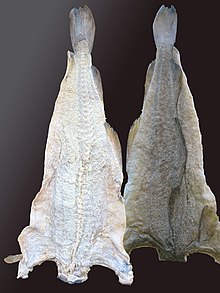

Drying fish is a method of preserving fish, allowing you to save it for a long time. Together with drying, it is one of the oldest ways to process fish by dehydrating it, which prevents the development of microorganisms. Dried and dried fish contain a small amount of water and have specific nutritional characteristics and taste, depending on the preliminary processing method (salting, boiling, baking). Dried fish is made from chilled , frozen or salted skinny fish with a fat content of not more than 2%, since fat is oxidized and rancid during drying and storage [1] . In contrast to drying during drying, the fish do not ripen during the dehydration process. Dried fish obtained by the method of cold drying is a semi - finished product that requires additional cooking before eating. Hot drying gives a food-ready product [2] .
The speed of the fish drying process is determined by the movement of moisture inside the product. The drying process itself consists of three phases: vaporization on the surface of the material or in its depth, transfer of the generated vapors to the external environment through the boundary layer and transfer of moisture inside the material to its surface. The drying rate depends on the speed of the phase motion of water in the fish, based on the diffusion phenomenon. External diffusion ensures the movement of steam from the surface of the fish into the surrounding atmosphere, and internal diffusion provides the movement of water in a vaporous or liquid state inside the fish from the inner layers to the surface. Both types of diffusion should occur simultaneously. If the internal diffusion lags behind the external, then the fish dries from the surface, the resulting crust prevents the flow of water from the depth to the surface and the drying process slows down.
The drying time is affected by temperature, moisture content and air velocity, as well as the chemical composition of the fish and the method of its cutting. Non-observance of temperature conditions causes fish cooking or slows down drying, which leads to fish spoilage. Too high air speed prevents the maintenance of a uniform temperature, too slow slows drying and spoils the fish. The optimum relative humidity for drying fish is 50–70%. When drying, large fish lose moisture less than small, so the duration of dehydration of large fish is longer [3] .
Content
Drying Methods
The main methods of drying fish are hot and cold, using different temperature conditions. In addition, lyophilization , sublimation under vacuum, is used to dry fish. Cold drying of fish is carried out using air heated to a temperature not exceeding 40 ° C. The method of cold drying produces fresh-dried stockfisk fish and salty-dried clipfisk , and also salty-dried partial fish is harvested [2] . Fresh-dried fish are not divided into varieties; salted-dried fish are classified by quality in the 1st and 2nd varieties. In the south of Russia, any dried fish is called ram . In the northern regions of Russia, where the temperature is kept low for a long period of time, fresh-dried products from cod and small fish are harvested by freezing under covered hangers [4] . In the last year of fishing, the local population of the Kuril Islands and the Bering Sea coast produces for their own needs salmon yukola [5] .
Small fish are subjected to hot drying at an air temperature above 100 ° C: bleak , ruff , gudgeon , loach , perch , smelt [6] [2] , smelt , and also non- greasy capelin . Small fish dried in a Russian oven is called the essence . During hot drying of fish, proteins denature , part of the fat and moisture are separated in the form of broth, vitamins are destroyed and enzymes are inactivated. Cold and hot-dried fish is packed in wooden or cardboard boxes; at a temperature of 8–10 ° C, it can be stored for 8–10 months [1] .
Dehydration of fish by lyophilization is performed in a frozen state. Ice in fish tissues as a result of heat supplied from the outside passes into a vaporous state, bypassing the liquid. To avoid thawing of fish during heating, drying is carried out in high vacuum in special vacuum sublimation units. The freeze-drying process lasts 10-20 hours. Finished products are vacuum packed in sealed containers, the shelf life is up to 2 years [1] . The resulting fish product is of high quality: it retains color, taste, smell and initial nutritional properties, vitamins and extractives, absorbs water well - up to 95% of the moisture contained in the fish before drying.
Defects of dried fish include brine - salt deposits on the surface, dampness, increased humidity. The pest of fish is shashel - the larva of the skin-beetle beetle [7] .
See also
- Screech
Notes
- ↑ 1 2 3 V.A. Timofeeva. Dried fish // Commodity research of food products. - 5th. - Rostov n / A: Phoenix, 2005 .-- S. 363-364. - 416 p. - 11,000 copies. - ISBN 5-222-07035-2 .
- ↑ 1 2 3 A.V. Korobeinik. Preparation of dried fish // Technology of processing and commodity science of fish and fish products / J. Prokhorova , O. Morozova . - Rostov n / A: Phoenix, 2002 .-- S. 166. - 288 p. - ISBN 5-222-02185-8 .
- ↑ V.P. Bykov. Drying of fish // Technology of fish products / ed. G. M. Belousova . - 2nd. - M .: Food Industry, 1980. - S. 146-150. - 320 p.
- ↑ A.V. Korobeinik. Preparation of freshly dried fish products // Technology of processing and commodity science of fish and fish products / J. Prokhorova , O. Morozova . - Rostov n / A: Phoenix, 2002 .-- S. 171. - 288 p. - ISBN 5-222-02185-8 .
- ↑ B.T. Repnikov. Assortment of dried fish // Commodity research and biochemistry of fish products. - M .: Publishing house "Dashkov and K", 2007. - S. 117-118. - 146 p. - ISBN 978-5-91131-420-0 .
- ↑ A. T. Vasyukova. Drying of fish // Processing of fish and seafood / ed. A.E. Illarionova . - M .: Publishing and trading corporation "Dashkov and Co.", 2009. - S. 68. - 104 p. - 1000 copies. - ISBN 978-5-394-00345-5 .
- ↑ Z. P. Matyukhina, E. P. Korolkova, S. P. Ascheulov. Dried and dried fish // Food products (commodity science): Textbook for prof. schools. - 2nd. - M .: Economics, 1982. - S. 113-114. - 232 p. - 40,000 copies.
Literature
- V.P. Bykov. Drying of fish // Technology of fish products / ed. G. M. Belousova . - 2nd. - M .: Food Industry, 1980. - S. 146-150. - 320 p.
- Drying and drying // Technology of fish and fish products / ed. A.M. Ershova . - SPb. : GIORD, 2006 .-- S. 443-471. - 941 s. - 1000 copies. - ISBN 5-901065-78-6 .