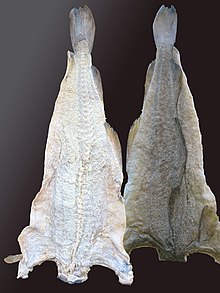
Klipfisk - a fish product obtained by cold drying , salted-dried cod or haddock . A dried clipfisk contains about 40% moisture and 20% salt. Freshly dried cod and haddock are called stockfisk .
Clipfisk is produced in almost all countries whose subject of fishing is cod or haddock: Canada, Great Britain, Iceland, Norway, Germany. The clipfisk is consumed mainly by the southern countries where it is known as bacalhau : Spain, Portugal, Italy, Argentina, Brazil, Cuba, which is due to the product's resistance at high storage temperatures. To prepare dishes from the clipfisk, it is pre-soaked.
The process of preparing a clipfisk is divided into two independent stages: the preparation of a semi-finished product - salted clipfisk and its drying. Often a clipfisk is sold in salt form without drying. The clipfisk is made only from completely fresh fish, bloodless in a living form. The whiteness of meat depends on bleeding, which is the main requirement for the appearance of the finished product. Asleep or reclaimed cod cannot be well bled. After bleeding, cod under a clipfisk is decapitated and spread out both manually and on special clipfixing machines. Subsequent thorough washing of the workpiece is done manually in clean sea water with hair or grass brushes. The clipfisk ambassador is made in the bins of the trawler’s hold with a stack 1–1.2 m high, skin down, in a straightened form, salt is put in the amount of 50-60%. The fish does not touch each other, and the brine drains and is absorbed by an excess of salt [1] . The duration of the ambassador is 12 days.
Clipfisk is dried in natural conditions or in dryers at a temperature not exceeding 30 ° C. Under natural conditions, the semi-finished clipfisk is laid out on shelves in stacks about 50 cm high with the skin down under the load. After 3-5 days, the fish are transferred to higher stacks and pressed again. The procedure is repeated several times with an increase in load as the fish dries. The drying time of the clipfix in natural conditions is about 40 days, in dryers - 3-4 times less [2] . The quality of products with artificial drying is worse than with natural. The finished product is pressed into 30 kg, sheathed in a dense fabric and stored in a dry room [3] .
Notes
- ↑ A. T. Vasyukova. Preparation of convenience foods. Salted and dried fish // Processing of fish and seafood / ed. A.E. Illarionova . - M .: Publishing and trading corporation "Dashkov and Co.", 2009. - S. 45-57. - 104 p. - 1000 copies. - ISBN 978-5-394-00345-5 .
- ↑ V.P. Bykov. Methods of drying fish // Technology of fish products / ed. G. M. Belousova . - 2nd. - M .: Food industry, 1980. - S. 148. - 320 p.
- ↑ B.T. Repnikov. Assortment of dried fish // Commodity research and biochemistry of fish products. - M .: litres.ru, 2007 .-- S. 117. - 146 p. - ISBN 978-5-91131-420-0 .
Literature
- A.T. Vasyukova. Preparation of convenience foods. Salted and dried fish // Processing of fish and seafood / ed. A.E. Illarionova . - M .: Publishing and trading corporation "Dashkov and Co.", 2009. - S. 45-57. - 104 p. - 1000 copies. - ISBN 978-5-394-00345-5 .
- V.P. Bykov. Methods of drying fish // Technology of fish products / ed. G. M. Belousova . - 2nd. - M .: Food industry, 1980. - S. 148. - 320 p.