Flaxseeds ( lat. Linaceae ) - a family of dicotyledonous plants of the order Malpigotsvetnye . The family includes, according to various sources, from 8 to 14 genera and from 260 to 300 species.
| Flaxseed | |||||||||||||||||
|---|---|---|---|---|---|---|---|---|---|---|---|---|---|---|---|---|---|
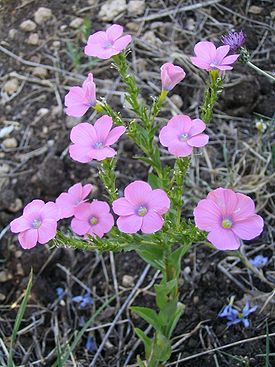 Linum pubescens | |||||||||||||||||
| Scientific classification | |||||||||||||||||
| |||||||||||||||||
| International scientific name | |||||||||||||||||
Linaceae DC. ex Perleb (1818), nom. cons. | |||||||||||||||||
| Type genus | |||||||||||||||||
Lepidobotrys | |||||||||||||||||
| Childbirth | |||||||||||||||||
See text | |||||||||||||||||
Content
- 1 Botanical Description
- 2 birth
- 3 notes
- 4 References
Botanical Description
These are annual or perennial herbs and shrubs, mostly bare, only a few species are soft-haired. Quite a few representatives of the family are tree vines (species of the genera Gugonia ( Hugonia ), Durandea ( Durandea )) climbing through hook-shaped spikes (metamorphosed lower branches of the inflorescence), twisted like sheep’s horns [2] .
The leaves are alternate and only in Radiola and Linum catharticum are opposite or whorled, whole, sessile, without stipules.
The correct bisexual flowers are collected in racemose or paniculate inflorescences. Five sepals (four in Radiola ); five petals ( Radiola has four); there are also five stamens, fused with the bases of the threads in one bundle. Pestle one, with five, four stigmas (for Radiola ) and with an upper five- or four-nest (for Radiola ) ovaries ; each nest is divided by a false septum in half and in each half of the nest there is one ovule.
Flower formula : .
The fruit is an almost spherical box opening on the partitions. The seed contains a direct fleshy embryo and poorly developed protein.
Flaxseeds are found in temperate and warm climates of both hemispheres; in European Russia there are two genera: Radiola Hill and Linum L. - the common flax also belongs to the latter.
Childbirth
Birth of the Flax family according to the Royal Botanic Gardens in Kew [3] :
- Anisadenia Wall. ex Meisn. - The Falls
- Cliococca Bab.
- Durandea Planch. - Durandea
- Hebepetalum Benth.
- Hesperolinon ( A.Gray ) Small - Hesperolinon
- Hugonia L. - Gugonia
- Indorouchera Hallier f. - Indoruchera
- Linum L. - Flax
- Philbornea Hallier f.
- Radiola Hill - Radiola (not to be confused with Rhodiola from the family Crassulaceae )
- Reinwardtia Dumort. - Reinvardtia
- Roucheria Planch.
- Sclerolinon CMRogers
- Tirpitzia Hallier f. - Tirpititia
Notes
- ↑ For the conventionality of specifying the class of dicotyledons as a superior taxon for the plant group described in this article, see the APG Systems section of the Dicotyledonous article .
- ↑ Egorova T.V. Flax family (Linaceae) // Plant Life: In 6 tons. - M .: Education, 1978. - T. 5/2. Flowering plants: Ed. A. L. Takhtadzhyana. - S. 270.
- ↑ Births of the Flax family according to the Royal Botanic Gardens in Kew (Eng.) (Retrieved May 16, 2010)
Links
- Flaxseed (English) : information on the GRIN website. (Retrieved May 16, 2010)
- Flaxseeds (English) : Information on the APWeb website . (Retrieved May 16, 2010)