Dungweed-dugouts , or dung beetles ( lat. Geotrupidae ) - a family of beetles, in some sources - the collective name of several subfamilies of beetles of the family lamellae . Most species belong to the subfamily Bolboceratinae (approximately 500 species).
| Dredgers |
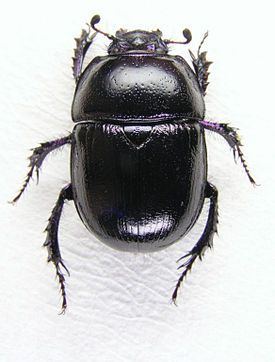
Common digger ( Geotrupes stercorarius ) |
| Scientific classification |
|---|
| No rank : | Bilateral symmetrical |
| Subtype : | Tracheo-breathing |
| Infraclass : | Winged insects |
| Treasure : | Fully Transformed Insects |
| Infrastructure : | Scarabaeiformia Crowson, 1960 |
|
| International scientific name |
|---|
Geotrupidae Latreille , 1802 |
| Type genus |
|---|
Geotrupes |
| Subfamilies |
|---|
- Bolboceratinae
- Geotrupinae
- Lethrinae
- Taurocerastinae
|
|
Content
The scientific name of the family " Geotrupidae " comes from the Greek: geos - land, and trypetes - driller, or digger - "digger bugs." [one]
Length is from 3 to 70 mm. The body is oval or round, yellowish, brown, yellow-brown, red-brown, purple, brown or black (with or without a metallic tint). Antenna 11-segment with 3-segment mace; all segments are pubescent. [one]
Larva
The larva is similar to the larvae of other lamellar C-shaped, thick, white or yellowish. The head capsule is highly sclerotized, brown or dark brown. The antennae are three-segmented. The frontal suture is absent (in Geotrupinae and Bolboceratinae ) or present (in Taurocerastinae ). [one]
In nature, there are over 600 species of dung beetles from 68 genera, [1] 20 species from 11 genera are found in the fauna of Russia. In the neoarctic zone, 55 species and 11 genera are common. [2]
Dung beetles are useful as " orderlies " and soil-forming agents. Some species are intermediate hosts of helminths . They spend most of their lives in their burrows, which can be a meter in depth and are located under carrion or droppings of animals. [2]
The nutrition of beetles is quite diverse - from detritophagous to coprophagous and mushroom-eating , but some beetles do not eat at all. Adult species lead a secretive lifestyle, most of which live in their burrows. Adult beetles do not care about their larvae, they only leave larvae food in the mink and leave it. One species, consisting of relatives of different generations, can coexist together. For example, Bolboceras , whose eggs , larvae , pupae, and adult beetles meet together in the same mink. [1] [2]
Geotrupes stercorarius cluster
The history of development in different species proceeds differently. Adult beetles burrow into vertical minks, which can be 15 to 200 cm deep, and also make larval cells under cover of foliage, cow dung, horse droppings or human feces. Minks of several species can be up to three meters deep. In some places there are species that live in semi-colonies . Most dung beetles are nocturnal residents and are often attracted to light from lamps or spotlights. There are also species that can creak, for example, dung beetle ( Geotrupes stercorarius ), which is common in forests in the Russian Federation, which starts to creak in case of alarm or danger. [one]
Nutrition
Larvae feed on carrion or droppings of animals. Adult beetles prefer mushrooms or animal droppings, but there are species that do not eat at all. [2]
There is debate about the taxonomy of this family. The diversity in the structure of larvae and adults leads to different opinions regarding the classification, evolution, and monophilia of this group of beetles and individual genera located in it. There is reason to believe that the group has two distinct branches: Bolboceratinae and Athyreinae , although Athyreinae is listed as a tribe in the subfamily Bolboceratinae , as well as Geotrupinae , Taurocerastinae , and Lethrinae can be considered tribes in the subfamily Geotrupinae . Scholz and Brown in 1996 (Scholtz & Browne, 1996) raised the Bolboceratinae subfamily to the rank of the Bolboceratidae family. The family of dung beetles can also be considered as a subfamily in the family of lamellae ( Scarabaeidae ). [one]
Classification
- Family: Geotrupidae [3]
- Subfamily: Bolboceratinae Mulsant, 1842
- Tribe: Athyreini Howden & Martinez, 1963
- Genus: Athyreus MacLeay, 1819
- Genus: Neoathyreus Howden & Martínez, 1963
- Genus: Parathyreus Howden & Martinez, 1963
- Genus: Pseudoathyreus Howden & Martinez, 1963
- Tribe: Bolboceratini Mulsant, 1842
- Genus: Australobolbus Howden & Cooper, 1977
- Genus: Blackbolbus Howden & Cooper, 1977
- Genus: Blackburnium Boucomont, 1911
- Genus: Bolbaffer Vulcano, Martinez & Pereira, 1969
- Genus: Bolbaffroides Nikolaev, 1979
- Genus: Bolbapium Boucomont, 1911
- Genus: Bolbelasmus Boucomont, 1911
- Genus: Bolbobaineus Howden & Cooper, 1977
- Genus: Bolbocaffer Vulcano, Martinez & Pereira, 1969
- Genus: Bolboceras Kirby, 1819
- Genus: Bolbocerastes Cartwright, 1953
- Genus: Bolboceratex Krikken, 1984
- Genus: Bolboceratops Krikken, 1978
- Genus: Bolbocerodema Nikolaev, 1973
- Genus: Bolboceroides Vulcano, Martinez & Pereira, 1969
- Genus: Bolbocerosoma Schaeffer, 1906
- Genus: Bolbochromus Boucomont, 1909
- Genus: Bolbogonium Boucomont, 1911
- Genus: Bolbohamatum Krikken, 1980
- Genus: Bolboleaus Howden & Cooper, 1977
- Genus: Bolborhachium Boucomont, 1911
- Genus: Bolborhinum Boucomont, 1911
- Genus: Bolborhombus Cartwright, 1953
- Genus: Bolbothyreus Howden, 1973
- Genus: Bolbotrypes Olsoufieff, 1907
- Genus: Bradycinetulus Cockerell, 1906
- Genus: Elephastomus WS Macleay, 1819
- Genus: Eubolbitus Reitter, 1892
- Genus: Eucanthus Westwood, 1848
- Genus: Gilletinus Boucomont, 1932
- Genus: Halffterobolbus Martinez, 1976
- Genus: Meridiobolbus Krikken, 1984
- Genus: Mimobolbus Vulcano, Martinez & Pereira, 1969
- Genus: Namibiobolbus Krikken, 1984
- Genus: Namibiotrupes Krikken, 1977
- Genus: Pereirabolbus Martínez, 1976
- Genus: Prototrupes Krikken, 1977
- Genus: Socotrabolbus Cambefort, 1998
- Genus: Somalobolbus Carpaneto, Mignani & Piattella, 1992
- Genus: Stenaspidius Westwood, 1848
- Genus: Zefevazia Martínez, 1954
- Subfamily: Geotrupinae Latreille, 1802
- Tribe: Ceratotrupini Zunino, 1984
- Genus: Ceratotrupes Jekel, 1865
- Genus: Chelotrupes Jekel, 1866
- Genus: Typhaeus Leach, 1815
- Tribe: Cretogeotrupini Nikolajev, 1996
- Genus: Cretogeotrupes Nikolajev, 1992
- Tribe: Geotrupini Latreille 1802
- Genus: Allotrypes François, 1904
- Genus: Anoplotrupes Jekel, 1865
- Genus: Baraudia Lopez-Colon, 1996
- Genus: Ceratophyus Fischer von Waldheim, 1823
- Genus: Cnemotrupes Jekel, 1866
- Genus: Enoplotrupes Lucas, 1869
- Genus: Geohowdenius Zunino, 1984
- Genus: Geotrupes Latreille, 1796 - Dredger-diggers (genus)
- Genus: Halffterius Zunino, 1984
- Genus: Haplogeotrupes Nikolaev, 1979
- Genus: Jekelius Lopez-Colon, 1989
- Genus: Megatrupes Zunino, 1984
- Genus: Mycotrupes LeConte, 1866
- Genus: Odontotrypes Fairmaire, 1887
- Genus: Onthotrupes Howden, 1964
- Genus: Peltotrupes Blanchard, 1888
- Genus: Phelotrupes Jekel, 1866
- Genus: Sericotrupes Zunino, 1984
- Genus: Silphotrupes Jekel, 1866
- Genus: Sinogeotrupes Bovo & Zunino, 1983
- Genus: Thorectes Mulsant, 1842
- Genus: Trypocopris Motschulsky, 1859
- Genus: Zuninoeus López-Colón, 1989
- Subfamily: Lethrinae Mulsant & Rey, 1871
- Genus: Lethrus Scopoli, 1777 - Kravchiki
- Subfamily: Taurocerastinae
- Genus: Frickius Germain, 1897
- Genus: Taurocerastes Philippi, 1866
Dung Mink ( Typhaeus typhoeus )
The cops drags a dead slug
A man’s man drags a dung ball for a female
