The Gottentot anthropological type is one of two anthropological variants of the South African race (along with the Bushman version ). Its representatives are the Khoisan peoples of the Hottentot group (koi-koin) , who currently live in southern and central Namibia , as well as partly in Botswana and South Africa [1] [2] [3] . The Hottentot anthropological type is traditionally regarded as larger and more massive in comparison with the smaller and gracile Bushman type [4] .
The Hottentot anthropological type stands out, in particular, in the works of the Soviet anthropologist G.F. Debets . In his classification of human races, the Hottentot type, together with the Bushman type, form the Bushman race of the African branch as part of the large Negro-Australoid race [5] .
Together with the Bushman anthropological type, the Hottentot type shares all the main anthropological features of the South African (capoid, Bushman) race. These signs include: lighter skin color in comparison with other African Negroids (often yellow-brown); more developed than other negroids, curly hair (hair is most often spiral-curled, tangled in small bundles); poor development of the tertiary hairline ; absolutely and relatively low height of the skull, in contrast to the high arch of the skull in most negroids; narrow nose with a very flat nose; relatively low growth ; a high degree of flatness of the face ; high frequency of epicanthus propagation; often noted steatopygia (increased fat deposition on the buttocks ) and other symptoms [1] [3] [6] .
In comparison with the Bushman anthropological type, the Hottentot type is characterized by such features as [2] [7] :
- greater sloping forehead ;
- greater development of ;
- less low carry;
- larger sizes of the skull as a whole, especially a larger height of the skull;
- significantly higher growth.
In addition to the Hottentot peoples themselves, some of the features of the Hottentot type are noted in the mestizo group of Rehobot bastards (descendants of the Hottentots and Dutch colonists ) living in Namibia [8] . Some peoples who speak Hottentot languages do not belong to the Hottentot anthropological type. For example, Damara , who speak the Nama language - they have signs of a Negro race [9] . The fact that ethnolinguistic affiliation does not always correlate with origin and anthropological type is evidenced by the latest genetic studies. According to these studies, some groups of Hottentots are genetically closer to the Bushmen than to other Hottentots, for example, Nama Hottentots [10] .
According to the assumptions of some anthropologists, differences between the characters of the Hottentot type and the Bushman type arose as a result of a partial crossbreeding of the Bushmen with representatives of the Negro race. Also, a change in the appearance of the Hottentots may have been affected by a change in lifestyle and type of food during the transition from gathering to cattle breeding [10] .

Representatives of the Hottentot Nama (early 20th century)

Hottentot woman with South African steatopigia
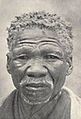
Representative of one of the Hottentot peoples

Representative of one of the Hottentot peoples

Classical Hottentot type, representative of the Qur'an people [~ 1]


Notes
- Comments
- ↑ According to the research of the Irish scientist .
- Sources
- ↑ 1 2 Alekseeva, Bogatenkov, Drobyshevsky, 2004 , p. 168.
- ↑ 1 2 Alekseeva, Bogatenkov, Drobyshevsky, 2004 , p. 362.
- ↑ 1 2 South African race / Pestryakov A.P. // Great Russian Encyclopedia : [in 35 vol.] / Ch. ed. Yu.S. Osipov . - M .: Great Russian Encyclopedia, 2004—2017. Archived copy . Date of treatment June 15, 2018. Archived December 30, 2017. (Retrieved April 20, 2018)
- ↑ Drobyshevsky S.V. The missing link. Signs of the Bushmen . Antropogenez.ru (2017). Archived on April 20, 2018. (Retrieved April 20, 2018)
- ↑ Schemes of racial classifications of humanity by G. F. Debets and J. Ya. Roginsky and M. G. Levin in the article by I. V. Perevozchikov “Human Races” . - Motherwort - Rumcherod. - M .: “The Great Russian Encyclopedia ”, 2015. - S. 257—259. - (The Big Russian Encyclopedia : [in 35 vols.] / Ch. Ed. Yu. S. Osipov ; 2004—, vol. 28). - ISBN 978-5-85270-365-1 . Archived December 29, 2017. (Retrieved April 20, 2018)
- ↑ Alekseeva, Bogatenkov, Drobyshevsky, 2004 , p. 373.
- ↑ Alekseeva, Bogatenkov, Drobyshevsky, 2004 , p. 354.
- ↑ Alekseeva, Bogatenkov, Drobyshevsky, 2004 , p. 155.
- ↑ Drobyshevsky S.V. The missing link. Origin of the South African (Bushman) race . Antropogenez.ru (2017). Archived on April 16, 2013. (Retrieved April 20, 2018)
- ↑ 1 2 Drobyshevsky S.V. The missing link. The oldest Bushmen - controversial and indisputable . Antropogenez.ru (2017). Archived July 16, 2012. (Retrieved April 20, 2018)
Literature
- Alekseeva T. I. (ed.), Bogatenkov D. V. , Drobyshevsky S. V. Anthropology: Educational-methodical complex [Electronic textbook] . - M .: Institute for Distant Education of the Peoples' Friendship University of Russia , 2004. - 459 p. Archived on September 10, 2016. (Retrieved April 20, 2018)
Links
- Hottentot type of koisanoid race . Physical Anthropology. Illustrated Dictionary . EdwART (2011). Archived on April 20, 2018. (Retrieved April 20, 2018)
- Negroids - Stanislav Drobyshevsky (PostNauka) (Retrieved April 20, 2018)