The Pacific typhoon season 2018 is part of the year when tropical cyclones form in the western Pacific . The scope of the article is limited from the east by the line of the change of dates, from the west by 110 meridian of east longitude, from the south by the equator. There are no strict restrictions on the time of formation of tropical cyclones in this region, but most of them are formed from June to November, when sea water is the warmest.
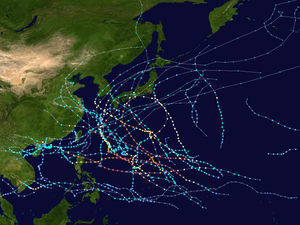 All tropical cyclones of the season | |
| The formation of the first cyclone: | December 29, 2017 |
|---|---|
| The dissolution of the last cyclone: | Season goes on |
| Severe storm: | Typhoon Jelawat - 935 hPa ( mbar ), 175 km / h (110 mph) |
| Total Depression: | 21, one not recognized by JMA |
| Total Storms: | 13, one is not recognized by JMA |
| Typhoons: | five |
| Total killed: | 114 |
| Total damage: | $ 1.41 billion (2018 USD ) |
| seasons Pacific typhoon 2016 , 2017 , 2018 , 2019, 2020 | |
There are two organizations in the region that name tropical cyclones: the Japan Meteorological Agency (JMA) and the Philippine Atmospheric, Geophysical and Astronomical Services (PAGASA). The tropical depressions observed by the Joint Naval Center for Typhoon Warning (JTWC) are numbered with the suffix W. The first storm got its own name on January 3, and the first typhoon reached the required wind power for this status on March 30, soon becoming the first super typhoon season.
Weather Forecasts
| release date forecast | Author forecast | Forecast period | Number of tropical cyclones | Footnote | |
|---|---|---|---|---|---|
| January 15, 2018 | PAGASA | January March | 13 | [one] | |
| January 15, 2018 | PAGASA | April June | 2 - 4 | [one] | |
| March 15, 2018 | Vnchmf | January December | 20-24 | [2] | |
| 2018 season of the year | A source data | Tropical cyclones | Tropical storms | Typhoons | Ref |
| Number of tropical cyclones of different strength according to various meteorological organizations | Jma | 21 | 13 | five | |
| Jtwc | 17 | 14 | 6 | ||
| PAGASA | ten | eight | one | ||
Throughout the year, several national weather services and academic institutions predict how many tropical cyclones, tropical storms and typhoons will form during the season and / or how many tropical cyclones will affect a particular country. These agencies include the Tropical Storm Risk Consortium (TSR) of University College London , the Philippine Office of Atmospheric, Geophysical, and Astronomical Services (PAGASA) and Taiwan Central Weather Bureau . The Hong Kong Observatory and the Vietnam National Center for Hydrometeorological Forecasts (VNCHMF) also issue regional forecasts.
The first forecast for the 2018 season was released by PAGASA on January 15 and covered the first half of the year [1] , in which the Philippine forecasting team suggested that from January to March one to three tropical cyclones will appear (in fact, two have arisen), and from April to June through the Vietnamese zone of responsibility will pass from two to four tropical cyclones [1] (as of mid-April, one cyclone passed through it). The same team suggested that La Niña would be short this year and would dissipate between February and April [1] .
On March 21, VNCHMF issued a forecast, which assumes that in the season 2018 from 12 to 13 tropical cyclones will affect Vietnam, which is higher than the average multi-annual values [2] . On March 23, the Hong Kong Observatory published its forecast, which suggested that five to eight cyclones would pass over a year less than 500 km from the city, which corresponds to long-term average values. It is separately noted that the first tropical cyclone affecting the city itself is expected in June or May [3] . On May 11, TSR released its first forecast for the season, expecting 27 storms with their own names, 17 typhoons and 9 strong typhoons [4] .
Season Timeline
The season of 2018 continued the season of last year without a break - the tropical depression, which later turned into a Bolaven storm (Agaton according to the PAGASA classification), arose at the end of December 2017, but was already developed in 2018 [5] . A month later, a tropical storm Samba (Basyang) hit the southern Philippines [6] , and in the middle of March in the open ocean the first typhoon of the season Jelawat was formed, which, despite its strength (unofficially received the status of super typhoon), did not bring any casualties and destruction, because he passed his life cycle in the open ocean away from the inhabited territories [7] .
Tropical cyclones of the season
Tropical Storm Bolaven (Agathon)
| Tropical Depression ( SSHS ) | |||
|---|---|---|---|
| Period | December 29 - January 4 | ||
| Intensity | 65 km / h (40 mph ) (10 min) , 1002 hPa ( mbar ) | ||
An area of low pressure developed into a tropical depression north-east of Palau in the early morning of December 30, 2017 [8] . The cyclone shifted westward and on January 1, 2018, PAGASA began to make recommendations about the system and named it Agaton [9] . JMA and JTWC followed the example of PAGASA, and on the same day, JTWC assigned depression 01W to the depression [10] . It is due to the fact that all designations were assigned to the system already in 2018, and also due to the fact that the storm caused all the damage as well in 2018, it was assigned to this season, despite the fact that it was formally formed in 2017 and should have been attributed to the season of last year . By January 3, the cyclone had intensified to a tropical storm and received the name Bolaven from JMA, becoming the first two-name storm of the season. A few hours later, the storm weakened and collapsed east of Vietnam on January 4 [11] .
The impact of the storm was moderate compared to the two previous cyclones Kai- tak and Tombin . From press reports, only two thousand people are known who were forced to expect better weather in the ports of the Visayas [12] ; no other traffic violations were reported in the countries of the region. The storm killed three people and caused damage to 554 million Philippine pesos. [13]
Tropical Storm Sanba (Basiang)
| Tropical Storm ( SSHS ) | |||
|---|---|---|---|
| Period | February 8 - February 16 | ||
| Intensity | 65 km / h (40 mph ) (10 min) , 1004 hPa ( mbar ) | ||
On February 8, the low-pressure area turned into a tropical depression located north of Truk, Federated States of Micronesia . The cyclone slowly intensified, and by the eleventh of February reached the power of a tropical storm, after which it received the international name Sanba from JMA. Almost immediately after this, the storm entered the Philippine zone of responsibility and received the regional name Basiang from PAGASA [14] . On February 13 , a storm hit landfall on Bohol , Philippines [15], already weakening to a tropical depression. The next day, the cyclone weakened to a tropical minimum, re-entering land in the province of South Surigao , Mindanao Island, Philippines [16] .
About 17,000 people were affected by the storm, and 14 were killed. Economic damage was estimated at 168 million Philippine pesos. [17]
Typhoon Jelawat (Kaloy)
| Category 4 Tropical Cyclone ( SSHS ) | |||
|---|---|---|---|
| Period | March 24 - April 2 | ||
| Intensity | 175 km / h (110 mph ) (10 min) , 935 hPa ( mbar ) | ||
On March 24, a tropical depression formed [18] south of the Mariana Islands , which received the designation 03W from the JTWC [19] . The next day, the cyclone intensified to a tropical storm and received the name Jelavat from JMA [20] , and by 18 o’clock on March 28 it intensified to a severe tropical storm [21] . Late in the evening of March 29, an eye began to form in the central part of the cyclone and at midnight on March 30, JMA raised the status of the system to a typhoon [22] . Over the next 12 hours, the typhoon experienced the effect of explosive intensification As a result, during this short time, the typhoon reached the fourth category, becoming the first super typhoon [23] of the season with a 10-minute averaged wind speed of 175 km / h, a wind speed averaged over 1 minute at 240 km / h and a minimum pressure of 935 hPa . Because of typhoon Jelawat, the tests of a Chinese unmanned submarine were postponed [24] , no casualties and damage were reported, the cyclone passed away from land [7] .
Tropical Depression 04W
| Tropical Storm ( SSHS ) | |||
|---|---|---|---|
| Period | May 10 - May 15 | ||
| Intensity | 55 km / h (35 mph ) (10 min) , 935 hPa ( mbar ) | ||
On May 10, the low-pressure area east of the Mariana Islands was given the status of tropical depression [25] , almost at the same time the JTWC issued a warning about the formation of a tropical cyclone [26] . For several days, depression moved through the uninhabited areas of the Pacific Ocean, after which it began to weaken and collapse. The final JWTC message was released on May 14 [27] , and the cyclone completely collapsed the next day. There were no reports of casualties or destruction.
Tropical Storm Evinar
| Tropical Storm ( SSHS ) | |||
|---|---|---|---|
| Period | June 2 - June 9 | ||
| Intensity | 65 km / h (40 mph ) (10 min) , 998 hPa ( mbar ) | ||
On May 2, a tropical depression formed over the South China Sea [28] . Passing along the coast of Vietnam, she headed towards Hainan Island [29] , the passage of a cyclone over the northeastern part of which is expected on the night of June 5-6 [30] . After that, the storm left on the coast of mainland China and again returned to Hainan Island, having already completed the third land access [31] . The cyclone caused heavy rains in the region, so in the east of the island 218 mm of precipitation fell, and from Tuesday to Friday in the northern part of the island more than half a meter of rain can fall. In the coastal part of the island, rail service was canceled, traffic on roads [32] was very difficult, and dozens of flights were canceled [31] . The storm caused damage of 3.67 billion yuan (537 million US dollars) and killed 8 people in China [33] .
Cruel Tropical Storm Malixi (Domen)
| Tropical Storm ( SSHS ) | |||
|---|---|---|---|
| Period | June 4 - June 11 | ||
| Intensity | 120 km / h (75 mph ) (10 min) , 970 hPa ( mbar ) | ||
An area of low pressure developed over the Philippine Sea for several days, until on June 4 it intensified to tropical depression [34] . Since the cyclone is located within the Philippine Responsibility Zone (FZO), immediately after reaching the required wind speed it received the name Domeng [34] , on the same day JTWS issued a warning about the formation of a tropical cyclone [35] . On June 5, the cyclone absorbed a minor tropical depression [35] , which a day earlier appeared near Yap Island [36] . As a result of heavy rains caused by a cyclone in the Philippines, two people died [37] . On June 10, it was announced that the cyclone intensified to a typhoon [38] , but later this message was disavowed [39] and finally the cyclone was assessed as a fierce tropical storm that left the FZO on June 10 [37] and turned into an extratropical cyclone in the late evening of June 11 [40] . Malixi caused significant rainfall in Japan, but no casualties or significant damage were reported [38] .
Tropical Storm 07W
| Tropical Storm ( SSHS ) | |||
|---|---|---|---|
| Period | June 13 - June 15 | ||
| Intensity | 75 km / h (45 mph ) (1-min) , 993 hPa ( mbar ) | ||
T. n. The “area of indignant weather” was formed on June 12 as part of an almost stationary atmospheric front that arises in the region during the summer. The next day, the cyclone matured to a tropical depression and headed towards the Yaeyama Islands, at about the same time the JTWC began to issue recommendations on this system [41] . The cyclone intensified before the tropical storm on June 14, but the JMA still considered it a disturbance built into the stationary front. The storm passed along the coast of Japan and dissipated in the open ocean. The storm was expected to affect the US base on Okinawa, but the cyclone passed by [42] . No casualties or damage were reported.
Gaimi Tropical Storm (Esther)
| Tropical Storm ( SSHS ) | |||
|---|---|---|---|
| Period | June 13 - June 16 | ||
| Intensity | 85 km / h (50 mph ) (1-min) , 990 hPa ( mbar ) | ||
On the afternoon of July 14, after two days of development as a low-pressure zone, a tropical depression formed in the Philippine zone of responsibility (FZO), which received the international designation 08W and the local name Ester [43] . The cyclone forms powerful precipitation in the Philippines and slowly shifts to the northeast [44] . The formation of depression intensified the monsoon [45] , which had previously actively flooded the country with rains [46] , so new floods and landslides should be expected in the near future [44] . The cyclone left the FZO on June 15 and headed north-east [47] , and, passing along the coast of Japan, on June 16 went beyond the scope of this article, becoming an extratropical cyclone. It finally dissipated away from the populated regions in the status of extratropical depression on June 18 [48] . A storm killed two and injured three more people in the Philippines [49] , with no casualties reported in other regions. During the passage along the coast of Japan, the cyclone caused heavy rains, in many cities long-term precipitation records were updated [50] , mudflows and landslides descended in the mountains.
Typhoon Prapirun (Florita)
| Category 1 Tropical Cyclone ( SSHS ) | |||
|---|---|---|---|
| Period | June 28 - July 4 | ||
| Intensity | 140 km / h (85 mph ) (1-min) , 960 hPa ( mbar ) | ||
On June 28, the low pressure zone east of Okinotori atoll formed into a tropical depression [51] , the next day the cyclone intensified to a tropical storm [52] , July 1 to a severe tropical storm [53] , and July 2 to a typhoon. The storm caused an increase in monsoon rainfall in the region, especially Luzon Island [53] , especially storms and precipitation were noted in Taiwan [54]. A cyclone killed one person [55] and seriously damaged the ruins of a medieval castle in Japan, which is UNESCO World Heritage Site [56] .
Typhoon Maria (Gardo)
| Category 5 Tropical Cyclone ( SSHS ) | |||
|---|---|---|---|
| Period | June 3 - July 12 | ||
| Intensity | 260 km / h (160 mph ) (1-min) , 915 hPa ( mbar ) | ||
On July 3, a tropical depression formed in the Pacific [57] , which was rapidly gaining momentum - the next day it intensified to a tropical storm [58] , which was named Maria, by the morning of July 5 - to a severe tropical storm [59] , and by the evening of that on the same day, he left the FSO and intensified to a typhoon [60] . On July 9, the cyclone's eye replaced the storm, and its strength became equivalent to the fifth category hurricane. A typhoon went to land on the night of June 11 in the Chinese province of Fujian [61] and collapsed the next day.
Maria caused damage to the region of $ 630 million: 623 million amounted to damage to East China [62] , $ 7.69 million to Okinawa [63] and $ 150 thousand to Guam [64] , a hurricane also killed 11 people in Japan [65] .
Shontin Tropical Storm (Henry)
| Tropical Storm ( SSHS ) | |||
|---|---|---|---|
| Period | July 6 - July 24 | ||
| Intensity | 75 km / h (45 mph ) (10 min) , 994 hPa ( mbar ) | ||
On July 15, north of Manila, the low-pressure area turned into a tropical depression. Since the cyclone was in the area of responsibility of the PAGASA agency, he immediately received the name Henry [66] , and the JTWC gave him the international designation 11W [67] . Two days later, the cyclone intensified to a tropical storm and received the name Shontin from JMA [68] . On July 18, a storm passed through Hainan Island, while it didn’t weaken [69] , then it somewhat intensified over the warm waters of Bakbo Bay [70] and went on land in North Vietnam [71] . The storm quickly weakened over the continent [72] [73] , but by July 21 its remnants again went to the sea [74] , where they began to re-turn into a tropical cyclone [75] and by the evening turned into a tropical depression [76] . On July 22, the JTWC reported that the cyclone intensified before the tropical storm [77] , and the JMA continued to claim that it was a tropical depression [78] . July 24, the cyclone collapsed completely [79] . Shontin caused massive floods in Vietnam and Laos, and also destroyed the hydropower plant under construction in Attapi (Laos). In the region, 170 people died from the impact of the elements [80] , more than a thousand are considered missing, economic damage exceeded $ 255 million [81] [82] .
Cruel Tropical Storm Ampil (Indy)
| Tropical Storm ( SSHS ) | |||
|---|---|---|---|
| Period | July 17 - July 24 | ||
| Intensity | 95 km / h (60 mph ) (10 min) , 985 hPa ( mbar ) | ||
On July 17, a mild tropical depression arose in the Philippine Sea. Given favorable conditions and deep convection, the JWTC assigned it the designation 12W on the same day [83] , and the next morning PAGASA joined it, giving it the name Indy. By 15 hours on July 18, the cyclone intensified to a tropical storm, which he received Ampil [84] , and the next day - intensified to a severe tropical storm [85] with a wind of 95 km / h [86] . By July 22, the cyclone had weakened to a tropical storm and in this status reached the coast of China [87] . The next day, the cyclone weakened to tropical depression [88] , and on July 24, it turned into a low-pressure region and finally decayed [89] .
Ampil caused heavy downpours in Shandong province, in some places it fell to 237 mm. The cyclone caused damage of $ 241 million and killed one person [90] .
Tropical Depression 13W (Josie)
| Tropical Depression ( SSHS ) | |||
|---|---|---|---|
| Period | July 20 - July 23 | ||
| Intensity | 55 km / h (35 mph ) (10 min) , 996 hPa ( mbar ) | ||
On July 20, the JMA announced that a tropical depression had occurred in the South China Sea. The next day, she entered the PAGASA area of responsibility and received the name Josie. [91] The cyclone tried to intensify before a tropical storm, but encountered a strong wind shear [92] and began to collapse before going to the coast of China [93] . In the evening of July 23, the cyclone was completely destroyed [94] .
Fierce Tropical Storm Wukong
| Category 1 Tropical Cyclone ( SSHS ) | |||
|---|---|---|---|
| Period | July 22 - July 26 | ||
| Intensity | 95 km / h (60 mph ) (10 min) , 990 hPa ( mbar ) | ||
Late in the evening of July 21, JWTC began tracking the tropical depression that occurred 600 km east-southeast of Minamitori Island (Japan), and assigned it another number 14W [95] . The JMA began to observe this cyclone in the morning of the next day, and towards evening, the JWTC assigned it the status of a tropical storm [96] , despite wind shear and some suppression of convection. By 3 p.m. on June 23, the JMA also raised the status of the cyclone and named it Wukong [97] . Moving north, the cyclone fell into an area with a weakened wind shear and warm enough water that immediately led to its strengthening - by three in the morning on July 25, JMA raised Wukong to a severe tropical storm, and nine hours later JWTC announced that the storm had turned into a typhoon of the first category [98] . The next day, the typhoon turned into an extratropical cyclone and left the scope of the article [99] . However, after this moment, the cyclone passed near the coast of the Russian Far East, causing heavy precipitation in the Kuril Islands [100] . No casualties or destruction were reported on the territory of Russia or abroad.
Typhoon Jondari
| Category 2 Tropical Cyclone ( SSHS ) | |||
|---|---|---|---|
| Period | July 23 - August 4 | ||
| Intensity | 140 km / h (85 mph ) (10 min) , 960 hPa ( mbar ) | ||
July 19, southeast of Guam, the first prerequisites for the formation of a tropical cyclone arose [101] . Two days later, the JWTC announced [102] that a tropical depression had formed in the region and began to monitor its development. JMA was more skeptical and announced the formation of tropical depression only in the late evening of July 23 [103] . By 21:00 a.m. July 24, both meteorological agencies announced that the cyclone had intensified before the tropical storm and received the name Jondari [104] [105] , and by noon the next day it had intensified before the severe tropical storm [106] and headed north-east [107 ] . On July 26, the storm intensified to the typhoon [108] , despite the vertical wind shear, and on July 27, it turned west and headed towards Japan [109] . Two days later, the typhoon went to land near Ise city in Mie Prefecture with a steady wind in 120 km / h and a pressure of 975 hPa [110] [111] . The cyclone began to rapidly lose strength after passing above the ground and re-entered land near Shanghai in the early morning of August 3 [112] , after which it continued to rapidly weaken and collapsed over the territory of China the next day. Jondari caused cumulative damage of $ 1.48 million, but there were no casualties.
Tropical Depression 16W
| Tropical Depression ( SSHS ) | |||
|---|---|---|---|
| Period | July 31 - August 1 | ||
| Intensity | 55 km / h (35 mph ) (10 min) , 1002 hPa ( mbar ) | ||
July 29, 807 km from the Japanese island of Io , signs of the formation of a tropical cyclone appeared [113] . Over the next two days, both regional meteorological organizations, JTWC (July 30) and JMA (July 31), recognized [114] [115] the cyclone as tropical depression, which received the next serial designation 16W. The first predictions suggested that the cyclone intensified before a slight tropical storm [116] , but the wind shear prevented it from intensifying [117] . The cyclone became subtropical at midnight on August 1, but both agencies tracked it until the complete collapse of August 2 [118] .
Typhoon Shanshan
| Category 2 Tropical Cyclone ( SSHS ) | |||
|---|---|---|---|
| Period | August 2 - August 10 | ||
| Intensity | 130 km / h (80 mph ) (10 min) , 970 hPa ( mbar ) | ||
On August 2, tropical depression began to develop east-northeast of Guam. By midnight on August 3, the JWTC officially recognized the cyclone as tropical depression [119] , which was designated 17W. During the day, the cyclone intensified to a fierce tropical storm [120] , called Shanshan [121] . On August 4, the storm intensified to the typhoon and continued moving towards Japan, which passed on the coast of August 8 and headed into the open ocean [122] . The typhoon had an impact on the coast of Japan, inflicted damage of 132 thousand dollars to Miyagi Prefecture [123] , but did not go on land and managed without casualties [124] .
Yagi Tropical Storm (Carding)
| Tropical Storm ( SSHS ) | |||
|---|---|---|---|
| Period | August 6 - August 15 | ||
| Intensity | 75 km / h (45 mph ) (10 min) , 990 hPa ( mbar ) | ||
Tropical Storm Bebinka
| Tropical Storm ( SSHS ) | |||
|---|---|---|---|
| Period | August 9 - August 17 | ||
| Intensity | 85 km / h (50 mph ) (10 min) , 985 hPa ( mbar ) | ||
Cruel Tropical Storm Lipi
| Category 1 Tropical Cyclone ( SSHS ) | |||
|---|---|---|---|
| Period | August 10 - August 15 | ||
| Intensity | 95 km / h (60 mph ) (10 min) , 994 hPa ( mbar ) | ||
Tropical Storm Hector
| Tropical Storm ( SSHS ) | |||
|---|---|---|---|
| Period | August 13 ( Moved from the Eastern Pacific ) - August 16 | ||
| Intensity | 75 km / h (45 mph ) (10 min) , 998 hPa ( mbar ) | ||
Tropical Storm Rumbia
| Tropical Storm ( SSHS ) | |||
|---|---|---|---|
| Period | August 14 - August 18 | ||
| Intensity | 85 km / h (50 mph ) (10 min) , 985 hPa ( mbar ) | ||
Typhoon Soulyk
| Category 3 Tropical Cyclone ( SSHS ) | |||
|---|---|---|---|
| Period | August 15 - August 24 | ||
| Intensity | 155 km / h (100 mph ) (10 min) , 950 hPa ( mbar ) | ||
Typhoon Simaron
| Category 3 Tropical Cyclone ( SSHS ) | |||
|---|---|---|---|
| Period | August 16 - August 24 | ||
| Intensity | 155 km / h (100 mph ) (10 min) , 950 hPa ( mbar ) | ||
Tropical Depression 24W (Louis)
| Tropical Depression ( SSHS ) | |||
|---|---|---|---|
| Period | August 21 - August 26 | ||
| Intensity | 55 km / h (35 mph ) (10 min) , 996 hPa ( mbar ) | ||
Typhoon Jebi (Miriam)
| Category 5 Tropical Cyclone ( SSHS ) | |||
|---|---|---|---|
| Period | August 26 - September 4 | ||
| Intensity | 195 km / h (120 mph ) (10 min) , 915 hPa ( mbar ) | ||
Typhoon Manghut (Ompong)
| Category 5 Tropical Cyclone ( SSHS ) | |||
|---|---|---|---|
| Period | September 6 - September 17 | ||
| Intensity | 205 km / h (125 mph ) (10 min) , 905 hPa ( mbar ) | ||
Tropical Storm Bararijat (Neneng)
| Tropical Storm ( SSHS ) | |||
|---|---|---|---|
| Period | September 8 - September 13 | ||
| Intensity | 75 km / h (45 mph ) (10 min) , 998 hPa ( mbar ) | ||
Typhoon Trami (Paeng)
| Category 5 Tropical Cyclone ( SSHS ) | |||
|---|---|---|---|
| Period | September 20 - October 1 | ||
| Intensity | 195 km / h (120 mph ) (10 min) , 915 hPa ( mbar ) | ||
Tropical Depression 29W
| Tropical Depression ( SSHS ) | |||
|---|---|---|---|
| Period | September 25 - September 27 | ||
| Intensity | 55 km / h (35 mph ) (10 min) , 1008 hPa ( mbar ) | ||
Typhoon Kong Rei (Queenie)
| Category 5 Tropical Cyclone ( SSHS ) | |||
|---|---|---|---|
| Period | September 28 - October 6 | ||
| Intensity | 215 km / h (130 mph ) (10-min) , 900 hPa ( mbar ) | ||
Typhoon Utah (Rosita)
| Category 5 Tropical Cyclone ( SSHS ) | |||
|---|---|---|---|
| Period | October 21 - November 2 | ||
| Intensity | 215 km / h (130 mph ) (10-min) , 900 hPa ( mbar ) | ||
Fierce Tropical Storm Usagi (Samuel)
| Category 1 Tropical Cyclone ( SSHS ) | |||
|---|---|---|---|
| Period | November 14 - November 26 | ||
| Intensity | 110 km / h (70 mph ) (10 min) , 990 hPa ( mbar ) | ||
Toraji Tropical Storm
| Tropical Depression ( SSHS ) | |||
|---|---|---|---|
| Period | November 16 - November 18 | ||
| Intensity | 65 km / h (40 mph ) (10 min) , 1004 hPa ( mbar ) | ||
Typhoon Man-E (Thomas)
| Category 2 Tropical Cyclone ( SSHS ) | |||
|---|---|---|---|
| Period | November 20 - November 28 | ||
| Intensity | 150 km / h (90 mph ) (10 min) , 960 hPa ( mbar ) | ||
Tropical Depression 35W (Usman)
| Tropical Depression ( SSHS ) | |||
|---|---|---|---|
| Period | December 25 - December 29 | ||
| Intensity | 55 km / h (35 mph ) (10 min) , 1000 hPa ( mbar ) | ||
Other cyclones
A small tropical depression formed on July 17 near Hong Kong and the next day broke up off the coast of Guangdong [125] [126] . She did not receive an international designation.
Storm Names
In the northwestern Pacific Ocean, two organizations give names to tropical cyclones: the Japan Meteorological Agency (JMA) and the Philippine Office of Atmospheric, Geophysical and Astronomical Services (PAGASA), as a result of which the same storm can get two names (one from each organizations) [127] . On behalf of the World Meteorological Organization, the Tokyo Typhoon Center of the Japanese Meteorological Agency assigns international names to tropical cyclones, in which the wind speed averaged over 10 minutes exceeds 65 km / h [128] . PAGASA assigns its names (not matching international ones) to all tropical cyclones passing through its area of responsibility, regardless of whether the cyclone has an international name [127] . The names of destructive cyclones are removed from the lists and forever assigned to the corresponding storm [128] . If the main list for the Philippine region is exhausted, the missing names will be taken from the auxiliary list published every year. All names are in English, unused names are highlighted in gray .
International Names
A tropical cyclone gets its name provided that the wind speed averaged over 10 minutes is greater than or equal to 65 km / h [129]. JMA selected names from a large list of 140 items formed by 14 countries of the World Meteorological Association and its committee on typhoons [130] . These 28 names are listed below, as well as an international number next to it, if available.
|
|
|
|
Names for the Philippine Region
PAGASA uses its own names for cyclones that originate or move through its area of responsibility [131] . The list of names for the 2018 season was previously used in the 2014 season , and is planned for reuse in the next 2022 season [131] . The names Glenda, Jose, Mario, Ruby and Seniang were removed from the list of the 2014 sample, since the corresponding tropical cyclones caused significant damage and these names will be assigned to them forever. Replaced names this year introduced new ones: Gardo, Josie, Maymay, Rosita and Samuel [131] . The primary and secondary list is given below.
|
|
|
|
|
Auxiliary list
|
|
|
|
|
Season Consequences
This table lists all tropical cyclones that originated or moved in the northwestern Pacific Ocean west of the date line in 2018. The table summarizes data on the intensity, duration, number of victims and the damage caused. As a rule, generalizing sources (annual reports of emergency services of the Philippines, China, Japan and Vietnam) describe the damage caused before the cyclone becomes non-tropical, therefore the damage caused in Russia or Alaska is not taken into account here and is mentioned in the article about a specific cyclone according to local sources.
| Name | Terms of existence | Classification at the peak of development | Average wind speed (km / h) | Minimum pressure in the center of the cyclone (hPa) | Affected Regions | Damage (USD) | Death toll | References |
|---|---|---|---|---|---|---|---|---|
| Bolaven (Agathon) | December 29, 2017 - January 4, 2018 | storm | 65 | 1002 | Philippines, Vietnam | 10.9 million | 3 | [13] |
| Sanba (Basiang) | February 8 - 16 | storm | 65 | 1000 | Philippines, Caroline Islands | 3.2 million | 14 | [17] |
| Jelawat (Kaloy) | March 24 - April 2 | typhoon | 195 | 915 | not | not | not | |
| 04W | May 10 - 15 | depression | 55 | 1008 | not | not | not | |
| Eviniar | June 29 | storm | 75 | 998 | Philippines, Vietnam, South China | 573 million | eight | [33] |
| Malixi (Domeng) | June 4 - 11 | fierce tropical storm | 120 | 970 | Philippines, Japan | unknown | 2 | [37] |
| TD | June 4-5 | depression | not determined | 1006 | not | not | not | |
| 07W | June 13 - 15 | storm | 65 | 993 | Taiwan, Ryukyu Islands | not | not | |
| Gaimi (Esther) | June 13 - 16 | storm | 85 | 990 | Taiwan, Ryukyu Islands, Philippines, South China | not | 3 | [49] |
| TD | June 17-18 | depression | 55 | 1000 | South china | not | not | |
| Prapirun (Florita) | June 28 - July 4 | typhoon | 120 | 960 | Ryukyu Islands, Japan, Korea, Far East | minimum | one | [55] |
| Maria (Gardo) | July 3-12 | typhoon | 195 | 915 | Mariana Islands, Taiwan, East China | 491 million | one | [132] |
| Shontin (Henry) | July 15-24 | tropical storm | 75 | 994 | Philippines, South China, Vietnam, Laos, Thailand, Myanmar | over 69 million | 58 | [133] [134] [135] [136] [137] [138] [139] [140] |
| TD | June 16-17 | depression | not determined | 998 | South China, Vietnam, Laos | not | not | |
| Ampil (Indy) | July 17 - 24 | fierce tropical storm | 95 | 985 | Ryukyu Islands, South China | 17 million | one | |
| 13W | July 20 - 23 | depression | 55 | 996 | Philippines, Taiwan, East China | 26.2 million | 7 | |
| Wukong | July 22 - 26 | fierce tropical storm | 95 | 990 | not | not | not | |
| Jongdari | July 23 – August 4 | typhoon | 140 | 965 | Caroline Islands, Banin Islands, Japan, China | not | not | |
| 16W | July 31 – August 2 | depression | 55 | 1000 | not | not | not | |
| Shanshan | August 2 - present | typhoon | 130 | 970 | Mariana islands | not | not | |
| TD | August 6 - present | depression | not determined | 1000 | not | not | not | |
| Season Summary | ||||||||
| 21 cyclones | December 29, 2017 - the season continues | 195 | 915 | 1.41 billion | 114 | |||
See also
- 2018 Atlantic Hurricane Season
- 2018 Pacific Hurricane Season
- 2018 North Indian Tropical Cyclone Season
Notes
- ↑ 1 2 3 4 5 Malano, Vicente B (January 15, 2018), January - June 2018 , Philippine Atmospheric Geophysical and Astronomical Services Administration , < https://archive.is/20170129154855/http://www.pagasa.dost.gov.ph/index.php/climate/climate-advisories/seasonal-climate-outlook > . Retrieved January 18, 2017.
- ↑ 1 2 Central region vulnerable to typhoons in 2018 . Vietnam News (March 15, 2018).
- ↑ Chi-ming, Shun. Director of the Hong Kong Observatory highlights Observatory's latest developments March 23, 2018 . Hong Kong Observatory (March 23, 2018). Date of appeal March 26, 2018.
- ↑ Saunders, Mark & Lea, Adam (May 11, 2018), Extended Range Forecast for Northwest Pacific Typhoon Activity in 2018 , Tropical Storm Risk Consortium , < http://www.tropicalstormrisk.com/docs/TSRNWPForecastMay2018.pdf > . Retrieved May 11, 2018.
- ↑ MAIN FEATURES OF ATMOSPHERIC CIRCULATION AND WEATHER IN THE NORTHERN HEMISPHERE IN JANUARY 2018 . Hydrometeorological Center of Russia . Date of appeal April 15, 2018.
- ↑ MAIN FEATURES OF ATMOSPHERIC CIRCULATION AND WEATHER IN THE NORTHERN HEMISPHERE IN FEBRUARY 2018 . Hydrometeorological Center of Russia . Date of appeal April 15, 2018.
- ↑ 1 2 KEY FEATURES OF ATMOSPHERIC CIRCULATION AND WEATHER IN THE NORTHERN HEMISPHERE IN MARCH 2018 . Hydrometeorological Center of Russia . Date of appeal April 15, 2018.
- ↑ Marine Weather Warning for GMDSS Metarea XI 2017-12-30T06: 00: 00Z unopened . WIS Portal - GISC Tokyo . Japan Meteorological Agency (December 30, 2017). Date of treatment December 30, 2017.
- ↑ Jhoanna Ballaran. Storm Signal No. 1 raised in several areas as LPA turns into depression . Inquirer (January 1, 2018).
- ↑ Tropical Depression 01W (One) Warning Nr 001 . Joint Typhoon Warning Center (January 1, 2018).
- ↑ Tropical Depression 01W (Bolaven) Warning Nr 010 . Joint Typhoon Warning Center (January 4, 2018).
- ↑ More than 2,000 passengers stranded due to 'Agaton' . Sunstar Philippines (January 2, 2018).
- ↑ 1 2 SitRep No. 13 re Preparedness Measures and Effects of Tropical Depression "AGATON" (January 22, 2018).
- ↑ Tropical Storm Basyang makes landfall in Surigao del Sur . rappler.com .
- ↑ Philippines: Tropical Storm Sanba makes landfall February 13 / update 1 .
- ↑ 'Basyang' weakens after pounding Surigao (February 13, 2018).
- ↑ 1 2 SitRep No. 11 re re Preparedness Measures and Effects for Tropical Storm "BASYANG" (February 23, 2018). (inaccessible link)
- ↑ TROPICAL CYCLONE ADVISORY . National Weather Service, NOAA .
- ↑ TROPICAL DEPRESSION 03W (THREE) WARNING NR 001 . National Weather Service, NOAA .
- ↑ TS 1803 JELAWAT (1803) UPGRADED FROM TD . National Weather Service, NOAA .
- ↑ STS 1803 JELAWAT (1803) UPGRADED FROM TS . National Weather Service, NOAA .
- ↑ TY 1803 JELAWAT (1803) UPGRADED FROM STS . National Weather Service, NOAA .
- ↑ SUPER TYPHOON 03W (JELAWAT) WARNING NR 024 . National Weather Service, NOAA .
- ↑ The Chinese unmanned submarine Hailong III subdued a depth of 4266 meters . regnum .
- ↑ Marine Weather Warning for GMDSS Metarea XI 2018-05-10T18: 00: 00Z unopened . WIS Portal - GISC Tokyo . Japan Meteorological Agency (May 10, 2018). Date of treatment May 11, 2018.
- ↑ Tropical Cyclone Formation Alert . Joint Typhoon Warning Center (May 10, 2018). Date of treatment May 11, 2018. Archived May 11, 2018.
- ↑ JOINT TYPHOON WRNCEN. THIS IS THE FINAL WARNING ON TROPICAL DEPRESSION 04W unspecified . http://www.metoc.navy.mil/ (May 14, 2018).
- ↑ Tropical depression Formed in the South China Sea . STORMnews (June 5, 2018).
- ↑ 05W track unspecified . NOAA (June 5, 2018).
- ↑ Tropical depression approaching the Chinese island of Hainan . STORMnews (June 5, 2018).
- ↑ 1 2 Typhoon Ewiniar makes second landfall in Hainan . xinhuanet (June 6, 2018).
- ↑ Ma Zhiping and Liu Xiaoli. Typhoon Ewiniar lashes Hainan . China Daily (June 6, 2018).
- ↑ 1 2 台风 “艾云 尼” 致 粤 赣 湘 闽 琼 14 人 死亡 失踪 , 中华人民共和国 减灾 部 (June 11, 2018). Date of treatment June 11, 2018.
- ↑ 1 2 ABS-CBN News. Tropical depression 'Domeng' develops within PAR . ABS-CBN (June 5, 2018).
- ↑ 1 2 JOINT TYPHOON WRNCEN. TROPICAL CYCLONE FORMATION ALERT . metoc.navy.mil (June 6, 2018).
- ↑ Marine Weather Warning for GMDSS Metarea XI 2018-06-04T06: 00: 00Z unopened . WIS Portal - GISC Tokyo . Japan Meteorological Agency (June 4, 2018). Date of treatment June 4, 2018.
- ↑ 1 2 3 2 dead in aftermath of Typhoon Domeng . CNN Philippines (June 11, 2018).
- ↑ 1 2 Eric Leister and Adam Douty. Severe Tropical Storm Maliksi to deliver glancing blow to Japan this week . AccuWeather (June 10, 2018).
- ↑ TY 1805 MALIKSI (1805) UPGRADED FROM STS . Japan Meteorological Agency (June 10, 2018).
- ↑ NASA / GODDARD SPACE FLIGHT CENTER. NASA finds Tropical Storm Maliksi weakening, expanding . eurekaler (June 11, 2018).
- ↑ Tropical Storm 07W running best track . Joint Typhoon Warning Center. Date of treatment June 14, 2018.
- ↑ DAVE ORNAUER. Tropical Storm 07W, # 6: Okinawa bases resume TCCOR 4 . Stars & Stripes (June 14, 2018).
- ↑ Tropical depression Ester to bring monsoon rains over Luzon . ABS-CBN EWS (June 15, 2018).
- ↑ 1 2 Tropical Depression Ester in PAR, set to enhance monsoon . rappler.com .
- ↑ SEVERE WEATHER BULLETIN # 3 TROPICAL DEPRESSION "ESTER" . pagasa.dost.gov.ph (June 15, 2018).
- ↑ PAGASA: Rainy season begins in the Philippines . rappler.com (June 8, 2018). Date of treatment June 14, 2018.
- ↑ RICARDO B. JALAD. [ndrrmc.gov.ph/attachments/article/3394/Update_Severe_Weather_Bulletin_No_05_FINAL_for_TD_ESTER_15June2018_11PM.pdf Severe Weather Bulletin # 5 (FINAL) for Tropical Depression "ESTER"] . NDRRMC (May 15, 2018).
- ↑ JMA. Marine Weather Warning for GMDSS Metarea XI 2018-06-18T18: 00: 00Z unopened . WIS Portal - GISC Tokyo (June 18, 2018).
- ↑ 1 2 RICARDO B. JALAD. SitRep No. 14 . ndrrmc.gov.ph (June 17, 2018).
- ↑ The typhoon "Gaemi" Fell on the south of Japan . RIA Novosti (June 16, 2018).
- ↑ Marine Weather Warning for GMDSS Metarea XI 2018-06-28T00: 00: 00Z unopened . WIS Portal - GISC Tokyo . Japan Meteorological Agency (June 28, 2018). Date of treatment June 28, 2018.
- ↑ Tropical Storm 09W (Prapiroon), # 8 . Stars and Stripes (June 30, 2018).
- ↑ 1 2 Florita intensifies into severe tropical storm . Rappler (1 July 2018).
- ↑ News, Taiwan Tropical Storm Prapiroon to bring unstable weather to Taiwan . Taiwan News (June 30, 2018).
- ↑ 1 2 1 dead, 1 missing as Typhoon Prapiroon approaches Korea . Koreaherald (July 2, 2018).
- ↑ Typhoon Prapirun damaged the medieval wall, a World Heritage Site in Okinawa. Video . STORMnews.ru (July 4, 2018).
- ↑ ASA / GODDARD SPACE FLIGHT CENTER. NASA sees tenth tropical depression form in northwestern Pacific, Guam posts warnings . EurekAlert! .
- ↑ The tropical storm Mary is approaching Guam . STORMnews.ru (July 4, 2018).
- ↑ PAGASA monitors Severe Tropical Storm Maria outside PAR, monsoon . Rappler (July 5, 2018).
- ↑ Typhoon Maria 'rapidly intensifies' outside PAR . Rappler (July 7, 2018).
- ↑ “玛莉亚” 在 福建 连 江黄岐 半岛 登陆 ( unopened ) . National Meteorological Center of CMA (July 11, 2018). Date of treatment July 11, 2018. Archived July 11, 2018.
- ↑ CMA (December 4, 2018). " Member Report: China " in ESCAP / WMO Typhoon Committee .: 1–2, ESCAP / WMO Typhoon Committee. Retrieved December 4, 2018 .
- ↑ 台風 8 号 被害 8 億 537 万 円 生育 期 の キ ビ が 9 割 沖 縄 県 内 農林 水産業 (Japanese) , Ryūkyū Shimpō (July 12, 2018). Date of treatment July 13, 2018.
- ↑ Guam Event Reports: Tropical Storm Maria . National Climatic Data Center (2018). Date of treatment February 28, 2019.
- ↑ Kindred, Alahna Japan landslide: 11 dead and 45 missing as Typhoon Maria strikes . Express.co.uk (July 7, 2018). Circulation date May 2, 2019.
- ↑ Severe Weather Bulletin # 1 For Tropical Depression Henry (inaccessible link) . Philippine Atmospheric, Geophysical and Astronomical Services Administration (July 15, 2018). Date accessed July 23, 2018. Archived July 15, 2018.
- ↑ Tropical Depression 11W (Eleven) Warning Nr 01 . Joint Typhoon Warning Center (July 15, 2018).
- ↑ Prognostic Reasoning for Tropical Storm 11W (Son-Tinh) Warning Nr 07 . Joint Typhoon Warning Center (17 July 2018).
- ↑ Prognostic Reasoning for Tropical Storm 11W (Son-Tinh) Warning Nr 10 . Joint Typhoon Warning Center (18 July 2018). Date of treatment July 23, 2018.
- ↑ Prognostic Reasoning for Tropical Storm 11W (Son-Tinh) Warning Nr 12 . Joint Typhoon Warning Center (18 July 2018). Date of treatment July 23, 2018.
- ↑ TS 1809 SON-TINH (1809 ) . Japan Meteorological Agency (July 18, 2018). Date of treatment July 23, 2018.
- ↑ Tropical Storm 11W (Son-Tinh) Warning Nr 014 . Joint Typhoon Warning Center (19 July 2018).
- ↑ TD DOWNGRADED FROM TS 1809 SON-TINH (1809) Japan Meteorological Agency (July 19, 2018). Date of treatment July 23, 2018.
- ↑ Tracking data . National Oceanic and Atmospheric Administration (July 22, 2018). Date of treatment July 22, 2018.
- ↑ Prognostic Reasoning for Tropical Depression 11W (Son-Tinh) Warning Nr 15 . Joint Typhoon Warning Center (21 July 2018). Date of treatment July 23, 2018.
- ↑ WARNING AND SUMMARY 210600 (English) . Japan Meteorological Agency (July 21, 2018). Date of treatment July 23, 2018.
- ↑ Prognostic Reasoning for Tropical Storm 11W (Son-Tinh) Warning Nr 18 . Joint Typhoon Warning Center (July 22, 2018). Date of treatment July 23, 2018.
- ↑ WARNING AND SUMMARY 220000 . Japan Meteorological Agency (July 22, 2018). Date of treatment July 23, 2018.
- ↑ Son-Tinh 2018 track . NOAA . NOAA. Circulation date May 3, 2019.
- ↑ Laos struggles to find missing after dam collapse . www.aljazeera.com . Circulation date May 3, 2019.
- ↑ CMA (December 4, 2018). " Member Report: China " in ESCAP / WMO Typhoon Committee .: 1–2, ESCAP / WMO Typhoon Committee. Retrieved December 4, 2018 .
- ↑ Global Catastrophe Recap July 2018 . Date of treatment August 9, 2018.
- ↑ Tropical Depression 12W (Twelve) Warning Nr 001 . Joint Typhoon Warning Center (17 July 2018).
- ↑ Tropical Storm 12W (Ampil) Warning Nr 005 (Eng.) . Joint Typhoon Warning Center (18 July 2018).
- ↑ Pagasa: 'Inday' now a severe tropical storm, new LPA approaching PH . The Manila Times Online (July 20, 2018). Circulation date May 4, 2019.
- ↑ Tropical Storm 12W (Ampil) Warning Nr 010 (English) . Joint Typhoon Warning Center (July 20, 2018).
- ↑ Prognostic Reasoning for Tropical Storm 12W (Ampil) Warning Nr 21 . Joint Typhoon Warning Center (July 22, 2018).
- ↑ Tropical Depression 12W (Ampil) Warning Nr 025 Joint Typhoon Warning Center (July 23, 2018).
- ↑ WARNING AND SUMMARY 241800 . Date of treatment July 25, 2018.
- ↑ Error in footnotes ? : Invalid
<ref>; for footnotesChina Member Reportno text specified - ↑ LPA now Tropical Depression Josie, enhancing monsoon . Rappler Circulation date May 5, 2019.
- ↑ Michael, David Tropical Depression 13W (JOSIE) Final Update . WeatherPhilippines Foundation . Circulation date May 5, 2019.
- ↑ Tropical Depression Josie exits PAR, LPA to enter . Rappler Circulation date May 5, 2019.
- ↑ Jenner, Lynn NASA Finds Tropical Depression 13W Hugging Southeastern Coast . NASA (July 23, 2018). Circulation date May 5, 2019.
- ↑ Tropical Depression 14W (Fourteen) Warning Nr 001 . Joint Typhoon Warning Center (21 July 2018).
- ↑ Tropical Storm 14W (Fourteen) Warning Nr 003 . Joint Typhoon Warning Center (July 22, 2018).
- ↑ News, Taiwan Tropical Storm Wukong to emerge south of Taiwan . Taiwan News . Circulation date May 6, 2019.
- ↑ Prognostic Reasoning for Typhoon 14W (Fourteen) Warning Nr 15 . Joint Typhoon Warning Center (July 25, 2018).
- ↑ Tropical Storm 14W (Wukong) Warning Nr 020 . Joint Typhoon Warning Center (July 26, 2018).
- ↑ MAIN FEATURES OF ATMOSPHERIC CIRCULATION AND WEATHER IN THE NORTHERN HEMISPHERE IN JULY 2018 . Hydrometeorological Center of Russia . Circulation date May 6, 2019.
- ↑ bwp152018.dat . Joint Typhoon Warning Center. Date of treatment July 27, 2018.
- ↑ Prognostic Reasoning for Tropical Depression 15W (Fifteen) Warning Nr 01 (English) (22 July 2018). Date of treatment July 27, 2018.
- ↑ WWJP25 RJTD 231800 (English) . Japan Meteorological Agency (23 July 2018). Date of treatment July 27, 2018.
- ↑ RSMC Tropical Cyclone Advisory 241800 Japan Meteorological Agency (24 July 2017). Date of treatment July 27, 2017.
- ↑ Prognostic Reasoning for Tropical Storm 15W (Jongdari) Warning Nr 12 (English) (24 July 2018). Date of treatment July 27, 2018.
- ↑ RSMC Tropical Cyclone Advisory 251200 Japan Meteorological Agency (July 25, 2017). Date of treatment July 28, 2017.
- ↑ Prognostic Reasoning for Tropical Storm 15W (Jongdari) Warning Nr 15 . Date of treatment July 28, 2018.
- ↑ RSMC Tropical Cyclone Advisory 261200 Japan Meteorological Agency (July 26, 2017). Date of treatment July 28, 2017.
- ↑ RSMC Tropical Cyclone Advisory 270,000 Japan Meteorological Agency (July 27, 2017). Date of treatment July 28, 2017.
- ↑ 平 成 30 年 台風 第 12 号 に 関 す る 情報 第 73 号 (Japanese) . Japan Meteorological Agency (July 28, 2018). Date of treatment July 28, 2018.
- ↑ 台風 第 12 号 (ジ ョ ン ダ リ) 平 成 30 年 07 月 29 日 01 時 50 分 発 表 (Japanese) . Japan Meteorological Agency (July 28, 2018). Date of treatment July 28, 2018.
- ↑ 中央 气象台 03 日 10 时 30 分 发布 台风 登陆 消息 (Chinese) . National Meteorological Center of CMA (August 3, 2018). Date of treatment August 3, 2018.
- ↑ ABPW10 PGTW 290600 (English) . Date of treatment July 29, 2018.
- ↑ Tropical Depression 16W (Sixteen) Warning Nr 001 . Joint Typhoon Warning Center (July 30, 2018).
- ↑ WWJP25 RJTD 310000 (English) . Date of treatment July 31, 2018.
- ↑ Tropical Depression 16W (Sixteen) Warning Nr 004 . Joint Typhoon Warning Center (July 31, 2018).
- ↑ Prognostic Reasoning for Tropical Depression 16W (Sixteen) Warning Nr 05 . Joint Typhoon Warning Center. Date of treatment July 31, 2018.
- ↑ Tropical Depression 16W (Sixteen) Warning Nr 006 Joint Typhoon Warning Center. Date of treatment July 31, 2018.
- ↑ Tropical Depression 17W (Seventeen) Warning Nr 001 (Eng.) (August 2, 2018 publisher = Joint Typhoon Warning Center).
- ↑ Prognostic Reasoning for Tropical Storm 17W (Shanshan) Warning Nr 04 . Joint Typhoon Warning Center (3 August 2018).
- ↑ Tropical Storm 17W (Shanshan) Warning Nr 003 . Joint Typhoon Warning Center (3 August 2018).
- ↑ Shanshan track by NOAA . NOAA. Circulation date May 29, 2019.
- ↑ 平 成 30 年 8 月 9 日 大雨 (台風 第 13 号) に よ る 被害 状況 に つ い て , Miyagi Prefectural Government, August 10, 2018 , < https://www.pref.miyagi.jp/uploaded/attachment/699977.pdf > . Retrieved August 11, 2018.
- ↑ MAIN FEATURES OF ATMOSPHERIC CIRCULATION AND WEATHER IN THE NORTHERN HEMISPHERE IN AUGUST 2018 . Hydrometeorological Center of Russia . Circulation date May 25, 2019.
- ↑ Marine Weather Warning for GMDSS Metarea XI 2018-06-17T06: 00: 00Z unopened . WIS Portal - GISC Tokyo . Japan Meteorological Agency (June 17, 2018). Date of treatment June 18, 2018.
- ↑ Marine Weather Warning for GMDSS Metarea XI 2018-06-18T06: 00: 00Z unopened . WIS Portal - GISC Tokyo . Japan Meteorological Agency (June 18, 2018). Date of treatment June 18, 2018.
- ↑ 1 2 Padgett, Gary. Monthly Tropical Cyclone Summary December 1999 . Australian Severe Weather. Date of treatment October 1, 2013. Archived on August 28, 2012.
- ↑ 1 2 The Typhoon Committee. Typhoon Committee Operational Manual 2013 (PDF) 37–38. World Meteorological Organization (February 21, 2013). Date of treatment October 1, 2013. Archived on August 28, 2012.
- ↑ Review of the 2015 typhoon season (submitted by the RSMC Tokyo - typhoon center) .
- ↑ Zhou, Xiao; Lei, Xiaotu. Summary of retired typhoons within the Western North Pacific Ocean // Tropical Cyclone Research and Review: journal. - The Economic and Social Commission for Asia and the Pacific / World Meteorological Organization's Typhoon Committee, 2012. - Vol. 1 , no. 1 . - P. 23-32 . - ISSN 2225-6032 . - DOI : 10.6057 / 2012TCRR01.03 . Archived August 12, 2017.
- ↑ 1 2 3 Philippine Tropical Cyclone Names (link not available) . Philippine Atmospheric, Geophysical and Astronomical Services Administration. Date of treatment April 18, 2015. Archived December 28, 2016.
- ↑ 强 台风 “玛莉亚” 造成 1.3 万 间 房屋 倒 损 (Chinese) . www.jianzai.gov.cn .
- ↑ SitRep No.5 re SW Monsoon enhanced by TD HENRY . NDRRMC (July 19, 2018).
- ↑ Lào Cai: Mưa lũ gây thiệt hại gần 300 tỷ đồng
- ↑ Yên Bái thiệt hại 520 tỷ đồng do mưa lũ
- ↑ Nghệ An: Thiệt hại kinh tế từ bão số 3 và áp thấp ước khoảng 654.38 tỷ đồng | Kinh tế | Báo Nghệ An điện tử
- ↑ Một huyện của Phú Thọ thiệt hại trên 80 tỉ đồng do mưa lũ
- ↑ Sơn La: Gia tăng thiệt hại về người do mưa lũ, ước thiệt hại hơn 48 tỷ đồng
- ↑ 27 người chết vì mưa lũ, 6 sự cố đê điều phát sinh
- ↑ Typhoon Son Tinh kills at least 32 in Vietnam , NHK World (July 22, 2018). Archived July 23, 2018.