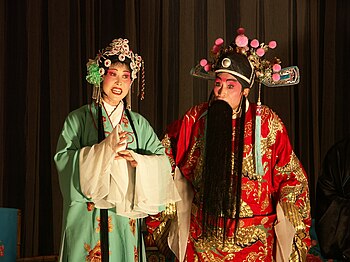
Chuanju ( Chinese trad. 川劇 , Ex . 川剧 , Pinyin : chuānjù ) is the main form of local theater in southwestern China ( Sichuan , Guizhou and Yunnan ). Another name is Sichuan opera. The Sichuan School of Chinese Opera originated about 400 years ago at the end of the Ming dynasty and at the beginning of the Qing era [1] . At that time , there were several different forms of folk theater in the Sichuan province. They were mixed, developed and subsequently turned into one common phenomenon - the Sichuan Opera. The most characteristic feature of this art form is singing in a high voice. The repertoire is very rich, includes more than 2 thousand works. Texts are distinguished by high artistic value and humor. The movements are detailed and very expressive [2] .
At present, it is believed that the capital of this art form is Chengdu [3] .
Content
Sichuan Opera Today
At the beginning of the 20th century there was a reformation of many kinds of Chinese art. The most famous reformer was Kan Zhilin, who headed the Sanqinq opera company (Three Celebrations), founded in 1912 [4] .
Today's Sichuan Opera is a synthesis of five melodic styles. The Sichuan school is characterized by solo parts, skillful acting, the use of many percussion instruments and very funny plots. The actors wear bright costumes and move with fast, expressive music. A distinctive feature of this genre is the brightly colored masks, which the actors manage to change in a fraction of a second unnoticed by the viewer. This trick, as well as acrobatics, such as jumping through a burning hoop or manipulating swords, is especially popular with viewers.
Face change
Reception of the mask change ( Chinese trad. 變臉 , Ex . 变脸 , Pinyin : biànliǎn ) was used about 300 years ago during the reign of Emperor Qianlong , a representative of the Qing dynasty. This is a very important element of the Sichuan Opera, and its secrets are kept in the strictest confidence. From generation to generation, without leaving the circle of theatrical families, there is a transfer of secrets of the technique of "magical change of faces." Actors turn away a face or simply wave a hand, and now a new character is looking at the viewer - and so many times in succession, to the amazement of the public.
At the very beginning, the actors used powder colored in different colors for their magical reception. The powder was in the cups, the actors blew in the bowl, and the powder stuck to their oil-covered faces. Another method was to apply color paste, hidden in the palms, on the face. Red color meant anger, black - an extreme degree of rage. By the twenties of the last century, the actors switched to the use of layers of masks made of paper. The artist just needed to quickly remove the next layer. Nowadays masks are made of silk; their number on the face of the actor can reach twenty-four. Individual masters can change up to 10 masks in 20 seconds.
These masks are also remarkable by the fact that there is nothing superfluous in them, everything in them is a symbol of carrying certain information about the character.
Ways to change faces
In total, there are three main styles of changing masks:
- Wiping Mask - The actor applies cosmetic paint. If the entire face needs to be changed, cosmetic paint is applied to the forehead or eyebrows; for changes on the lower half of the face, paint is applied to his cheeks or nose. As a rule, this paint has a special composition, due to which it quickly hardens on the face during the performance.
- “Blowing Mask” (Blowing Mask) - the actor works with powder cosmetics, such as gold, silver, special ink. Sometimes a tiny box is placed on the stage into which the actor is blowing, due to which the powder sticks to the face. Sometimes a similar ink mixture is placed in a special cup. The secret of success: close your eyes and mouth in time, hold your breath.
- “Pulling the mask” (Pulling Mask) is the most difficult element. The masks are painted on pieces of damask , cut, fastened with silk thread and slightly glued to the face one after the other. Silk thread is fixed in an inconspicuous part of the suit. By clicking on the cloak, the performer magically changes the masks one by one [5] .
Meaning of mask colors
The value of the masks used in the Chinese opera can help determine the qualities of the character of the characters, tell a lot about the role of this character in the performance. Also the colors of the masks express the basic abilities of the characters of theatrical performance.
Black
Initially, a black mask in combination with flesh-colored skin signified sincerity. Over time, values of honesty, valor, integrity, integrity, impartiality were added. It is traditionally male color.
Red
This color means courage and loyalty to duty. As a rule, red is used for positive characters: soldiers, celestial beings, virtuous wives, etc.
White
This color can be combined with different light shades: beige, pale pink, soft purple. However, such a mask will be worn by a villain. White symbolizes slyness, deceit, duplicity. Also this color can indicate old characters, monks, eunuchs, wanderers who have left the world.
Green
This color is positive, as a rule, it symbolizes courage, recklessness, strength of mind. The heroes who came out of the people, the rebels, the noble brigands were often depicted with green masks.
Blue
This color in its symbolic content is identical to green, however, it may have a connotation of malice and cunning.
Purple
This color expresses solemnity, openness, justice. Sometimes this color is used to inform the viewer about the deformity of the face of this hero.
Yellow
This color embodies courage, ruthlessness and resilience, however, a character with a yellow mask may have hot temper and cruelty.
Silver and gold
In the Chinese Opera, these colors are very unusual due to the relative rarity of the dye, which is why they symbolize the most iconic characters. As a rule, they are used to show the power and supernatural character of a character, belonging to high military ranks, or a connection with the other world. As a rule, magic characters (buddhas, immortals, hermits, gods) wear masks of exactly these colors.
Notes
- ↑ Halson, Elizabeth (1966). Peking Opera: A Short Guide. Hong Kong: Oxford University Press. pp. 68-69.
- ↑ Theater Encyclopedia. Volume 5 / Chapters. ed. P. A. Markov - M .: Soviet Encyclopedia, 1967. - 1136 stb. with ill., 8 p. ill.
- ↑ Cheng Du online (October 21, 2007). The appeal date is April 16, 2018.
- ↑ Stanton, Sarah. Banham, Martin. [1996] (1996). The Cambridge Paperback Guide to Theater. Cambridge press publishing. ISBN 0-521-44654-6
- S China Sichuan Opera: Face Changing Art, Masks . www.travelchinaguide.com. The appeal date is April 16, 2018.