Clever Geek Handbook
📜 ⬆️ ⬇️

Lyapunov exponent

The Lyapunov exponent of a dynamic system is a value that characterizes the speed of removal of trajectories from each other. The positive Lyapunov exponent usually indicates the chaotic behavior of the system.

Named in honor of Alexander Mikhailovich Lyapunov .

Definition

The flow of a dynamical system is defined as a one-parameter family of mappings;
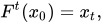
Ft(x0)=xt,{\ displaystyle F ^ {t} (x_ {0}) = x_ {t},} {\displaystyle F^{t}(x_{0})=x_{t},}

Wheret↦xt {\ displaystyle t \ mapsto x_ {t}} {\displaystyle t\mapsto x_{t}} denotes a trajectory in a dynamic system. Lyapunov exponent can be determined as follows:

λ(x)=limt→∞onet⋅ln⁡‖dxFt‖{\ displaystyle \ lambda (x) = \ lim _ {t \ to \ infty} {\ tfrac {1} {t}} \ cdot \ ln \ | d_ {x} F ^ {t} \ |} {\displaystyle \lambda (x)=\lim _{t\to \infty }{\tfrac {1}{t}}\cdot \ln \|d_{x}F^{t}\|}

Key Features

  • For systems that preserve volume, the Lyapunov exponent is not negative.
  • If the system has a negative Lyapunov exponent, then all the trajectories converge to a fixed point.
Source - https://ru.wikipedia.org/w/index.php?title= Lyapunova_ indicator&oldid = 93180715


More articles:

  • Semenov, Konstantin Igorevich
  • Shemur
  • Raevsky, Alexander Evgenievich
  • KinoOstrov
  • Liu Xiaotong
  • Danilov, Boris Ivanovich
  • Key 198
  • Key 182
  • Hamgee Nugges
  • Amstel Gold Race 2018

All articles

Clever Geek | 2019
