"Japanese tragedy" , another translation of the name - "The Tragedy of Japan" ( Japanese 日本 の 悲劇 , nihon no Higeki ; Eng. A Japanese Tragedy ) - Japanese black and white drama film directed by Keishuke Kinoshita , which appeared on the screen in 1953 . A gloomy portrait of post-war Japan and the story of mother’s sacrifice. Thanks to the masterful interweaving of the narrative of art with retrospective memories of the heroine and newsreel materials, Keisuke Kinoshita shows an insightful account of the personal victims of the war. In this work, the director questions the unity within the main social unit - the family - in the difficult times that post-war Japan experienced.
| Japanese tragedy | |
|---|---|
| jap. 日本 の 悲劇 ( nihon no higeki ) | |
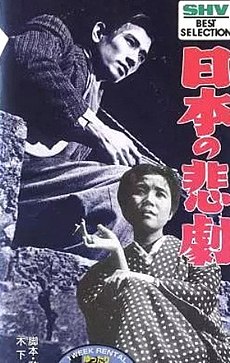 | |
| Genre | movie drama |
| Producer | Kaisuke Kinoshita |
| Producer | Takashi Conde Retaro Kuvata |
| Author script | Kaisuke Kinoshita |
| In the main cast | Yuko Motizuki , Yoko Katsuragi Masami Taura Keiji garden |
| Operator | Hiroshi Kusuda |
| Composer | Chuji Kinoshita |
| Film company | " Shiku " |
| Duration | 116 minutes |
| A country |  Japan Japan |
| Tongue | Japanese |
| Year | 1953 |
| IMDb | |
Content
Story
Widow Haruko works as a servant in a small hotel in the tourist town of Atami , famous for its hot springs. She has only one life goal - to put on her feet and educate Seyichi's 17-year-old son, and God forbid, she would successfully marry the 19-year-old daughter Utako.
Haruko, a dark woman, alone, raised her children on her own and gave them the opportunity to learn. To do this, she had to speculate on the black market, work as a maid in a resort hotel, and finally sell her body. She did all this for her children, not expecting any reward. But children look at things in their own way. They are ashamed of the mother’s actions, her darkness, they are cold towards her. They do not want to see even her motherly love.
Daughter - Utako did not want to part with her savings of 40 thousand yen, when it was required to help her mother out of a desperate situation. The trouble that happened with Utako, when she studied at a female gymnasium, made her hate people, she lost human feelings, except for the excessively developed conceit. As a result, Utako escapes in an unknown direction with an English teacher who is much older than her in love with her.
Son - Seiichi is even more cruel. “Mother has nothing to do with us. She lives in another world. There are such women ... Everything can be in our world ... ”he says. And the mother leaves, entering a rich house by an adopted son.
Once Haruko realizes that her children do not love her, do not respect her victims. She is completely destroyed and devastated, having realized the collapse of her illusions, Haruko throws herself under the train.
Cast
- Yuko Motizuki - Haruko Inoue
- Yoko Katsuragi - Utako, daughter of Haruko
- Masami Taura - Seiichi, son of Haruko
- Keiji Sada - Tatsuya, street musician
- Teiji Takahashi - Sato, cook at the hotel
- Keiko Awaji - Wakamaru, Geisha
- Ken Uehara - Masayuki Akzawa, English teacher
- Sanae Takasugi - Mrs. Akzawa, his wife
- Shinichi Himori - Ichizo, brother-in-law Haruko
- Tanie Kitabayashi - Ichizo's Wife
- Fujio Suga - Fujita
- Kyoko Enami - Yoko Musume
- Yoshiro Kusakari - Katsuo
- Jun Tatara - Unknown
- Eijiro Yanagi - Iwami
Premieres
- - The national premiere of the film took place on June 17, 1953 [1] .
- - The European premiere took place in Stockholm on October 8, 1970 [2] .
- - first shown on the American continent on May 30, 1979 in New York [2] .
Awards and nominations
- Mainity Film Award
- 8th Award Ceremony (1954) [3]
- Won:
- Award for Best Screenplay - Keisuke Kinoshita (ex aequo - “ Love Letter ”, dir. Kinyu Tanaka and “ Sincerity ”, dir. Masaki Kobayashi ).
- Award to the best actress of 1953 - Yuko Motizuki.
- Blue Ribbon Film Award
- 4th Award Ceremony (for 1953)
- Won:
- Award for Best Screenplay - Keisuke Kinoshita (ex aequo - “Love Letter”, dir. Kinyu Tanaka and “Sincerity”, dir. Masaki Kobayashi). [four]
- Film Award " Kinema Jumpo " (1952)
- Nomination:
- for the best film of 1951, however, according to the results of the vote, the film took 6th place [5] .
Notes
- ↑ 日本 の 悲劇 (1953) on the website of the Kinema Jumpo magazine (Japanese)
- ↑ 1 2 Nihon no higeki (1953) —Release Info on the IMDb website
- ↑ Winners of the 1953 work awards on the official website of the Mainity Prize (Japanese)
- ↑ Blue Ribbon Awards — 1954 on the IMDb website
- ↑ Kinema Junpo Top YBY on Rinkworks.com
Links
- Japanese Tragedy on the Internet Movie Database
Literature
- Iwasaki, Akira . "Contemporary Japanese Cinema", 1958, (translated from Japanese 1962, Translators: Vladimir Grivnin, L. Levin), - M .: Art, 1962, P.524.
- Sato, Tadao . “Cinema of Japan”: Translation from English - M., “Rainbow”, 1988. - S. 224. ISBN 5-05-002303-3