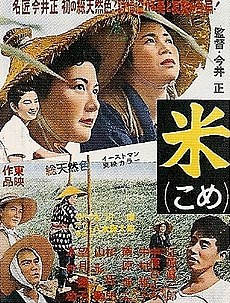
“Rice,” another name is “People of Rice” [comm. 1] ( Japanese 米 , kome ; The Rice People ) - Japanese film drama directed by Tadashi Imai , which appeared on the screen in 1957 . Director Imai shot a social drama in which he showed pictures of poverty reigning in a Japanese village in the 1950s, and images of young peasants who could not find a way out of this situation were displayed. The film was named the best film of the year at the ceremony of presenting the three most prestigious Japanese film awards: " Kinema Jumpo ", " Mainity " and " Blue Ribbon ". The film was also nominated for the Golden Palm Branch of the 10th Cannes Film Festival .
| Rice (Rice people) | |
|---|---|
| Japanese 米 ( kome ) | |
 | |
| Genre | movie drama |
| Producer | Tadashi Imai |
| Producer | Hiroshi Ookawa |
| Author script | Yasutaro Yagi |
| In the main cast | Masako Nakamura , Shinjiro Ebara, Yuko Motizuki |
| Operator | Shunichiro Nakao |
| Composer | Yasushi Akutagawa |
| Film company | Toei |
| Duration | 118 minutes |
| A country |  Japan Japan |
| Tongue | Japanese |
| Year | 1957 |
| IMDb | |
Content
Story
Tsuguo, the second son in a peasant family living near the Kasumigaura lagoon, left home and, together with Senkichi, went fishing in a small vessel. Senkiti has returned from the National Self-Defense Corps and is now the leader among the village boys. Senkichi’s younger sister, Sadako, likes Tsuguo, but he cannot forget Chiyo, the girl from that side of the lagoon that he met during the holiday. The Chiyo family is very poor, the father is sick, and the whole burden of caring for the family fell on the shoulders of his mother, Yone, who cultivates a piece of land and fish on the lake. One night, the ship on which Tsuguo and Senkiti were stationed turned over. Senkichi is dead, and Tsuguo saves Chiyo. For some time, Tsuguo lives in Chiyo's house and becomes her good friend. But Yone was called to the police because she was engaged in illegal fishing. Landowner Matsunosuke says that for 10 thousand yen he could have settled the matter with the police. Upon learning of this, Tsuguo leaves Chiyo 10 thousand yen and leaves. On a rainy day, Yone goes to the police. She comes back running, fear of punishment oppresses her. She rushes into the lagoon. Before the start of the harvest festival, Tsuguo and his mother go to the village to ask for Chiyo’s hands, but they come to the funeral of her mother, who committed suicide in the lagoon.
Cast
- Masako Nakamura - Chiyo Yasuda
- Shinjiro Ebara - Tsuguo Tamura
- Yuko Motizuki - Yone Yasuda
- Isao Kimura - Senkiti
- Yoshi Kato - Takedo Yasuda
- Hitomi Nakahara - Yoshino Tamura
- Shinji Nambara - Aikiti Tamura
- Mayumi Fujisato - Tomiko Tamura
- Izumi Hara - Ume Tamura
- Isao Yamagata - Matsunosuke Ota
- Sake Umezu - Take
- Yoshiko Okada - a neighbor of the Yasuda family
- Kouji Sugi - Wholesale Manager
- Akiko Hino - Tokiko
- Sen Hara - Ume Tamura
- Koji Kiyomura - Goro
- Etsuko Miyata - Hiroko
- Eijiro Tono - Sakuzo
Premieres
- - The national premiere of the film took place on March 4, 1957 [1] .
- - The world premiere took place as part of the competitive screening of the tape at the Cannes Film Festival on May 7, 1957 [2] .
Awards and nominations
The Japanese film "Rice" does not at all idealize Japan. In many ways, it resembles “Shoe Cleaner” - a realistic film, depicting the dark side of life. The same applies to Rice. This is in every way a modern, unadorned tale of the Japanese village. Moreover, his realism has tremendous power, it creates the feeling that the walls are falling on you ... The landscape is beautiful. Amazingly truthfully conveyed human drama. The viewer sees a picture of extreme poverty and deprivation ... Young life wilts, not having time to bloom. The hero of the film was born the second son in the family and therefore is doomed to constant struggle, otherwise he will disappear. "Rice" won a prize in Cannes. And if you do not turn away from drama, from the truth, he will receive your prize. The film is very interesting, deeply exciting. In addition, like everything Japanese, it captivates.
- Mainity Film Award
- 12th Award Ceremony (1958) [4]
- Won:
- 1957 Best Film Award
- Award to the best director of 1957 - Tadashi Imai (ex aequo - " A Tale of Pure Love ").
- Award for the best work of a sound engineer - Koichi Iwata.
- Blue Ribbon Film Award
When Rice was on display in Europe, it was rated as one of the best works of Japanese neorealism. However, in this film there is already a danger that realists like Imai, that is, artists who particularly value objectivity, are easily exposed. This objectivity, which should be called naturalistic, is especially clearly felt in the image of life in the house of the fisherwoman, who, driven by want, persecuted by the police, eventually commits suicide by throwing herself in the water. The danger lies in the old-fashionedness of some scenes, for example, the last funeral scene, when the funeral procession moves among the rice fields and the camera (and therefore the director and spectator) retreats at a slow pathetic pace, and the procession continues its movement among the rice fields, going farther and farther and further. In general, I, apparently, am prejudiced by such a shooting of the final shots, when the camera, moving back (treck back), gradually switches to the general plan (long), and the caption “End” appears. I am firmly convinced that the film should have been finished vigorously, making the leitmotif of the final scenes a hope whose sprouts finally begin to turn green in the hearts of young men and women.
- 8th Award Ceremony (for 1957) [6]
- Won:
- 1957 Best Film Award
- Award to the best director of 1957 - Tadashi Imai (ex aequo - " A Tale of Pure Love ").
- The award for the best actress of 1957 is Yuko Motizuki (ex aequo - “ Catch an Eel ”).
- Cinema Prize " Kinem Jumpo " (1958) [6]
- Won:
- 1957 Best Film Award
- Award to the best director of 1957 - Tadashi Imai.
- 10th Cannes International Film Festival (1957)
- Nomination:
- for the main prize "Golden Palm Branch" [7] [6] .
About the movie
Having conceived the production of the film, director Tadashi Imai, along with screenwriter Yasutaro Yagi, spent several months in villages and fishing villages around Lake Kasumigaura , collecting information about the life of local fishermen and built a plot that naturally follows from his information [8] .
When the management of the Toei film company took up this production, it was decided that the film would be in color, and 20 million yen was allocated for direct expenses [8] . But this amount was not enough. Filming lasted five to six months - from the rice planting season to harvesting. Production costs were four times the original estimate. Nevertheless, the management of the company did not object to the director, closing the eyes of the studio bosses made it possible for Imai to complete the production [8] . And did not fail. "Rice" collected decent fees at the national box office, and after no less successful screening of the tape at the Cannes Film Festival, it was purchased for rental in many countries around the world.
Comments
- ↑ The name "People of Rice", found both on the net and in some books on cinema, comes from the English name of the film at the international box office: The Rice People . In the Russian translation, the film appeared on the network on torrent trackers and online viewing sites called “Rice” (as in the Japanese original title).
Notes
- ↑ 米 (1957) on the website of the Kinema Jumpo magazine (Japanese)
- ↑ Kome (1957) —Release Info on the IMDb website
- ↑ Iwasaki, Akira . "Contemporary Japanese Cinema", 1958, (translated from Japanese 1962, Translators: Vladimir Grivnin, L. Levin), - M .: Art, 1962, S.222-223. (Russian)
- ↑ Winners of the 1957 work awards on the official website of the Mainity Prize (Japanese)
- ↑ Iwasaki, Akira . "Contemporary Japanese Cinema", 1958, (translated from Japanese 1962, Translators: Vladimir Grivnin, L. Levin), - M .: Art, 1962, p. 271. (Russian)
- ↑ 1 2 3 Kome (1957) —Awards on the IMDb website
- ↑ Cannes Film Festival (1957) on the IMDb website
- ↑ 1 2 3 Iwasaki, Akira . "Contemporary Japanese Cinema", 1958, (translated from Japanese 1962, Translators: Vladimir Grivnin, L. Levin), - M .: Art, 1962, P.270, 275. (Russian)
Links
- Rice on the Internet Movie Database
Literature
- Iwasaki, Akira . "Contemporary Japanese Cinema", 1958, (translated from Japanese 1962, Translators: Vladimir Grivnin, L. Levin), - M .: Art, 1962, P.524.
- Iwasaki, Akira . “History of Japanese Cinema”, 1961 (translation from Japanese 1966, Translators: Vladimir Grivnin, L. Levin and B. Raskin). - M.: Art, 1966, S.320.
- Sato, Tadao . “Cinema of Japan”: Translation from English - M., “Rainbow”, 1988. - S. 224. ISBN 5-05-002303-3
- " Director's Encyclopedia : Cinema of Asia, Africa, Australia, Latin America", Research Institute of Motion Picture Arts, T. N. Vetrova (editor-in-chief), Materik. M. , 2001, pp. 44–45. ISBN 5-85646-053-7 .