
Lach numbers , discovered by a mathematician from Slovenia, Ivo Lah in 1955 [1] , are coefficients expressing increasing factorials in terms of decreasing factorials .
Unsigned Lach numbers have interesting meanings in combinatorics - they reflect the number of ways in which a set of n elements can be divided into k nonempty ordered subsets. Lach numbers are related to Stirling numbers .
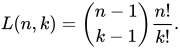
Unsigned Lach numbers (sequence A105278 in OEIS ):
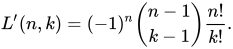
Signed Laha numbers (sequence A008297 in OEIS ):
L ( n , 1) is always n ! In the above interpretation of partitioning the set {1, 2, 3} into 1, the set can be implemented in 6 ways:
- {(1, 2, 3)}, {(1, 3, 2)}, {(2, 1, 3)}, {(2, 3, 1)}, {(3, 1, 2)}, {(3, 2, 1)}
L (3, 2) corresponds to 6 partitions into two ordered sets:
- {(1), (2, 3)}, {(1), (3, 2)}, {(2), (1, 3)}, {(2), (3, 1)}, {( 3), (1, 2)} or {(3), (2, 1)}
L ( n , n ) is always equal to 1, because, for example, splitting the set {1, 2, 3} into 3 nonempty subsets leads to subsets of length 1.
- {(1), (2), (3)}
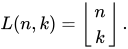
When using the Karamat-Knuth notation for Stirling numbers, it was proposed to use the following alternative notation for Lach numbers:
Content
- 1 Rising and decreasing factorials
- 2 Identities and Relationships
- 3 table of values
- 4 See also
- 5 notes
- 6 Literature
Rising and decreasing factorials
Let be denotes an increasing factorial , but - decreasing factorial .
Then and
For example,
Compare with the third row of the value table.
Identities and Relationships
-
- Where - Stirling numbers of the first kind , and - Stirling numbers of the second kind . If you accept that and at .
Value Table
Lach value table:
| one | 2 | 3 | four | 5 | 6 | 7 | 8 | 9 | 10 | eleven | 12 | |
|---|---|---|---|---|---|---|---|---|---|---|---|---|
| one | one | |||||||||||
| 2 | 2 | one | ||||||||||
| 3 | 6 | 6 | one | |||||||||
| four | 24 | 36 | 12 | one | ||||||||
| 5 | 120 | 240 | 120 | twenty | one | |||||||
| 6 | 720 | 1800 | 1200 | 300 | thirty | one | ||||||
| 7 | 5040 | 15120 | 12600 | 4200 | 630 | 42 | one | |||||
| 8 | 40320 | 141120 | 141120 | 58800 | 11760 | 1176 | 56 | one | ||||
| 9 | 362880 | 1451520 | 1693440 | 846720 | 211680 | 28224 | 2016 | 72 | one | |||
| 10 | 3628800 | 16329600 | 21772800 | 12700800 | 3810240 | 635040 | 60480 | 3240 | 90 | one | ||
| eleven | 39916800 | 199584000 | 299376000 | 199584000 | 69854400 | 13970880 | 1663200 | 11880 | 4950 | 110 | one | |
| 12 | 479001600 | 2634508800 | 4390848000 | 3293136000 | 1317254400 | 307359360 | 43908480 | 3920400 | 217800 | 7260 | 132 | one |
See also
- Stirling numbers
- Pascal Matrix
Notes
- ↑ Riordan, 1958 .
Literature
- John Riordan. Introduction to Combinatorial Analysis . - Princeton University Press, 1958. - ISBN 978-0-691-02365-6 . The article was reprinted in 1980, and one more time in 2002 (Dover Publications)