Aleksander Stepanovich Vereshchagin ( , - , ) - Russian historian of the Vyatka region , archaeographer , teacher, outstanding local historian [2] [3] [4] , state adviser [5] .
| Alexander Stepanovich Vereshchagin | |||
|---|---|---|---|
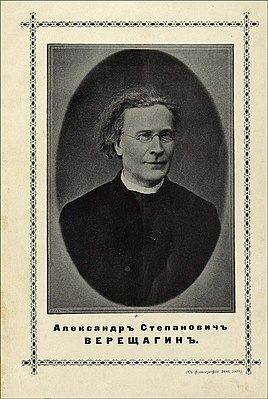 Portrait of an obituary in "Proceedings of the Vyatka Scientific Archival Commission." 1909. Issue one | |||
| Aliases | Buevsky, A .; B — n, A .; V — n, A. S. [1] | ||
| Date of Birth | |||
| Place of Birth | |||
| Date of death | |||
| A place of death | |||
| Citizenship (citizenship) | |||
| Occupation | historian , archaeographer , teacher , local historian | ||
| Years of creativity | 1863-1908 | ||
| Awards |
| ||


Content
- 1 Biography
- 2 Contribution to historical science
- 2.1 Criticism of the theory of the late emergence of Vyatka
- 3 Bibliography
- 4 notes
- 5 Literature
Biography
Alexander Stepanovich came from a family of deacon of the Resurrection Church of the city of Urzhum , Vyatka province . He graduated from the Nolinsky Theological College, then, in 1854, the Vyatka Theological Seminary , after which the board of the seminary, as one of the best students, was sent at the state expense to continue spiritual education at the Kazan Theological Academy , which he graduated in June 1858. A fellow practitioner of A. S. Vereshchagin at this educational institution was the well-known schism historian Afanasy Prokofievich Shchapov , who graduated from the academy in 1857 and at the same time began teaching in his alma mater . Under the influence of A. P. Shchapov, A. S. Vereshchagin set about studying Vyatka history [6] .
On September 1, 1858, at a conference at the Academy, the young scientist was approved as a candidate of theology . Two weeks earlier, on August 19, he was appointed a teacher of world history and the Greek language at the Samara Theological Seminary . Within a year and a half after this, he changed several posts there, until in February 1860 he left Samara , expressing a desire to go to the Vyatka Theological Seminary. From February 24, 1860, Alexander Stepanovich taught Latin and patristics in Vyatka, but in the Vyatka seminary he also changed several posts or combined them at the same time for 2-3: French teacher , librarian, assistant inspector. The biographer Vereshchagin A. A. Shubin, noting the inclination of Alexander Stepanovich to frequent changes of places and positions, explained this phenomenon by the desire to forget himself in work after the death of his wife. Since November 25, 1863, in addition to working at the Vyatka Seminary, Vereshchagin began editing the unofficial part of the Vyatka Provincial Gazette , and from February 26, 1864 he left the seminary altogether [7] .
Alexander Stepanovich became the full editor of the Vyatka Provincial Gazette and the head of the newspaper table under the Vyatka Provincial Board [7] . At the same time, he collaborated in the newly opened newspaper Vyatka Diocesan Vedomosti [8] . Then he was elected a full member of the Vyatka Provincial Statistical Committee - his circle of public interests is diverse. But the editorial activity of Vereshchagin did not last long, already on August 1, 1865 he left the post of editor and returned to the field of education, he decided to become a teacher of Latin at the Vyatka Provincial Gymnasium, a year later he already worked as a teacher of Russian language and literature at the Vyatka Mariinsky Girls' Gymnasium. A year later, on August 1, 1867, he returned to the Vyatka Theological Seminary, where he again taught Latin [7] .
On February 6, 1880, by the decree of the Holy Synod, A. S. Vereshchagin was appointed acting inspector of the Perm Theological Gymnasium, but less than six months later, on July 19, he returned to the Vyatka Theological Seminary to the previous position of teacher of the Latin language. On August 4, 1882, he was appointed superintendent of the Vyatka Theological College . Two years later, he was appointed a member of the Vyatka Diocesan School Council, but in the summer of 1887 he retired and devoted himself completely to scientific activity [9] .
According to his political views, A. S. Vereshchagin did not belong to any of the political parties in Russia, but according to his main convictions he was closest to the sixties, while maintaining an independent way of thinking. Alexander Stepanovich was married, but his wife died less than a year after the wedding, leaving him a newborn daughter, Evgenia Alexandrovna. On July 28, 1885, the daughter married Alexander Nikolaevich Vechtomov, court counselor and teacher of the Vyatka Theological School, who became the priest of the Nikolaev Church in Elabuga in 1909. Alexander Stepanovich died on December 5, 1908 in Vyatka from a cold, complicated by pneumonia . The coffin with the body of Vereshchagin was carried by members of the Vyatka Scientific Archival Commission, headed by Governor S. D. Gorchakov . One of the streets in the city of Kirov is named after Alexander Vereshchagin [5] .
Contribution to Historical Science
The research and development activities of A. S. Vereshchagin began even when he worked as a teacher, mainly during vacation time. He studied local and metropolitan archives: the archive of the Holy Synod, the archive of the Ministry of Justice , the manuscript department of the Imperial Public Library in St. Petersburg, the archive of the Rumyantsev Museum of Moscow. The scientist published the results of his scientific research in various Vyatka periodicals. These works concerned mainly the history of the native Vyatka region [10] .
Preparing his works for publication, he was faced with a lack of funds for their publication, and then he came to the conclusion that it was necessary to establish the Vyatka Scientific Archival Commission (VUAK), about which he initiated the necessary petition. His initiative was successful, and on November 28, 1904, the Vyatka Scientific Archival Commission was opened, and Alexander Stepanovich was approved by its deputy chairman and editor of the Proceedings of VUAK (the chairman was a prominent Vyatka historian and statistician N. A. Spassky ) [3] [ 11] .
Proceedings of the Archival Commission were published annually in the amount of four to six volume issues. They were distinguished by the depth and thoroughness of the historical study and the variety of content, mainly the “Works of the Vyatka Scientific Archival Commission” consisted of the works of A. S. Vereshchagin himself. The publications of the remaining members of the Commission made up only a very small part of the “Proceedings of the VUAK” [3] [11] .
The historian studied and published most of the manuscript sources on the early period of Vyatka history of the XIV-XVII centuries , in particular, " The Tale of the Country of Vyatka ". He is the author of numerous works on the history of the ancient Vyatka, Vyatka diocese , about the outstanding Vyatkans who left their mark on the history and culture of the region. The historical works of A. S. Vereshchagin are inherent in actual reliability and accuracy. Their extensive publication in Proceedings of the Vyatka Scientific Archival Commission, in fact, made it possible to lay, in the opinion of V. A. Berdinsky , “a powerful source base for local historiography” [3] .
The works of A. S. Vereshchagin received positive reviews on the pages of the Journal of the Ministry of Public Education and the Historical Bulletin . The recognition of A.S. Vereshchagin the historian began in 1887 in Yaroslavl at the VII Archaeological Congress, where he was sent by the Vyatka Statistical Committee. On August 17, he read two essays on the history of the ancient Vyatka: “Was Vyatka populated by Novgorod immigrants in the 12th century?” And “Where did the testimonies of the Vyatka chronicler come from?” In his report, he thoroughly criticized the opinion that had existed since N. M. Karamzin that the history of Vyatka dates back to the 12th century. This opinion was rooted on the basis of the evidence of the so-called “Vyatka chronicler” (a monument of the Vyatka script of the 17th – 18th centuries “The Tale of the Vyatka Country”). It was supported by historians A.I. Veshtomov , M.P. Pogodin , N.I. Kostomarov , A.I. Herzen , S.M. Soloviev , V.O. Klyuchevsky . A. S. Vereshchagin was able to prove the complete inconsistency of this opinion and justified the emergence of Russian settlements in the Vyatka starting only from the XIV century [12] .
Later, in 1905, in the article “From the History of the Old Russian Vyatka: I. The Question of the Initial Settling of Vyatka Rus”, speaking of the Ipatiev Chronicle (brought to 1292), the Lavrentiev Chronicle (1112-1305) and the Novgorod First Chronicle according to the Synodal to the list (until 1333), A. S. Vereshchagin summarized:
The silence of these chronicles about the Vyatka is simply explained by the fact that they had nothing to say about it: the “Russian Vyatka” did not exist until the time when these chronicles were finished, and we didn’t find any traces of residence on the banks of the Vyatka . But as soon as Russian life appears on Vyatka, the subsequent annals begin to talk about Vyatka. The author of this work of 44 years searched for these traces, and did not find it; he would be very happy if he had been given at least some reliable indications of Russian residence on the banks of the Vyatka until the middle of the 14th century.
- A. S. Vereshchagin: “From the History of the Old Russian Vyatka”: I. “The Question of the Initial Settlement of Vyatka by Rus”. - Vyatka, 1905.55 p.
Two abstracts of A. S. Vereshchagin at the closing of the congress in Yaroslavl were recognized as an exemplary historical work, "which made an irrevocable change in the views of science on the issue they raised and a final turn in all further works on the history of Vyatka and Novgorod colonization in the east" [13] . The famous historian I.E. Zabelin, who presided at the Archaeological Congress, said in his concluding remarks: “We cannot but rejoice at the studies that were told to us, for example, about Sylvester Medvedev - the first bibliographer and chronicler of Vyatka and his legends, about the priest Bogomil or Yeremey . Such exemplary works, of course, make up our harvest. ” The performance in Yaroslavl brought the historian the fame of a serious scientist. The Imperial Moscow Archaeological Society asked him to provide him with abstracts read at the congress. The Rostov Museum of Church Antiquities elected him among its members. The Nizhny Novgorod Academic Archival Commission also did the same [13] .
In a number of subsequent works, the historian again and again turned to the analysis and criticism of the evidence of the “Vyatka chronicler”:
Thus, leaving the testimony of the Tale about the campaign of Novgorodians to Vyatka in 1174, as not only unconfirmed, but also directly refuted by other completely reliable testimonies, one has to accept the testimony of chronicles about the arrival of Novgorodians in Vyatka in 1374, the validity of which does not raise any doubts and confirmed by further annalistic news quite reliable.
- A. S. Vereshchagin, “Afterword to the Tale” // Transactions of VUAK, 1905. - Issue. III, Dep. 2. - S. 97.
“For the first time, we read about the appearance of Russians in Vyatka in five annals under 1374,” he wrote in another work. According to his findings, the first Russian settlers in the Vyatka lands were Novgorod settlers of the XIV, and not the XII century. The opinion of the scientist was new and was not immediately accepted by the historical community. Vereshchagin’s contemporary N. A. Rozhkov adhered to the previous “Vyatich theory” of the early origin of settlements in Vyatka. Gradually, a new look at the history of the Vyatka region, developed by the Vyatka historian, became universally recognized in historical science [12] .
Criticism of the theory of the late emergence of Vyatka
Candidate of historical sciences, secretary of the Vyatka diocese A. G. Balyberdin questioned the correctness of the conclusions of A. S. Vereshchagin. How could it happen that the year of foundation of Vyatka - 1374, indicated in various Russian annals, turned into the year 1174 in "The Tale of the Country of Vyatka"? Why was this distortion done? Balyberdin refers to the opinion of Vereshchagin, who accuses him of manipulating the fact of the nameless Vyatka scribe who wanted to depict the history of his land more ancient and, therefore, more glorious. A. S. Vereshchagin wrote:
It cannot be resolutely asserted that in The Tale 1174, instead of the annals of 1374, was not set intentionally. The preface of the Tale (filled with fables about the celebrity of the ancient Slavs and their princes) in the Tolstoy list directly indicates the desire of its compiler to glorify its Vyatka forefathers and link their initial history with the history of the famous Novgorod ancient Slavs ... Who knows - maybe our compiler " Tales ”, for the same reasons, replaced the letter of the annalistic news (6882–1374), which means 800, with the letter that means 600 (6682–1174), and the seemingly insignificant“ correction ”of the campaign of the Novgorodians in Vyatka took more time early with what he was, exactly two hundred years ...
- A. S. Vereshchagin, “Afterword to the Tale”. // Proceedings of VUAK, 1905. - Issue. III, Dep. 2 .-- S. 90.
Speaking about all the circumstances of this distortion of truth, writes A. G. Balyberdin, Vereshchagin nowhere talks about the specific time of the founding of the city of Vyatka. By Vyatka both among the chronicler and historians A.S. Vereshchagin and A.A. Spitsyn, one needs to understand not one city, but the entire territory along the banks of the Vyatka River , the Vyatka land in the broad sense. The ancient city on the Vyatka River itself was called Khlynov, not Vyatka. Vereshchagin did not write that the city was founded by Novgorod ushkuyniki . All this was thought up later, in the early 1970s by Kirov professor A.V. Emausky . According to his hypothesis, in 1374 Novgorod Ushkuyniki founded the city of Vyatka. This hypothesis fell into the hands of the regional leadership of the Kirov region, which in 1974 decided to magnificently mark the 600th anniversary of the founding of the city of Kirov and use the anniversary to derive its benefits in the form of obtaining financial preferences for the Kirov region from the central authorities, writes A. G. Balyberdin [14 ] .
Without discussing the scientific validity of the hypothesis of A. V. Emausky, the regional authorities achieved the award of the city of Kirov with the Order of the Red Banner of Labor , the construction of several important facilities, including the regional Palace of Pioneers. Until the end of the Soviet period, "The Tale of the Country of Vyatka" was considered a "tendentious composition of Russian churchmen." Meanwhile, Professor Emaussky himself wrote in later works that “archaeological materials, local traditions and later records of the Vyatka scribes indicate that the Russian colonization of the Vyatka region began in the XI - beginning of the XIII century ... Therefore, it is no coincidence in the official Vyatka documents of the late XVIII century, the year of foundation of Khlynov was considered the year 1199 ”, with the clarification that the first Novgorod settlements on the Vyatka of those years should not be considered cities in the usual sense, but small villages, and the settlement of new lands by Russians was not yet a hundred only numerous [14] .
Research resultsL.P. Gussakovsky , L. D. Makarova , A. L. Musikhin , a professor at Seattle University Daniel Clark Wo, said that Russian settlements on the Vyatka existed long before 1374. “All this, in aggregate, could not but lead to a reassessment of the scientific heritage of Vereshchagin and a revision of established views on the ancient history of Vyatka land. Figuratively speaking, in our days Khlynov again became an unknown city. It turned out that we still do not know the answer to the main questions: When, where, by whom, how, for what purpose was our city founded? What is its original name? From whom do modern Vyatchians and Kirovskites originate? ”Writes A. G. Balyberdin [14] .
Bibliography
- "Materials for the history of the Pugachev riot ." // either the Vyatka Provincial Gazette [15] [16] , or the Vyatka Diocesan Vedomosti [17] , 1864;
- “Ancient Acts Relating to the History of the Vyatka Territory”: Appendix to the 2nd volume of the collection “A Century of the Vyatka Province”. // [foreword A. Vereshchagin]; Edition of the Vyatka Provincial Statistical Committee. - Vyatka: Printing house of the provincial government, 1881. - X, 245, XXV p. - Decree. persons: s. I — X. - Decree. geo: s. X — XVI. - adj. to the 2nd vol. "A Century of the Vyatka Province";
- Two abstracts read at a meeting of the VII Archaeological Congress in Yaroslavl on August 17, 1887, by a full member of the Vyatka Statistical Committee A. Vnim: [I. “Was Vyatka populated by Novgorod immigrants in the 12th century?” II. “Where are the testimonies of the“ Vyatka chronicler ”obtained from and how reliable in general” (“Tales of the Vyatka country”)?] // [A. S. Vereshchagin] Ed. lips. stat. committee; 7 Archaeological Congress in Yaroslavl. - Vyatka: Lip. typ., 1887. - 46 p .;
- "Excerpts from the" Notes "Rychkova and Khitrovo about the ancient Vyatka"; "Excerpts from the writings of travelers XVI-XVIII centuries. about Vyatka and its inhabitants. " [Text]. - Vyatka, 1892. - 115 p .;
- "Wonderful, but forgotten Vyatchets." - Vyatka, 1894. - 13 p .;
- " V. Ya. Kolokolnikov ": [Biogr. sketch]: On the history of the Vyatka Seminary. - Vyatka: Lip. stat. com., 1895. - 40 p. ;
- "Vyatka poets of the XVIII century." [Contents: M. A. Ushakov , E. I. Kostrov and others] // In 2 issue. - Vyatka, 1897. - Issue. 1. - 92 s .; Vyatka, 1898. - Issue. 2. - 60 s .;
- "A rare freemason on Vyatka of the thirties." // [About A. N. Muravyov ] / [A. AT.]. - Vyatka: Lip. typ., 1899. - 24 p .;
- "Episodes from the life of the founder of the Vyatka Seminary ( Lavrenty Gorka )." // In 2 issue. - Vyatka, 1899. - Issue. 1. - 103 s .; Vol. 2. - 1902. - 209 p .;
- "The veneration of Nikola Mozhaisky in Vyatka in the XVII century." [Text]. - Vyatka, 1902. - 14 p .;
- A. Vn , “Concerning the bibliographic note < A. A. Spitsyna > about the“ Memorial Book of the Vyatka Province. for the year 1902 "." // Historical Bulletin , 1902, October. - C. 393—397;
- "Concerning the open letter of D. K. Zelenin ." - Vyatka: Lip. typ., 1904. - 32 p .;
- “Was the city of Khlynov alone?” // Memorial book of the Vyatka province for 1904. - 1903;
- “On the history of ancient Khlynov: is Khlynov older or Khlynovo?” “Was the city of Khlynov alone?” // [Op.] By A. S. V-na. - Vyatka: Provincial Printing House, 1904. - [2], 91 p .;
- “Tales of Russian chroniclers about Vyatka” // Collected and published by A. Vn. - Vyatka: Provincial Printing House, 1905. - 121, [1] p .;
- “Chronicler of the old years”: a monument to the Vyatka script of the 17th — 18th centuries. / Published by A.S. - Vyatka: Provincial Printing House, 1905. - 27 p .;
- “Vyatka temporary. Monument of Vyatka writing at the end of the 17th century. ” [Text] // Vyatka, 1905. - 98 p .;
- “A hedgehog is contemplated by a Chronicler of the Russian Princes, when reigning began in the Russian land and confirming the city. It is briefly written. ” // Proceedings of the Vyatka Scientific Archival Commission. - Vyatka, 1905. Issue. II. Sep. II. S. 90-96;
- "From the history of the old Russian Vyatka." 1. "The question of the initial settlement of Vyatka Rus." // [op.] A. S. V-na. - Vyatka: Provincial Printing House, 1905. - 55 p .;
- “Tales of the Great Icon of St. Nicholas ”: Monuments of the Vyatka Writing of the 17th — 18th Centuries // [foreword. and after publisher]. - Vyatka: published by A. S. Vn, 1905. - 76 p .;
- "The Tale of the Country of Vyatka" (Vyatka chronicler). Monument of Vyatka writing of the XVII — XVIII century . Published by A.S. // Vyatka, Provincial Printing House. 1905. - 97, [1] p .;
- "Afterword to the story of the country of Vyatka." // Proceedings of the Vyatka Scientific Archival Commission. - Vyatka. 1905. Issue 3. S. 69–97;
- "Errata (Criticism of the judgments of N. M. Karamzin , N. I. Kostomarov , N. A. Rozhkov and other historians on the problems of the history of the Vyatka region)." // Proceedings of the Vyatka Scientific Archival Commission. - Vyatka. 1905. Issue 1. Dep. 3. S. 25-29;
- “Errata (A critical review of the“ Vyatka plots ”by V. N. Krylov’s book“ Mr. Veliky Novgorod ”).” // Proceedings of the Vyatka Scientific Archival Commission. - Vyatka. 1905. Issue 2. Sep. 3. S. 76—77;
- “Four royal letters of land ownership of the Verkhov-Vyatka Transfiguration Catherine Monastery : 1595, 1598, 1606 and 1614” // Proceedings of the Vyatka Scientific Archival Commission. - Vyatka. 1905. Issue 5-6. Sep. 3, pp. 216–218;
- "The Newfound Yermolinsk Chronicle." // Proceedings of the Vyatka Scientific Archival Commission. - Vyatka. 1905. Issue 1. Dep. 3. S. 1-4;
- "Suzdal-Nizhny Novgorod princes in the history of the ancient Vyatka." // Proceedings of the Vyatka Scientific Archival Commission. - Vyatka. 1906. - Vol. I — II, Dep. III. - S. 1-30;
- "The account book of the Zemsky headman of the city of Khlynov I. Repin." 1678-1680. [Text] // Vyatka, 1906. - 105 p .;
- ““ Vyatka Bose ”according to the bit records of 1489.” // Proceedings of the Vyatka Scientific Archival Commission. - Vyatka. 1906. Issue 5-6, det. 3. S. 1-12;
- "The letters and acts of the Vyatka Assumption Trifonov Monastery 1580-1764 years." // Proceedings of the Vyatka Scientific Archival Commission. - Vyatka. 1907. - Issue. IV, 530, II p .;
- "Certificate and acts of the Vyatka bishop's house of 1551-1699." // Proceedings of the Vyatka Scientific Archival Commission. - Vyatka. 1907. - Issue. 2. S. 1-116 (No. 1-73); Vol. 3, pp. 117–212 (No. 74–119), Vol. 4. S. 213-306 (No. 120-180). 1908. Issue. 1, additional acts. S. 307-324 (No. 1-43);
- "On the campaign of the Vyatchans to Ugra in 1499." // Proceedings of the Vyatka Scientific Archival Commission. - Vyatka. 1908. - Vol. I. Sep. III. S. 1-14;
- “Prince I. M. Vorotynsky and the Monk Tryphon of Vyatka ” [Text]. // History and culture of the Volga-Vyatka region. (To the 90th anniversary of the Vyatka Scientific Archival Commission): Abstracts of reports and messages to the interregional scientific. conferences. Kirov, October 18–20, 1994 / KSPI; Region scientific bk them. A.I. Herzen. - Kirov: Volga-Vyatka Prince. Publishing House, 1994. - S. 19-36. - ISBN 5-7420-0586-5 .
Notes
- ↑ Masanov I.F. Dictionary of pseudonyms of Russian writers, scientists and public figures. In 4 t . - M .: All-Union Book Chamber, 1960. - V. 4. - S. 101-102.
- ↑ Rudakov, 1909 , p. 1257.
- ↑ 1 2 3 4 Berdinsky, 1996 , v. 6., p. 81-82.
- ↑ Vakhrushev, 2011 , p. 29, 69.
- ↑ 1 2 Vereshchagin Alexander Stepanovich. Historian and archaeographer, writer, local historian, state adviser (1835-1908)
- ↑ Shubin, 1909 , p. one.
- ↑ 1 2 3 Shubin, 1909 , p. 2.
- ↑ A. P. Lopukhin, “The Orthodox Theological Encyclopedia or Theological Encyclopedic Dictionary”. Volume III Baal - Vyacheslav. "Vyatka diocese." "Vyatka diocesan sheets"
- ↑ Shubin, 1909 , p. 3.
- ↑ Shubin, 1909 , p. 5.
- ↑ 1 2 Shubin, 1909 , p. 6.
- ↑ 1 2 Shubin, 1909 , p. 7.
- ↑ 1 2 Shubin, 1909 , p. 8.
- ↑ 1 2 3 Balyberdin, 2017 , p. 1-244.
- ↑ Vereshchagin, Alexander Stepanovich // New Encyclopedic Dictionary : In 48 volumes (29 volumes were published). - SPb. , Pg. , 1911-1916.
- ↑ Shubin, 1909 , p. 9.
- ↑ Rudakov, 1909 , p. 1258.
Literature
- Shubin A.A. Alexander Stepanovich Vereshchagin. (Obituary). // "Vyatka diocesan sheets", 1909, No. 1;
- Shubin A.A. Alexander Stepanovich Vereshchagin : Obituary // Proceedings of the Vyatka Scientific Archival Commission. - 1909. - Vol. 1. - S. 1-20. ;
- Rudakov V. E. A. S. Vereshchagin : Obituary // Historical Bulletin. - 1909. - No. 3. - S. 1257-1259.
- Emmausky A.V. Alexander Stepanovich Vereshchagin // Calendar of significant and memorable dates for 1965 (Kirov region). - Kirov, 1965. - S. 25-27.
- Petryaev E. D. People, manuscripts, books: Lit. finds. - Kirov: Volgo-Vyat. Prince publishing house, 1970. - 288 p.: ill .;
- Petryaev E. D. Literary findings: Essays on the cult. past Vyat. land. - 2nd ed., Ext. - Kirov: Volgo-Vyat. Prince Publishing House, 1981. - 288 pp., ill.
- Chudova G.F. In those far years: Essays on the local history of Vyat. provinces. - Kirov: Volgo-Vyat. Prince Publishing House, 1981. - 159 pp.: ill.
- Kolevatov N.A. Vereshchagin Aleksandr Stepanovich // Kolevatov N.A. - Kirov, 1990. - S.155-156.
- Berdinsky V. A. Vyatka historians: A word about Vereshchagin. - Kirov, 1991 .-- S. 43-82.
- Berdinsky V. A. Encyclopedia of the land of Vyatka: Noble people (biographical dictionary): in 10 volumes . - Kirov: GIPP Vyatka, 1996. - T. 6. - 540 p. - 15,000 copies.
- Vyatka. Monuments and memorable places / Comp. M.N. Boychuk. - Kirov, 2002 .-- S. 172: photo .;
- Berdinsky V. A. County historians: Rus. provincial historiography. - M., 2003 .-- S. 352-389;
- Zagidullina Ch. Studying the contribution of A. S. Vereshchagin to the cultural and historical heritage of the Vyatka region // Tomsk State University Journal. Cultural Studies: Sat. scientific materials of students and graduate students. - Kirov, 2003. - Issue. 1. - Kirov, 2003. - S. 8-11;
- Vakhrushev A. A. Educational mission of the press and literature in provincial Russia : Based on material from the Vyatka province of the 17th - early 20th centuries. - Izhevsk: Publishing house "Udmurt University", 2011. - 274 p. - 500 copies. - ISBN 978-5-4312-0018-2 .
- Balyberdin A. G. Unknown Khlynoff : Popular about the important. - Ridero, 2017 .-- 244 p. - ISBN 978-5-4483-9986-2 .