Mosquito bells [1] , or mosquito-jerkers [1] , or chironomids [2] [3] ( lat. Chironomidae ) - a family of dipterans . 7046 species [4] . Mosquitoes got their name because of the characteristic sound that occurs due to the high frequency of wing flapping (up to 1000 per second). Adults do not feed, their mouth organs are underdeveloped. The larvae of mosquito bells, some of which are known as bloodworms , live in near-bottom silt. Larvae feed on detritus and microorganisms, some are predators. Ringing mosquitoes are harmless to humans. Larvae are used as food for fish. They are found everywhere, including Antarctica ( Belgica antarctica ), the open ocean and thermal springs . The species Troglocladius hajdi was found in a deep cave (980 m) [5] .
| Mosquito bells | |||||||||||||||||||||||||||||||||||||||||
|---|---|---|---|---|---|---|---|---|---|---|---|---|---|---|---|---|---|---|---|---|---|---|---|---|---|---|---|---|---|---|---|---|---|---|---|---|---|---|---|---|---|
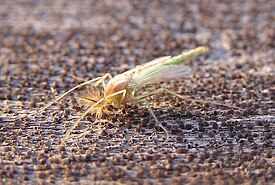 Bells mosquito | |||||||||||||||||||||||||||||||||||||||||
| Scientific classification | |||||||||||||||||||||||||||||||||||||||||
| |||||||||||||||||||||||||||||||||||||||||
| International scientific name | |||||||||||||||||||||||||||||||||||||||||
Chironomidae Jacobs , 1900 | |||||||||||||||||||||||||||||||||||||||||
Content
- 1 Classification
- 1.1 Some births
- 2 Interesting Facts
- 3 See also
- 4 notes
- 5 Links
Classification
Includes several subfamilies:
- † Aenneinae
- Aphroteniinae
- Buchonomyiinae
- Chilenomyiinae
- Chironominae
- Diamesinae
- Orthocladiinae
- Podonominae
- Prodiamesinae
- Tanypodinae
- Telmatogetoninae
- Usambaromyiinae
Some birth
- Calopsectra
- Chironomus
- Cricotopiella
- Electrotenia
- Manlayamyia
- Nomochirus
- Palpomyia
- Sendelia
- Spaniotoma
- Tanytarsus
Interesting Facts
- The larvae of the Polypedilum vanderplanki mosquito are the most complex known organisms that can tolerate drying [6] . As part of the Biorisk space experiment, the larvae spent more than a year in open space on the outer side of the ISS in a dried state, and more than 80% of the larvae survived.
- In Berdyansk, a monument was erected to the mosquito-ringing [7] .
See also
- Micropsectra calcifontis
- Pseudorthocladius cristagus
Notes
- ↑ 1 2 Animal life. Volume 3. Arthropods: trilobites, chelicerae, tracheal breathing. Onychophors / ed. M.S. Gilyarova , F.N. Pravdina, Ch. ed. V. E. Sokolov . - 2nd ed. - M.: Education, 1984. - S. 396. - 463 p.
- ↑ Shilova A. I. Chironomids of the Rybinsk Reservoir / Editor-in-Chief A. A. Strelkov. - L .: Nauka, 1976 .-- 251 p.
- ↑ Linevich A. A. Chironomids of Baikal and Pribaikalye / Editor-in-Chief Yu. V. Bekman. - Novosibirsk: Nauka, 1981. - 153 p.
- ↑ Catalog of Life: Chironomidae Family Retrieved March 29, 2014.
- ↑ Andersen T., Baranov V., Hagenlund LK, Ivković M., Kvifte GM, Pavlek M. Blind Flight? A New Troglobiotic Orthoclad (Diptera, Chironomidae) from the Lukina Jama - Trojama Cave in Croatia // PLOS ONE: Journal. - PLOS , 2016 .-- Vol. 11 (4). - P. 1-15 (e0152884). - DOI : 10.1371 / journal.pone.0152884 .
- ↑ Cornette, Richard Kikawada, Takahiro. The induction of anhydrobiosis in the sleeping chironomid: current status of our knowledge // IUBMB life: Journal article. - 2011. - No. 63 . - S. 419-429 .
- ↑ Monument to the mosquito-bell in the Resort will soon be put in place.