DeLorean Motor Company ( DMC ) is an automotive company , founded by John Delorean in 1975 . DMC is known for its only model released - the DeLorean DMC-12 sports car with a stainless steel body and gullwing doors . By 1982, the company fell into disrepair, was transferred to external management and was declared bankrupt .
| DeLorean Motor Company | |
|---|---|
 | |
| Type of | Ceased operations |
| Base | October 24, 1975 |
| Abolished | |
| Founders | John Delorean |
| Location | Detroit , United States Dunmarry , Northern Ireland |
| Industry | Automotive |
| Products | DeLorean DMC-12 |
| Number of employees | 2500+ ( 1981 ) |
| Affiliated companies | DeLorean Motor Cars Limited DeLorean Research Partnership |
| Site | delorean.com |

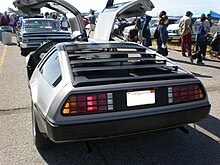
The car DeLorean DMC-12 gained worldwide fame thanks to the fantastic movie trilogy " Back to the Future ", in which the eccentric scientist and inventor Emmett L. Brown converted DMC-12 into a time machine .
Content
History
John Delorean founded the DeLorean Motor Company in Detroit, Michigan, on October 24, 1975. By this time, John had a strong reputation in the automotive business - he was described as a talented and capable engineer who sought innovation in the automotive industry. This was said by the fact that John Delorean became the youngest head of General Motors (GM). The money that was needed to open your own company was received mainly as a loan from Bank of America . In addition, several well-known media people entered the project as presenters - presenter Johnny Carson and actors Roy Clark and Sammy Davis Jr. At the initial stage, John offered dealerships to invest in the creation of cars, in exchange for the company's shares. Due to this, Delorian immediately solved two problems - project financing and implementation channels.
Understanding the economic realities, DeLorean planned to raise funds from state and non-profit funds. For this, he planned to build his first factory in a country or area where the unemployment rate was particularly high. One of the options was Ireland , although the then Minister of Industry and Trade, Desmond O'Malley, decided not to support the project, because he seemed to him too ambitious and divorced from the industrial realities of the market. The agreement with Puerto Rico has already been reached and approved by the government, but at the last moment John Delorean accepted an offer from the Northern Ireland Industrial Development Board. In addition to private investment, the DeLorean Motor Company was counting on funding the British government in the amount of about $ 120 million out of the claimed 200 million start-up costs. The British government was extremely interested in creating jobs in Northern Ireland to reduce religious violence by reducing unemployment. As part of this proposal, Delorian apparently thought that the British government would provide his company with expanded funding, in exchange for guaranteed exports to the US and the corresponding tax duties.
In October 1978, the construction of a 660,000-foot (61,000 m²) manufacturing plant with six buildings in Northern Ireland began, which was designed by the architectural bureau Brodie and Hawthorn Architects. Officially named DMCL (DeLorean Motor Cars, Ltd.), the facility was located in Dunmurri, a suburb of Belfast. It was located at the junction of two communities with different political views: the Republican Twinbrook and the trade union community of Dunmurri.
The production line was planned to start as early as 1979, but due to technical delays and cost overruns on the assembly lines, the conveyor began to fully function only in early 1981. The workers' professional competencies left much to be desired - besides their lack of proper professional experience, many of them never had a job before joining the DMC in principle. This is due to the emergence of constant problems with the quality of cars produced in the first stages of production. Due to numerous complaints about the quality of automobiles, it was decided to establish Quality Assurance Centers (QAC), located in California, New Jersey and Michigan, where it was planned to finish the cars, eliminating defects before sending them to dealerships.
Together, the plant and QAC managed to improve the overall quality of the cars produced, although private complaints about the quality of the car arose regularly. The 1981 DMC was shipped to sellers with a 12-month warranty (19,000 km). By 1982, improvements to a number of assembly parts and the involvement of experienced engineers contributed to improving the quality of assembly. Nevertheless, disputes between dealerships and customers arose, because many dealerships refused to carry out warranty work, because they were not compensated for, and there were a lot of warranty repair work.
At the end of 1981, it became obvious that the company was faced with a number of problems - in addition to the constant production headache, John Delorean clearly overestimated the demand for their cars, and buyers angry with the quality of futuristic cars made poor new advertising for the company’s cars. John's company estimated its own break-even point in the range from 10 to 12 thousand sold cars, but only about 6,000 were sold. To solve this problem, a decision was made to restructure the company - DeLorean became a holding company, which included a manufacturing company, distributor and research subdivision.
In January 1982, due to claims from the U.S. Securities and Exchange Commission regarding the company's viability, Delorean was forced to cancel a share issue for a new holding company, which, Delorian hoped, could raise about $ 27 million. John Delorian sought financial support from the British government, but he was refused because he could not guarantee a large amount of private investment.
Prosecution and Bankruptcy
Toward the end of the company's operations, allegedly in a desperate attempt to raise the funds necessary to support the work, John Delorean was photographed receiving money as a result of drug trafficking, but later he was fully acquitted, and the charges against him were recognized as a provocation.
According to some reports, this was the result of a conflict when, before being dismissed from the General Motors Company, John decided to publish all the internal feuds of the company and published a book on internecine wars within the company, which, of course, did not like the top ranks of this automotive giant. The fabricated drug trafficking case became a kind of leadership revenge for the revelation. All investors, without waiting for a court decision, withdrew their capital from the DeLorean Motor Company. When Delorean was subsequently found not guilty, his cash balance was zero.
Between January 1981 and December 1982, about 9,000 vehicles were produced, although the actual production figures are not clear, and the estimates of market researchers differ. Some of the cars that were released in 1982, but were not installed in the states (since the American division of the DMC did not have the money to "buy" essentially their own cars from a factory in Northern Ireland).
Modern DMC
Although John Delorean was charged with all drug trafficking charges, he still had to take part in a number of court proceedings (as a result of the company's bankruptcy) until the 1990s. He declared bankruptcy in September 1999, and in March 2000 he was evicted from his estate, covering 434 acres (1.76 km2) in New Jersey. He died of stroke complications at the age of 80 on March 19, 2005.
In 1995, Liverpool-born mechanic Stephen Wine [1] founded his independent company using the name “DeLorean Motor Company”, and soon after acquired the remaining assets, [2] as well as the stylized DMC logo of the former DeLorean Motor Company. [3] The current company is located near Houston, Texas, and is not and has never been associated with the original Delorean company, but provides support to DeLorean car owners. DMC additionally has 5 authorized franchise dealers: Bonita Springs, Florida; Crystal Lake , Illinois; Garden Grove, California; Bellevue, Washington and Hem; Netherlands.
On December 3, 2009, DMC released a collection of T-shirts and hats in collaboration with the streetwear brand The Hundreds. The collection featured modernized DeLorean images in graphic design based on the style of Los Angeles. The collaboration project also included a special, upgraded edition of the DeLorean DMC, painted in a recognizable JAGS The Hundreds pattern, in black stripes, which was sold from December 3, 2009 and displayed at the flagship store The Hundreds in Los Angeles.
In October 2011, DMC announced its intention to sell pre-order electric cars DeLorean in 2013, which at that time were still under development due to legal obstacles. In 2014, Sally Baldwin, the widow of John DeLorian, sued an independent DMC from Texas for misuse of trademarks and images that she said were not acquired after the bankruptcy of the original company, claiming that they still belonged to her. She motivated her lawsuit by the fact that the new company does not produce cars (the rights to which they bought), but has speculated on visual images and has the lion's share of profits from merchandising, which was not part of the deal. On October 20, 2015, the lawsuit was settled in court. The amount of the transaction was never published, but the widow finally gave DMC the rights to the name, trademark and logo of the DeLorean Motor Company.
DeLorean production should have been resumed in 2017. The company management spoke about 300 brand new cars. However, as of April 2018, the cars were never produced, and the release date was shifted to January 2019.
In October 2017, DMC released the DMC watch, which came in two variations with design solutions from DeLorean [4] .
Cars
Delorean DMC-12 was the only model released by the company. A distinctive feature of the model were the legendary gull wings. Despite high expectations, the actual technical characteristics of the model left much to be desired. Futuristic design combined with a mediocre filling, which is no superior to the competition in the class. The car was heavy and slow, often broke, and repairs took an inadmissibly long time. However, the company’s plans included a whole range of products that remained at the concept level.
DMC-24
An extended version of the DeLorean, the DMC-24 was planned as a full 4-seater sedan. At the same time, it was planned to retain the shape of the body and the wing doors of the Delorian gull in the car. The project was not agreed even at the concept level, as it had several design solutions. One design, a 2-door, would have doors and a cabin that were extended to be able to integrate the rear entrance and rear seats. Another design had a separate set of rear doors. The 4-door design had a futuristic layout designed by the iconic ItalDesign based on the Lancia Medusa concept car. The bill for the ItalDesign version was not paid for by the DMC, and ItalDesign continued to modify it to eventually turn the concept into a Lamborghini Marco Polo.
DMC-44
It was planned that the DMC-44 will be the first SUV of the company, which in addition to the recognizable design will have increased maneuverability, the Company even released a commercial in which it announced the project. The video was sent to potential investors, at whose expense it was planned to implement the project, but due to the lack of interest and funding, the project was frozen.
DMC-80
On the one hand, the concept of the bus from Delorean was similar to the agony of a dying company that was looking for new markets and customers. On the other hand, many technical solutions that were offered at Delorean were adopted by German engineers, who implemented them in buses that serve passenger traffic at airports.
Notes
- ↑ Back to the future as DeLorean goes electric , BBC News (April 1, 2012).
- ↑ Stephen Wynne, CEO of The De Lorean Motor Company - Q & A
- ↑ DeLorean Motor Company Home
- ↑ DMC Watches | DeLorean Motor Company Watches | DMC-12 | Time Machine DMC Watches. The appeal date is April 29, 2019.
Links
- DeLorean Motor Company (Eng.)
Literature
- John Z. DeLorean, Ted Schwarz, Delorean , Zondervan (September 1985), ISBN 0-310-37940-7
- John Fallon, James Srodes, Dream Maker: The Rise and Fall of John Z Delorean (November 1985), ISBN 0-399-12821-2
- William Haddad, Hard Driving: My Years with John DeLorean (August 12, 1985), ISBN 0-394-53410-7
- J Lamm, DeLorean Stainless Steel Illusion , 2nd edition (2003), ISBN 0-9744141-0-7
- RM Clarke, Delorean 1977-1995 Gold Portfolio (December 28, 1995), ISBN 1-85520-331-6