In a comprehensive analysis, the function complex variable called
- holomorphic at the point if it is differentiable in some open neighborhood
- analytical at the point if there exists some neighborhood of the point , wherein coincides with a convergent power series

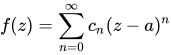
One of the most important results of complex analysis is the theorem that holomorphic functions are analytic . Corollaries to this theorem include, among others, the following results:
- uniqueness theorem: two holomorphic functions whose values coincide at each point of the set (which has a limit point inside the intersection of the domains of definition of functions) also coincide in any open connected subset of their domains of definition that contains .
- since the power series is infinitely differentiable, the corresponding holomorphic function is also infinitely differentiable (in contrast to the case of a differentiable real function).
- the radius of convergence always coincides with the distance from the center a to the nearest singular point . If there are none, (i.e. if Is an entire function ), then the radius of convergence is equal to infinity.
- an entire holomorphic function cannot be compactly supported, i.e. cannot have as a (compact) support a connected open subset of the complex plane.

Proof
The proof, first proposed by Cauchy, is based on the Cauchy integral formula and on the expansion in the power series of the expression

Let be 


![{\displaystyle {\begin{aligned}f(z)&{}={1 \over 2\pi i}\int _{C}{f(w) \over w-z}\,\mathrm {d} w\\[10pt]&{}={1 \over 2\pi i}\int _{C}{f(w) \over (w-a)-(z-a)}\,\mathrm {d} w\\[10pt]&{}={1 \over 2\pi i}\int _{C}{1 \over w-a}\cdot {1 \over 1-{z-a \over w-a}}f(w)\,\mathrm {d} w\\[10pt]&{}={1 \over 2\pi i}\int _{C}{1 \over w-a}\cdot {\sum _{n=0}^{\infty }\left({z-a \over w-a}\right)^{n}}f(w)\,\mathrm {d} w\\[10pt]&{}=\sum _{n=0}^{\infty }{1 \over 2\pi i}\int _{C}{(z-a)^{n} \over (w-a)^{n+1}}f(w)\,\mathrm {d} w.\end{aligned}}}](https://wikimedia.org/api/rest_v1/media/math/render/svg/b8e6cbb27553e01d97842e63d6a283e2792a2267)
The permutation of the integration operations and the infinite sum is valid, since the expression is limited by some positive constant for any on while inequality
also true on with some positive . In this way,
on . The row converges uniformly on on the basis of Weierstrass convergence , which means that the signs of the sum and integral can be rearranged.
Since the expression independent of the variable, it can be taken out of the sign of the integral
- {\ displaystyle f (z) = \ sum _ {n = 0} ^ {\ infty} (za) ^ {n} {1 \ over 2 \ pi i} \ int _ {C} {f (w) \ over (wa) ^ {n + 1}} \, \ mathrm {d} w}
Thus, the decomposition of the function acquires the desired power-law form from :
with coefficients
Notes
- Since power series can be differentiated term by term, the above reasoning can be applied in the opposite direction to the expansion of the expression
- having thus
- This is the Cauchy integral formula for derivatives. Thus, the above power series is a Taylor series of function .
- The proof is valid only if the point is closer to the center drive than to any singular point . Consequently, the radius of convergence of the Taylor series cannot be less than the distance from to the nearest singular point of the function. (Obviously, the radius also cannot be greater than this distance, since the power series has no singular points within their radius of convergence.)
- A special case of the same theorem From the previous remark follows a special case of the uniqueness theorem for a holomorphic function. If two holomorphic functions coincide on a (possibly very small) open neighborhood points , then they match on the open drive where - distance from to the nearest singular point.