The Rassias hypothesis is an open problem with primes . The hypothesis was expressed by Michael T. Rassias when he was preparing for the International Mathematical Olympiad [1] [2] [3] [4] [5] [6] [7] . The hypothesis states the following:
- For any simple there are two simple such that


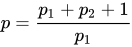
Relationship with other open issues
Rassias's hypothesis can be formulated in equivalent form:
- For any prime there are simple such that
This reformulation shows that the hypothesis is a combination of the problem of generalized numbers Sophie Germain
with the additional condition that should also be simple [3] [4] . This makes the hypothesis a special case of the Dickson hypothesis . Note that the Dixon conjecture (and its generalization, Conjecture H ) appeared before the Rassias conjecture. See the Preface by Pre-Michailescu [7] for a comparison of Rassias's hypothesis with other well-known hypotheses and open problems in number theory .
Cunningham sequences are also associated with the hypothesis, i.e. sequences of simple for fixed mutually prime positive integers . Unlike the breakthrough of Ben Green and Terence Tao [8] on simple arithmetic progressions , the results on large Cunningham sequences are not known. Rassias's hypothesis is equivalent to the existence of Cunningham sequences with parameters for such that is simple [3] [4] .
Notes
- ↑ Andreescu, Andrica, 2009 , p. 12.
- ↑ Balzarotti, Lava, 2013 , p. 140–141.
- ↑ 1 2 3 Mihăilescu, 2011 , p. 45–47.
- ↑ 1 2 3 Mihăilescu, 2014 , p. 13-16.
- ↑ Rassias, 2005 , p. 885.
- ↑ Rassias, 2007 , p. 47.
- ↑ 1 2 Rassias, 2011 .
- ↑ Green, Tao, 2008 , p. 481-547.
Literature
- Andreescu T., Andrica D. Number Theory: Structures, Examples and Problems. - Birkhäuser, Boston, Basel, 2009 .-- S. 12.
- Balzarotti G., Lava PP La Derivata Arithmetica. - Editore Ulrico Hoepli Milano, 2013. - S. 140–141.
- Preda Mihăilescu. Book Review // Newsletter of the European Math. Soc .. - 2011 .-- T. 79 . - S. 45–47 .
- Preda Mihăilescu. On some conjectures in Additive Number Theory // Newsletter of the European Math. Soc .. - 2014 .-- T. 92 . - S. 13–16 .
- Rassias M. Th. Open Problem No. 1825 // Octogon Mathematical Magazine. - 2005 .-- T. 13 . - S. 885 .
- Rassias M. Th. Problem 25 // Newsletter of the European Math. Soc .. - 2007 .-- T. 65 . - S. 47 .
- Rassias M. Th. Problem-Solving and Selected Topics in Number Theory. - Springer, 2011 .-- C. xi – xiii, 82.
- Ben Green, Terence Tao. The primes contain arbitrarily long arithmetic progressions // Annals of Mathematics. - 2008 .-- T. 2 . - S. 481-547 . - DOI : 10.4007 / annals.2008.167.481 .