In mathematics, a trigonometric number [1] is an irrational number obtained as the sine or cosine of a rational number of revolutions or, equivalently, the sine or cosine of an angle whose value in radians is a rational multiple of pi , or sine or cosine of the rational number of degrees .
A real number other than 0, 1, −1 is a trigonometric number if and only if it is the real part of the root of unity .
The proof of the theorems on these numbers was given by the Canadian-American mathematician Ivan Niven [1] , later his proofs were improved and simplified by Li Zhou and Lubomir Markov [2] .
Any trigonometric number can be expressed in terms of radicals . Thus, each trigonometric number is an algebraic number . The last assertion can be proved [1] , taking as a basis the Moire formula for the case for coprime k and n:


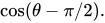
Extending the left side and equating the material parts gives the equation in and substituting , we obtain the polynomial equation having by its decision, therefore the latter is by definition an algebraic number. Also is an algebraic number because it is equal to an algebraic number Finally, where is rational, multiple is algebraic, which can be obtained by equating the imaginary parts of the two sides of the decomposition of the Muavre equation with each other and dividing by to obtain a polynomial equation in






Notes
- ↑ 1 2 3 Niven, Ivan. Irrational Numbers , Carus Mathematical Monographs no. 11, 1956.
- ↑ Li Zhou and Lubomir Markov. Recurrent Proofs of the Irrationality of Certain Trigonometric Values (English) // American Mathematical Monthly : journal. - 2010 .-- Vol. 117 . - P. 360-362 . - DOI : 10.4169 / 000298910x480838 . https://arxiv.org/abs/0911.1933