Andean gull [2] ( lat. Chroicocephalus serranus ) is a species of birds from the gull family (Laridae) [1] . Previously, scientists belonged to the genus Larus . Distributed in the Andes in the territory of Argentina , Bolivia , Chile , Colombia , Ecuador and Peru . It nests in mountainous areas, which is unusual for a seagull.
| Andean Gull | |||||||||||||||||||||||||||||||||||
 | |||||||||||||||||||||||||||||||||||
| Scientific classification | |||||||||||||||||||||||||||||||||||
|---|---|---|---|---|---|---|---|---|---|---|---|---|---|---|---|---|---|---|---|---|---|---|---|---|---|---|---|---|---|---|---|---|---|---|---|
| |||||||||||||||||||||||||||||||||||
| International Scientific Name | |||||||||||||||||||||||||||||||||||
Chroicocephalus serranus | |||||||||||||||||||||||||||||||||||
| Synonyms | |||||||||||||||||||||||||||||||||||
| |||||||||||||||||||||||||||||||||||
| Security status | |||||||||||||||||||||||||||||||||||
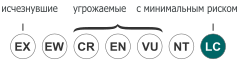
Content
Description
The length of the body is 45–48 cm, which makes the Andean gull the largest black-headed gull in both Americas. It is also the largest species of the genus Chroicocephalus . Color birds: dark hood, the back is a pale gray, black and white plumage pattern [3] .
Spread and behavior
It nests in the mountains, at altitudes from 3000 m above sea level. In areas with a harsh winter, seagulls migrate to winter in lower places, sometimes down to the sea coast. Groups of Andean gulls are often found in southern Peru and northern Chile, but where these birds nest is not established. On the Altiplano Plateau nest at an altitude of 4000 m above sea level, and in southern Argentina - 2000 m above sea level. They nest in small groups, sometimes just in pairs, preferring the shores of small reservoirs. Unlike other gulls of similar sizes, they reach sexual maturity in two rather than three years [3] .
The basis of the diet are insects and worms. Gulls can also catch flying insects, as well as feed on garbage, if available.
Gallery
Normal Color, Peru
Mating color
Seagulls in southern Bolivia
Notes
- ↑ 1 2 Coursers, noddies, gulls, terns, auks, sandgrouse : [ eng ] / F. Gill & D. Donsker (Eds). // IOC World Bird List (v 8.1). - 2018. - DOI : 10.14344 / IOC.ML.8.1 . (Checked March 17, 2018) .
- ↑ Boehme RL , Flint V. Ye. The five-language dictionary of animal names. Birds. Latin, Russian, English, German, French / Under total. ed. Acad. V.E. Sokolova . - M .: Rus. lang, "RUSSO", 1994. - p. 91. - 2030 copies. - ISBN 5-200-00643-0 .
- ↑ 1 2 Chroicocephalus serranus Neopr . Neotropical Birds Online . Cornell Lab of Ornithology. The appeal date is December 12, 2013.
Links
- "The Birds of Ecuador" by Robert S. Ridgely & Paul Greenfield. Cornell University Press (2001), ISBN 978-0-8014-8722-4 .
- Pons JM, Hassanin A., Crochet P.-A. Phylogenetic relationships within the Laridae (Charadriiformes: Aves) inferred from mitochondrial markers // Molecular Phylogenetics and Evolution. - 2005. - Vol. 37, No. 3 . - p. 686-699. - DOI : 10.1016 / j.ympev.2005.05.011 .