Quintana Roo ( Spanish: Quintana Roo [kinˈtana ˈro] ), the official name is the Free and Sovereign State of Quintana Roo ( Spanish: Estado Libre y Soberano de Quintana Roo ) - a state in Mexico , in the east of the Yucatan Peninsula . In the north and west it borders with the states of Yucatan and Campeche , in the east it is washed by the Caribbean Sea , and in the south it borders with the state of Belize .
| State | |||||
| Quintana Roo | |||||
|---|---|---|---|---|---|
| Spanish Quintana roo | |||||
| |||||
| A country | Mexico | ||||
| Includes | 10 municipalities | ||||
| Adm. Centre | Chetumal | ||||
| Governor | Carlos Joaquín González, PRD  from 09.25.2016 from 09.25.2016 | ||||
| History and Geography | |||||
| Date of formation | October 8, 1974 | ||||
| Square | 50 350 km² (19th place ) | ||||
Height
|
| ||||
| Timezone | UTC-5 [1] | ||||
| The largest city | Cancun | ||||
| Population | |||||
| Population | 1,325,578 people ( 2010 ) ( 26th place ) | ||||
| Density | 26.33 people / km² (25th place) | ||||
| Nationalities | Métis, Maya Yucateco, Ishil, white. | ||||
| Denominations | Catholics (73.2%), Protestants and evangelists (11.2%), other Christians (4.6%), Jews (0.1%), other religions (0.2%), atheists and agnostics (9, 6%). | ||||
| Digital identifiers | |||||
| Abbreviation | QR | ||||
| ISO 3166-2 Code | MX-ROO | ||||
| Postal codes | QR | ||||
| Auto Code numbers | FHA-FMZ (23) | ||||
| Official site | |||||
 | |||||
![Flag [d]](http://upload.wikimedia.org/wikipedia/commons/thumb/a/a0/Flag_of_Quintana_Roo.svg/160px-Flag_of_Quintana_Roo.svg.png)
Content
Etymology
The name of the state comes from the name of (1787-1851) - a politician, writer, poet and journalist. He was a deputy and one of the signatories of the Declaration of Independence of Mexico [2] .
Geography
Quintana Roo is located in the transition between the tropical forests of the Peten Basin and the deciduous forests of northern Yucatan. The relief of the state is gentle and flat with the highest altitudes up to 400 m above sea level. The surface of Quintan Roo consists of sedimentary rocks. To the southwest, the relief rises and is marked by the hills of the Sierra Baja Highlands (Sierra Baja, in Mayan Puuc) 60 m above sea level. Due to the porosity of the soil, there are almost no rivers in the state. Only on the border with Belize flows Rio Ondo (río Hondo). Another river flowing along the border with Belize is Asul (río Azul). Other major state rivers are the Jass north of Calderitas; Turbio (East Turbio) east of Chiquilá and south of the island of Holbox; Indio south of the bay of Bahía del Espíritu Santo, and Kik, northeast of Calderitas. The coast abounds with lagoons. The state has karst dips and underground rivers and lakes. The largest such reservoirs are the Laguna de Bacalar. The climate of the state has 3 types: hot and rainy, warm and semi-warm. Precipitation averages 1300-1500 mm per year. The average annual temperature is +27 ° C.
History
Pre-Hispanic Age
The skeleton of a 15-year-old girl (Naia), discovered in the flooded Oyo-Negro cave ( Sak-Aktun cave system) on the Yucatan Peninsula, is estimated to be 13 thousand years ago. In Naya, the mitochondrial haplogroup D (subclade D1) was determined by geneticists [3] .
Already about 3000 liters. n Here lived the ancestors of the Mayans. Throughout history, this region has been fairly densely populated by Mayan tribes, the first of which were here. Archaeological sites such as Chacchobén, Chakanbakán, Chamax, Cobá, Dzibanché, Ichpaatán, Kohunlich, Muyil, Oxtankah, Tankah, Tulum, Tupak, Xel-Há and Xcaret have been discovered here. Later, the Itza, together with part of the Toltecs and Chichimeks, formed the Mayan League, which was a kind of free union of Mayan cities. In 1194 Chichen Itza was abandoned by its inhabitants, who left for Pétain.
The Spanish Age
In 1502, the first Mayan contacts with Europeans began. At that time, several members of the expeditions of H. Columbus met with local fishermen. In 1511, a Spanish ship stuck on a shallow off the coast of the current state of Quintana Roo. Several Spaniards from the survivors were killed, and two of them - G. Guerrero (Gonzalo Guerrero) and H. de Aguilar (Jerónimo de Aguilar) assimilated with the locals. In 1518, expeditions of E. de Cordoba (Hernández de Córdoba) and H. de Grijalva (Juan de Grijalba) successively came to the region. In 1519 E. Hernán Cortés met de Aguilar in Chetumal and took him with him. In 1526, F. de Montejo (Francisco de Montejo) invites King Charles V to conquer Yucatan. The peninsula was finally taken under Spanish control after a long struggle in 1546. In the 16th and 17th centuries. coast often attacked by pirates of the Caribbean. The Spaniards began to try to prevent a possible settlement of the British, who had already begun to settle in Belize. The first attempts to evangelize the natives began in the 18th century. During the Mexican War of Independence, strong clashes did not occur in the region.
Age of Independence
After Mexico gained independence from Spain in 1821, for a long time the territory of modern Quintana Roo was part of the state of Yucatan. In the 1840s, during the Yucatan Race , all non-Indian populations were expelled from the region, and an independent Mayan state was founded with its center in modern Felipe Carrillo Puerto . For a long time, the region was controlled by priests of the “talking cross” cult, who claimed to have received instructions from a magical cross located in the sanctuary. Until the beginning of the twentieth century, the Mexican government had virtually no control over the territory. At the end of the 19th century, Yucatan did not have enough funds to conquer the Mayan rebels operating in the eastern part of the peninsula. President Porfirio Diaz sought economic and political control on the Belizean border and exploitation of these resource-rich lands.
In 1902 , on January 24, President Porfirio Díaz allocated Quintana Roo to a separate territory, which was named after Andres Quintan Roo , one of the fathers of Mexican independence. In the 1910s, the Mexican army largely suppressed Mayan resistance, and in 1915, Quintana Roo was again incorporated into the state of Yucatan. But in 1930, Quintana Roo again became an independent territory.
September 27, 1955 a powerful tropical storm Janet destroyed a number of cities, including the capital city of Chetumal. In the 1960s, the tourism sector began to develop in the state economy. All necessary infrastructure began to be built.
Quintana Roo received state status in 1974 and is now Mexico's youngest state. Around the same time, tourism infrastructure began to develop in Cancun, Isla Mujeres and Cozumel.
In the 1990s, the state governor was Mario Villanueva-Madrid , who was accused of corruption and connections with Colombian drug dealers . Villanueva Madrid was the subject of such serious friction between the governments of the United States and Mexico that when he left his post in 1999, charges were brought against him and he fled the country. Only in 2001, he was arrested and returned to Mexico to face justice. Since then, Quintana Roo has regained its reputation and has become even more popular among tourists.
Population
The administrative center of the state is the city of Chetumal . The state also has the large resort city of Cancun , the islands of Cozumel and Isla Mujeres , the cities and settlements of Bacalar , Felipe Carrillo Puerto , Playa del Carmen , Puerto Juarez , Akumal , Puerto Morelos , numerous monuments of the Mayan civilization and national park Sian Ka'an .
The state covers an area of 50,350 km² and has a population of 1,325,578 (2010). The state has always had the lowest population density in the country, but is currently experiencing a sharp influx of migrants from other areas of Mexico.
Largest settlements
| Locality | Spanish name | Population (2005) |
|---|---|---|
| Cancun | Cancún | 880,000 |
| Chetumal | Chetumal | 136 825 |
| Playa del carmen | Playa del carmen | 100 383 |
| Cozumel | Cozumel | 71 401 |
| Felipe Carrillo Puerto | Felipe carrillo puerto | 21 530 |
| Tulum | Tulum | 14,790 |
| Alfredo Bonfil | Alfredo V. Bonfil | 13 822 |
| Isla Mujeres | Isla mujeres | 11 147 |
| Jose Maria Morelos | José maría morelos | 10 424 |
| Bachelor | Bacalar | 9 833 |
Municipalities
Administratively, the state is divided into 10 municipalities:
| No. | Municipality | Spanish name |
|---|---|---|
| one | Felipe Carrillo Puerto | Felipe carrilo puerto |
| 2 | Cozumel | Cozumel |
| 3 | Isla Mujeres | Isla mujeres |
| four | Benito Juarez | Benito juárez |
| five | Lazaro Cardenas | Lázaro cárdenas |
| 6 | Oton Pompeio Blanco | Othón Pompeyo Blanco |
| 7 | Solidaridad | Solidaridad |
| eight | Tulum | Tulum |
| 9 | Jose Maria Morelos | José maría morelos |
| ten | Bachelor | Bacalar |
Economics
The basis of the economy of Quintana Roo is tourism (80-90%). The main resort center of Cancun , which was once uninhabited. In addition to tourism, part of the population is engaged in agriculture. Most rice is cultivated - 84% of the sown area. Beans, chili, peanuts, tomatoes, watermelons, soybeans, sorghum, vegetables, sugarcane, oranges, papaya, grapefruits are also grown. Cattle, pigs, poultry are bred, honey is produced. Developed fishing (shrimp, lobster, shark). The third place in the structure of the state economy is occupied by industry. Sugar and building materials are mainly produced. A state with tourism as an important economic item often finds itself in the path of devastating hurricanes .
Coat of Arms
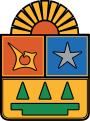
The coat of arms of Quintan Roo is a three-part shield. The upper half is divided in half vertically. On the right side of the scarlet field is a golden Mayan ornament element depicting a stylized shell of a sea mollusk. It symbolizes the wealth of the bowels of the earth and sea. In the left heraldic part on the azure field, a white five-pointed star, symbolizing rebirth, is depicted. At the bottom there are three green triangles in a golden field on a stand of the same color. Stylized trees symbolize the wealth of state nature. The shield is crowned with an image of the rising sun, the number of rays of which symbolizes the number of municipalities into which the state is divided. The coat of arms was adopted on January 1, 1994. The state of Quintana Roo does not have an officially approved flag. Often used a white panel with a coat of arms in the center.
Attractions
In the underwater cave of Hoyo Negro, located in the northeast of the Yucatan Peninsula , the remains of a teenage girl who lived 13-12 thousand years ago were discovered. Genetic analysis of mitochondrial DNA showed that she was the owner of the haplogroup D1 [4] [5] .
Notes
- ↑ Mexico Time Zones . Date of appeal October 25, 2017.
- ↑ Pospelova, Chesnokova, 2005 , p. 234.
- ↑ Scientists have managed to restore the DNA of the ancient Indians
- ↑ Late Pleistocene Human Skeleton and mtDNA Link Paleoamericans and Modern Native Americans
- ↑ Ends in water or Beginnings from water the oldest person in America - Anthropogenesis.ru
Literature
- Pospelova N.M., Chesnokova O.S. Toponymy of Mexico: names of states and their capitals // Bulletin of the Russian University of Friendship of Peoples. Series: Russian and Foreign Languages and the Methodology of Their Teaching: Journal. - 2005. - No. 1 . - S. 227-237 .